Home The Turing Test: What It Is, How It Works, and Why It Still Matters
The Turing Test: What It Is, How It Works, and Why It Still Matters
The Turing Test evaluates whether a machine can exhibit intelligent behavior indistinguishable from a human. Explore how it works, its history, criticisms, and relevance to modern AI.
What Is the Turing Test?
The Turing Test is a method for evaluating whether a machine can exhibit intelligent behavior that is indistinguishable from that of a human. Proposed by British mathematician and computer scientist Alan Turing in 1950, it remains one of the most recognized benchmarks in artificial intelligence.
The core idea is simple: if a human evaluator cannot reliably tell whether they are communicating with a machine or another person, the machine is said to have passed the test.
The test does not measure whether a machine truly "thinks" or possesses consciousness. It measures observable behavior. Turing deliberately sidestepped the philosophical question of machine consciousness by reframing it as a practical question about performance. Can the machine produce responses that are convincingly human? That is the only criterion.
The Turing Test has shaped how researchers, engineers, and the public think about machine intelligence for over seven decades. It established the principle that intelligence can be assessed through external behavior rather than internal mechanisms, an idea that continues to influence the design and evaluation of conversational AI systems, chatbots, and language models.
How the Turing Test Works
The Imitation Game Setup
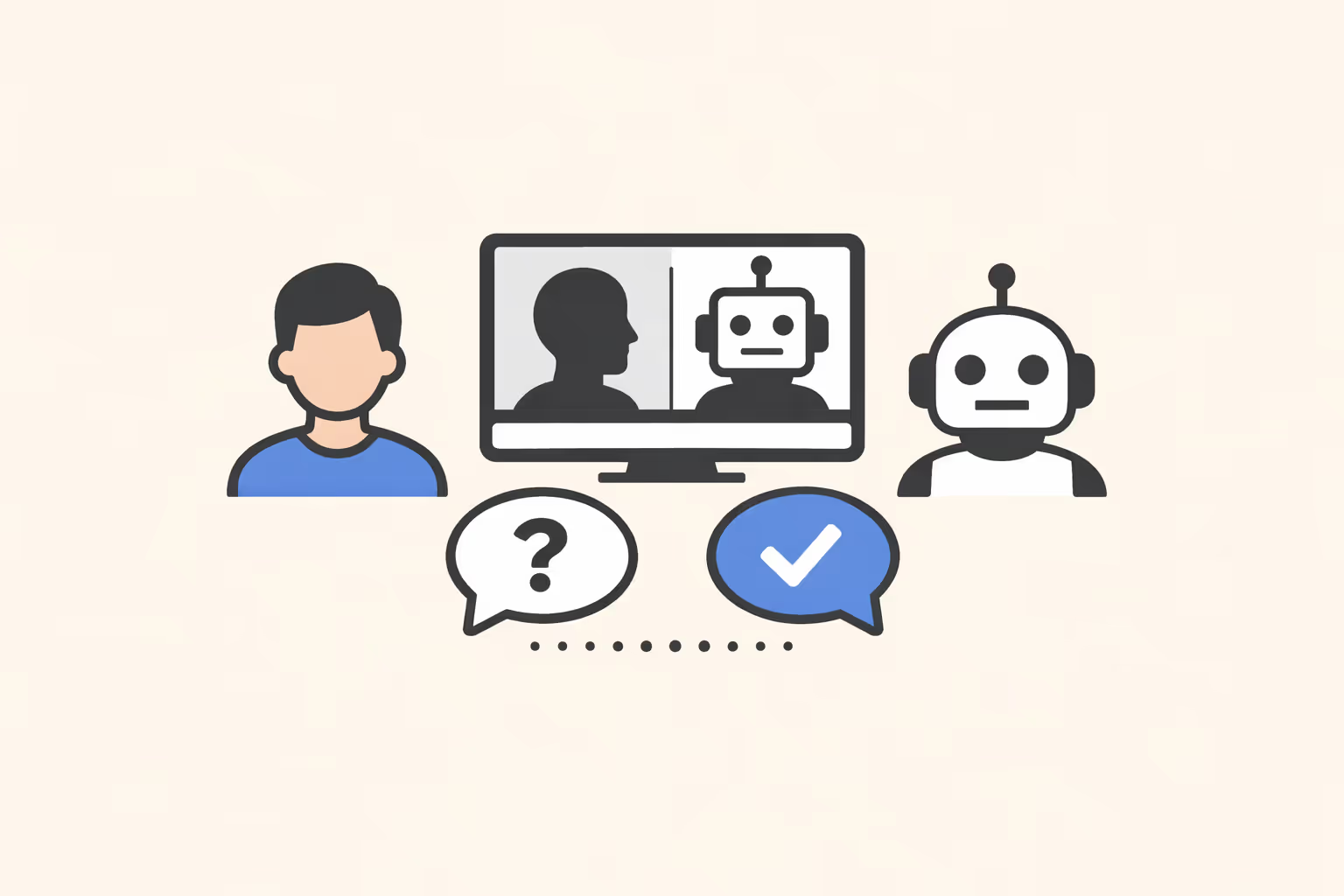
Turing originally described the test as an "imitation game" involving three participants: a human interrogator (Player C), a human respondent (Player B), and a machine (Player A). The interrogator communicates with both the human and the machine through a text-only channel, without seeing or hearing either participant. The interrogator's task is to determine which respondent is the machine and which is the human.
The interrogator may ask any question on any topic. The machine's goal is to produce responses that make the interrogator believe it is human. The human respondent answers honestly. If the interrogator cannot consistently identify the machine after a sustained period of questioning, the machine is considered to have passed.
Key Design Principles
Several aspects of the test's design are deliberate and important. The text-only interface eliminates variables like voice, appearance, and body language. This focuses the evaluation entirely on linguistic and reasoning ability. Turing recognized that mimicking human appearance was a separate engineering problem that had little to do with intelligence.
The test also avoids defining intelligence directly. Rather than specifying what intelligence is, it defines a behavioral threshold: if a machine's responses are indistinguishable from a human's across open-ended conversation, that performance constitutes a meaningful demonstration of intelligent behavior. This pragmatic approach avoids the philosophical quagmire of defining consciousness or understanding.
The interrogator's freedom to ask anything is another critical feature. The test is not limited to trivia or factual recall. The interrogator can probe emotional understanding, humor, common sense, creativity, and self-awareness. This open-ended format makes the test far more challenging than narrow domain-specific evaluations.
What Counts as Passing
There is no universally agreed-upon threshold for passing the Turing Test. Turing himself predicted that by the year 2000, a machine would be able to fool 30 percent of human judges during a five-minute conversation. Some implementations use this as a benchmark, while others require higher success rates or longer conversations.
The ambiguity around passing criteria has been a source of both flexibility and controversy. Different competitions and research groups have applied different standards, making it difficult to compare claims about which systems have or have not passed the test.
| Component | Function | Key Detail |
|---|---|---|
| The Imitation Game Setup | Turing originally described the test as an "imitation game" involving three participants:. | — |
| Key Design Principles | Several aspects of the test's design are deliberate and important. | The text-only interface eliminates variables like voice, appearance |
| What Counts as Passing | There is no universally agreed-upon threshold for passing the Turing Test. | Turing himself predicted that by the year 2000 |
History and Significance
Turing's Original Paper
Alan Turing introduced the test in his landmark 1950 paper "Computing Machinery and Intelligence," published in the journal Mind. The paper opened with a question that would define the field for decades: "Can machines think?" Turing immediately argued that this question was too vague to be useful and proposed the imitation game as a concrete alternative.
The paper addressed and systematically refuted nine objections to machine intelligence, including theological arguments, mathematical limitations, arguments from consciousness, and the claim that machines could never be original. Turing's responses were remarkably prescient.
He anticipated many of the debates that continue in AI research today, including discussions around artificial general intelligence and whether machines can achieve truly flexible reasoning.
Turing also introduced the concept of a "child machine" that could learn and improve over time, an early description of what would become machine learning. He argued that rather than programming a machine with all necessary knowledge, it would be more effective to build a machine capable of learning from experience and instruction.
The Loebner Prize and Early Competitions
The Loebner Prize, established in 1990, was the first formal competition based on the Turing Test. Each year, human judges conversed with both humans and chatbots, awarding prizes based on how convincingly the programs mimicked human conversation. The competition ran annually for nearly three decades and highlighted both the progress and the persistent limitations of conversational AI systems.
Early entrants relied on pattern matching, scripted responses, and conversational deflection. Programs like ELIZA, developed in the 1960s, demonstrated that even simple keyword-matching scripts could create a convincing illusion of understanding in limited contexts. PARRY, a program simulating a paranoid patient, fooled some psychiatrists in controlled tests during the 1970s.
These early systems illustrated an important point: passing the Turing Test, even partially, does not necessarily require genuine understanding. It may require only a sufficiently convincing simulation. This distinction became central to later criticisms of the test itself.
The Test's Influence on AI Research
The Turing Test shaped the trajectory of artificial intelligence research in several lasting ways. It established natural language conversation as a benchmark for machine intelligence, which drove investment in natural language processing for decades.
It also popularized the behaviorist approach to intelligence: the idea that what matters is what a system does, not how it works internally.
This behavioral framing influenced the development of neural networks, statistical language models, and eventually the large language models that power today's generative AI systems.
The test's emphasis on producing convincing text output aligns closely with the training objectives of modern language models, which are optimized to generate text that is statistically consistent with human-produced language.
Criticisms and Alternatives
The Chinese Room Argument
The most famous philosophical objection to the Turing Test is John Searle's Chinese Room argument, presented in 1980. Searle described a scenario in which a person who does not understand Chinese sits in a room, receiving Chinese characters through a slot and using an elaborate rulebook to produce appropriate responses. To an outside observer, the room appears to understand Chinese, but the person inside has no comprehension of the language.
Searle's argument targets the assumption that behavioral equivalence implies genuine understanding. A system that produces perfect human-like responses might be following rules without any comprehension, just as the person in the Chinese Room manipulates symbols without grasping their meaning. This distinction between syntactic manipulation and semantic understanding remains one of the deepest unresolved questions in AI philosophy.
Measuring Imitation Rather Than Intelligence
Critics argue that the Turing Test measures a machine's ability to deceive rather than its ability to think. A system could pass by exploiting conversational strategies like changing the subject, making jokes, or deliberately introducing human-like errors such as typos and hesitations. These tactics demonstrate conversational skill, not intelligence.
This criticism gained practical weight when chatbots like Eugene Goostman attracted media attention for allegedly passing the Turing Test. Eugene Goostman was programmed to impersonate a 13-year-old Ukrainian boy with limited English fluency, which provided a convenient excuse for linguistic errors and gaps in knowledge. Many researchers argued this was a demonstration of clever persona design rather than genuine machine intelligence.
The Problem of Narrow Scope
The Turing Test focuses exclusively on text-based conversation, which captures only a fraction of what constitutes human intelligence. It does not evaluate visual perception, physical reasoning, emotional intelligence, motor skills, or the ability to learn new tasks without specific training. A system might produce flawless conversational responses while lacking the most basic capabilities in other domains.
This limitation has become more apparent as research moves toward artificial general intelligence, which aims to create systems with flexible, cross-domain reasoning abilities. A text-only conversational test is insufficient for measuring progress toward that goal.
Alternative Benchmarks
Researchers have proposed numerous alternatives to address the Turing Test's limitations:
- The Winograd Schema Challenge presents sentences with ambiguous pronoun references that require common sense reasoning to resolve. Unlike open-ended conversation, it tests specific cognitive abilities with verifiable correct answers.
- The Coffee Test, proposed by Apple co-founder Steve Wozniak, asks whether a machine could enter an average American kitchen and make a cup of coffee. This tests physical reasoning, navigation, and object manipulation, capabilities entirely outside the Turing Test's scope.
- The Lovelace Test evaluates creativity by asking whether a system can produce genuinely novel outputs that its designers did not explicitly program. This addresses concerns about systems that merely recombine existing patterns.
- Visual Question Answering (VQA) benchmarks test whether systems can answer natural language questions about images, combining language understanding with visual perception.
- ARC (Abstraction and Reasoning Corpus) tests the ability to discover abstract patterns from very few examples, targeting the kind of fluid reasoning that current AI systems struggle with.
Each of these alternatives addresses specific gaps in the Turing Test, but none has achieved the same cultural recognition or broad applicability. The Turing Test persists partly because its simplicity makes it universally accessible, even to audiences without technical backgrounds.
The Turing Test in Modern AI
Large Language Models and Conversational Fluency
The emergence of large language models has fundamentally changed the conversation around the Turing Test. Systems built on deep learning architectures and trained on massive text corpora can now produce responses that are often indistinguishable from those written by humans, at least in short conversational exchanges.
Modern language models like those powering ChatGPT Enterprise and similar platforms generate fluent, contextually appropriate text across a wide range of topics. They can adjust tone, explain complex concepts, write poetry, engage in debate, and produce code.
In many informal settings, these systems already pass a casual version of the Turing Test, and users frequently cannot tell whether they are speaking with a human or a machine.
This raises a critical question: if machines can produce human-like text without understanding its meaning, does passing the Turing Test still tell us anything meaningful about intelligence? The answer depends on whether one accepts Turing's original behavioral framing or demands something deeper than surface-level performance.
Beyond Text: Multimodal Intelligence
Modern AI systems increasingly operate across multiple modalities. Vision models can describe images in natural language. Audio models can transcribe and generate speech. Multimodal models can reason about text, images, and video simultaneously. These capabilities go far beyond what the original Turing Test was designed to evaluate.
The expansion of AI capabilities into perception, generation, and embodied reasoning suggests that a modern equivalent of the Turing Test would need to be multimodal. It would need to test not just conversation but also visual understanding, audio processing, and physical reasoning.
Some researchers argue that the progression toward artificial superintelligence will require benchmarks that assess capabilities across all of these dimensions simultaneously.
Implications for Narrow and General AI
The distinction between narrow AI and general AI is directly relevant to evaluating the Turing Test's modern significance. Current AI systems, no matter how fluent their conversational output, remain narrow. They excel at specific tasks for which they have been trained but cannot transfer skills across domains the way humans do.
A language model might discuss quantum physics, write a sonnet, and debug Python code, but it cannot tie a shoe, navigate an unfamiliar room, or learn to play a new board game from reading the rules once. The Turing Test, by focusing exclusively on conversation, can only evaluate the narrow dimension of linguistic intelligence. It provides no measure of the broader cognitive flexibility that defines general intelligence.
This gap has led some AI researchers to argue that passing the Turing Test is a necessary but insufficient condition for genuine machine intelligence. It demonstrates linguistic competence, but linguistic competence alone does not constitute understanding, reasoning, or consciousness.
Challenges and Open Questions
The Problem of Consciousness
The Turing Test deliberately avoids the question of machine consciousness, but that question has not gone away. As AI systems become more capable, the distinction between genuinely understanding language and merely processing it becomes increasingly important. If a machine produces responses indistinguishable from those of a conscious being, does it matter whether the machine is conscious?
This question has practical implications. If machines are eventually deemed conscious or sentient, it would raise profound ethical and legal considerations about their treatment, rights, and responsibilities. The Turing Test provides no framework for addressing these questions because it was specifically designed to avoid them.
Moving Goalposts
Every time an AI system achieves a capability once thought to require human intelligence, the standard for "real" intelligence tends to shift. When computers mastered chess, critics said chess was not true intelligence. When systems mastered Go, the goalpost moved to open-ended conversation. Now that language models produce convincing conversation, some argue that conversation was never a meaningful test of intelligence.
This pattern suggests that no single test will ever be accepted as definitive proof of machine intelligence. The Turing Test captures one dimension of intelligent behavior, but intelligence is multidimensional. The field may need a suite of evaluations rather than a single benchmark.
Ethical Dimensions
The Turing Test also raises ethical questions about deception. If a machine is designed to be indistinguishable from a human in conversation, users may be deceived about the nature of their interaction. This has practical consequences in customer service, therapy, education, and social media, where the distinction between human and machine communication carries ethical weight.
Regulations in several jurisdictions now require disclosure when users are interacting with AI systems rather than humans. These rules reflect a growing recognition that the ability to mimic human behavior carries responsibilities. The relationship between convincing conversational AI and transparent deployment practices is becoming a central concern in AI governance.
The Role of the Turing Test in Education and Training
The Turing Test remains a valuable pedagogical tool. It introduces students to fundamental questions about intelligence, computation, and the philosophy of mind in an accessible format. Courses in computer science, cognitive science, and philosophy regularly use the Turing Test as a starting point for exploring what it means for a machine to be intelligent.
For professionals working in machine learning and AI development, understanding the Turing Test provides important historical context. The test's strengths and limitations illuminate ongoing challenges in AI evaluation, including the difficulty of measuring understanding versus mimicry and the gap between task-specific and general-purpose intelligence.
The concept also connects directly to conversations about the singularity, the hypothetical point at which machine intelligence surpasses human intelligence in all domains.
FAQ
Has any AI system actually passed the Turing Test?
No AI system has definitively passed the Turing Test under rigorous, widely accepted conditions. Some programs, such as Eugene Goostman in 2014, have been reported as passing under specific competition rules, but these claims are disputed. The program used a persona that provided plausible excuses for conversational shortcomings. Most AI researchers do not consider these demonstrations to be genuine passes of the test as Turing originally conceived it.
What is the difference between the Turing Test and a chatbot?
The Turing Test is an evaluation framework, not a technology. A chatbot is a software application designed to conduct conversations with users. Some chatbots are built with the goal of being as human-like as possible, which aligns with the Turing Test's criteria. Others are designed for specific tasks like customer support or information retrieval and make no attempt to appear human. The test is a benchmark; the chatbot is the system being evaluated against that benchmark.
Is the Turing Test still relevant?
The Turing Test remains relevant as a conceptual framework and cultural touchstone, but its practical utility as a rigorous AI benchmark has diminished. Modern AI evaluation relies on more specific tests that measure particular capabilities like reasoning, factual accuracy, code generation, and multimodal understanding. The Turing Test's value today lies primarily in the questions it raises about the nature of intelligence rather than in its use as a technical evaluation tool.
Can modern language models pass the Turing Test?
Modern large language models can produce text that is frequently indistinguishable from human writing in short interactions. In informal, unstructured conversations, many users cannot reliably tell whether they are communicating with a human or a generative AI system.
However, sustained, adversarial questioning by informed evaluators can still expose patterns, inconsistencies, and gaps in knowledge or reasoning that reveal the machine. Whether this counts as "passing" depends on the specific criteria applied.
How does the Turing Test relate to artificial general intelligence?
The Turing Test evaluates one dimension of intelligence: conversational ability. Artificial general intelligence refers to a system that can perform any intellectual task a human can, across all domains.
Passing the Turing Test might indicate strong natural language processing capabilities, but it does not demonstrate the cross-domain reasoning, learning flexibility, and physical-world understanding that AGI would require. The test is a subset of what AGI evaluation would need to encompass.
Further reading

What Is an Expert System? Definition, Architecture, and Examples
Learn what an expert system is, how it works, its core architecture, real-world examples across industries, and how it compares to machine learning.

Backpropagation Algorithm: How It Works, Why It Matters, and Practical Applications
Learn how the backpropagation algorithm trains neural networks, why it remains essential for deep learning, and where it applies in practice.

Chain-of-Thought Prompting (CoT): Definition, Examples, and Practical Guide
Chain-of-thought prompting explained: learn what CoT is, how it works, see practical examples, and master techniques for improving AI reasoning step by step.

What Is Natural Language Understanding? Definition, How It Works, and Use Cases
Learn what natural language understanding (NLU) is, how it works, and where it applies. Explore the difference between NLU, NLP, and NLG, plus real use cases and how to get started.
What Is Stemming? Definition, Algorithms, and NLP Applications
Learn what stemming is in NLP, how stemming algorithms work, the differences between stemming and lemmatization, common use cases, and key limitations.

Automated Reasoning: What It Is, How It Works, and Use Cases
Automated reasoning uses formal logic and algorithms to prove theorems, verify software, and solve complex problems. Explore how it works, types, and use cases.