Home Robo-Advisor: Definition, How It Works, and Key Use Cases
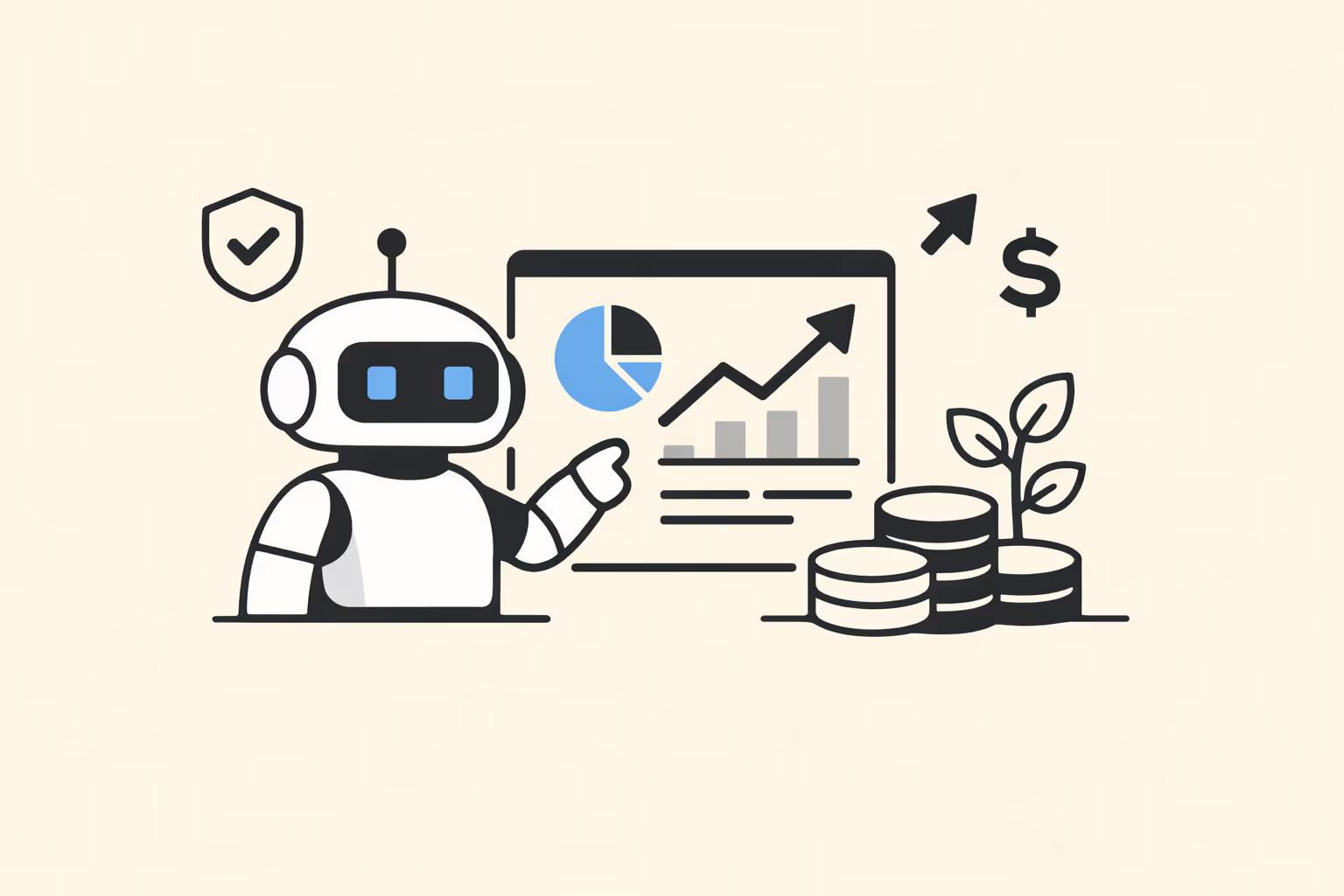
Robo-Advisor: Definition, How It Works, and Key Use Cases
A robo-advisor is an automated digital platform that provides algorithm-driven financial planning and investment management. Learn how robo-advisors work, their benefits, limitations, and real-world applications.
What Is a Robo-Advisor?
A robo-advisor is a digital platform that delivers automated, algorithm-driven financial planning and investment management services with minimal human supervision. These platforms collect information about a user's financial situation, goals, and risk tolerance through online questionnaires, then use software algorithms to recommend and manage a diversified investment portfolio on the user's behalf.
The term "robo-advisor" combines "robot" and "advisor" to signal the replacement of traditional human financial advisors with automated systems. Despite the name, robo-advisors are not physical robots.
They are software applications built on artificial intelligence and algorithmic logic that execute portfolio management tasks such as asset allocation, rebalancing, tax optimization, and risk assessment without requiring a human advisor to make each individual decision.
Robo-advisors emerged in the late 2000s as a response to the high fees and accessibility barriers associated with traditional wealth management. Early platforms like Betterment and Wealthfront demonstrated that core investment management functions could be automated at a fraction of the cost of human advisors. The model has since expanded globally, with major banks, brokerages, and fintech companies offering robo-advisory services to millions of users.
What distinguishes a robo-advisor from a simple stock-picking app or trading tool is the end-to-end management of the investment process. A robo-advisor does not merely suggest trades. It constructs a portfolio aligned with the user's stated objectives, monitors that portfolio continuously, and makes adjustments as market conditions change or as the user's goals evolve.
This level of intelligent process automation brings professional-grade investment management to individuals who might otherwise lack the knowledge, time, or capital to access it.
How Robo-Advisors Work
Robo-advisors follow a structured process that mirrors the workflow of a traditional financial advisor, but executes each step through algorithms and automation rather than human judgment.
Client Profiling and Risk Assessment
The process begins when a user completes an onboarding questionnaire. This questionnaire captures key data points including the user's age, income, net worth, investment timeline, financial goals, and risk tolerance. Some platforms use a handful of straightforward questions, while more sophisticated systems employ behavioral finance techniques to assess how the user would react to hypothetical market downturns or gains.
The platform's algorithms translate these responses into a risk profile, typically expressed as a score or category ranging from conservative to aggressive. This profile serves as the foundation for all subsequent investment decisions. The accuracy of this profiling step is critical because it determines how well the portfolio aligns with what the user actually needs.
Poorly designed questionnaires can lead to machine learning bias in the profiling process, resulting in portfolios that do not reflect the user's true risk capacity.
Portfolio Construction and Asset Allocation
Once the risk profile is established, the robo-advisor constructs a portfolio using Modern Portfolio Theory (MPT) or a related quantitative framework. MPT, developed by economist Harry Markowitz, provides the mathematical basis for building portfolios that maximize expected return for a given level of risk. The algorithm selects a mix of asset classes, typically using low-cost exchange-traded funds (ETFs), that together form a diversified portfolio matching the user's risk profile.
Asset allocation decisions are driven by predictive modeling that evaluates historical return data, correlation patterns among asset classes, expected volatility, and current market conditions. The algorithm determines the optimal percentage of the portfolio to allocate to domestic equities, international equities, bonds, real estate investment trusts, commodities, and other asset categories.
This mathematical approach removes the emotional biases that often affect human investment decisions.
Automated Rebalancing
Markets move constantly, and those movements cause a portfolio's asset allocation to drift away from its target. If stocks perform well over a quarter, the equity portion of a portfolio may grow from 60% to 68%, increasing risk beyond the user's intended level. Robo-advisors monitor portfolio allocations continuously and execute trades automatically to bring the portfolio back to its target allocation.
Rebalancing can be triggered by calendar intervals, threshold-based drift detection, or a combination of both. Some platforms rebalance daily, others quarterly. The frequency and method depend on the platform's design and the tax implications of trading. This continuous monitoring and adjustment represents a core advantage of robo-advisors over self-managed portfolios, where investors frequently neglect rebalancing.
Tax Optimization
Many robo-advisors offer tax-loss harvesting, a strategy that involves selling investments at a loss to offset capital gains taxes on other investments. The algorithm identifies positions that have declined in value, sells them to realize the tax loss, and immediately purchases a similar (but not identical) investment to maintain the portfolio's overall allocation and risk profile.
This process requires careful execution to avoid violating IRS wash-sale rules, which disallow the tax deduction if a "substantially identical" security is purchased within 30 days. Robo-advisors handle this complexity automatically, tracking wash-sale windows and selecting substitute investments that maintain portfolio characteristics while capturing the tax benefit. For taxable accounts, automated tax-loss harvesting can add meaningful after-tax returns over time.
| Component | Function | Key Detail |
|---|---|---|
| Client Profiling and Risk Assessment | The process begins when a user completes an onboarding questionnaire. | The user's age, income, net worth, investment timeline |
| Portfolio Construction and Asset Allocation | Once the risk profile is established. | MPT, developed by economist Harry Markowitz |
| Automated Rebalancing | Markets move constantly, and those movements cause a portfolio's asset allocation to drift. | Rebalancing can be triggered by calendar intervals |
| Tax Optimization | Many robo-advisors offer tax-loss harvesting. | The algorithm identifies positions that have declined in value |
Why Robo-Advisors Matter
Robo-advisors represent a significant shift in how financial services are delivered, and their impact extends well beyond convenience.
Democratizing Access to Investment Management
Traditional financial advisors typically require minimum account balances of $100,000 to $500,000 or more, effectively excluding most individuals from professional investment management. Robo-advisors have reduced minimums to as low as $0 to $500, opening access to investment services for people at every income level.
This democratization is a direct consequence of automation: because algorithms handle portfolio management at scale, the marginal cost of serving an additional client is negligible.
The implications for financial inclusion are substantial. Young professionals, first-generation investors, and individuals in underserved communities can now access diversified, professionally managed portfolios that were previously available only to the wealthy. This expansion aligns with broader trends in the robot economy, where automation creates efficiencies that lower barriers to participation across industries.
Reducing Costs
Robo-advisors typically charge annual management fees between 0.15% and 0.50% of assets under management. Traditional financial advisors charge between 1.0% and 1.5% annually, and actively managed mutual funds add another 0.5% to 1.0% in expense ratios. Over a 30-year investment horizon, this fee difference compounds dramatically. An investor paying 0.25% instead of 1.25% annually on a $100,000 portfolio earning 7% returns would accumulate roughly $130,000 more by retirement.
The cost advantage stems from automation. Machine learning algorithms and rules-based systems perform the same portfolio management tasks that human advisors do, but without the salaries, office space, and operational overhead that drive traditional advisory fees.
For investors whose needs are well served by passive, diversified investing strategies, this cost reduction represents a direct transfer of value from advisory firms to clients.
Removing Emotional Bias from Investing
Human investors and human advisors alike are susceptible to behavioral biases that degrade investment performance. Fear during market downturns leads to selling at lows. Greed during bull markets leads to chasing overvalued assets. Confirmation bias leads to overweighting familiar investments. These cognitive patterns are well documented in behavioral finance research and consistently erode long-term returns.
Robo-advisors execute their strategies mechanically, adhering to the predetermined allocation and rebalancing rules regardless of market sentiment. When markets drop sharply, the algorithm rebalances by purchasing discounted assets rather than panic-selling.
This disciplined execution is one of the strongest arguments for algorithmic investment management, and it reflects the broader value proposition of autonomous AI systems that operate based on data rather than emotion.
Robo-Advisor Use Cases
Robo-advisors serve a variety of financial planning needs, from basic savings goals to complex multi-account strategies.
Retirement Planning
The most common use case for robo-advisors is retirement investing. Users specify their target retirement date and desired lifestyle, and the platform constructs a portfolio that gradually shifts from growth-oriented (equity-heavy) to conservative (bond-heavy) as the retirement date approaches. This "glide path" strategy is automated and requires no intervention from the user.
Platforms manage Individual Retirement Accounts (IRAs), Roth IRAs, and rollover accounts, applying tax-advantaged strategies appropriate to each account type. Some robo-advisors integrate retirement income projections that model Social Security benefits, pension income, and withdrawal rates to give users a comprehensive view of their retirement readiness.
The supervised learning techniques underlying these projection models improve as they process data from larger user populations.
Goal-Based Savings
Beyond retirement, robo-advisors support savings goals such as buying a home, funding education, building an emergency reserve, or saving for a major purchase. Each goal receives its own sub-portfolio with an allocation tailored to the goal's time horizon and priority. A five-year home purchase fund would be invested more conservatively than a 25-year retirement fund, and the algorithm manages each independently.
This goal-based approach mirrors how financial planners organize client portfolios, but makes it accessible to users who might otherwise keep all their savings in a single low-yield bank account. The visual tracking and milestone reporting that most platforms provide adds a behavioral benefit: users who see clear progress toward named goals tend to save more consistently.
Taxable Investment Management
For investors with taxable brokerage accounts, robo-advisors deliver particular value through automated tax-loss harvesting, asset location optimization, and tax-efficient fund selection. Asset location involves placing tax-inefficient investments (such as bonds and REITs) in tax-advantaged accounts and tax-efficient investments (such as index equity funds) in taxable accounts. This cross-account optimization is computationally intensive and difficult for individual investors to manage manually.
The algorithms powering these strategies draw on neural network architectures and optimization models that evaluate thousands of potential trade combinations to identify the most tax-efficient path. The cumulative tax savings from these strategies can significantly enhance long-term portfolio growth.
Socially Responsible Investing
Many robo-advisors now offer socially responsible investing (SRI) or environmental, social, and governance (ESG) portfolio options. These portfolios screen investments based on criteria such as carbon emissions, labor practices, board diversity, and corporate governance standards. Users who want their investments to reflect their values can select ESG portfolios without sacrificing the diversification and professional management that robo-advisors provide.
The integration of ESG criteria into automated portfolio management demonstrates how responsible AI principles can extend beyond the technology sector into financial decision-making. Algorithms that incorporate social and environmental factors alongside financial metrics represent a more holistic approach to investment management.
Challenges and Limitations
Despite their advantages, robo-advisors have meaningful constraints that users and industry observers should understand clearly.
Limited Personalization for Complex Financial Situations
Robo-advisors excel at standardized investment management but struggle with the nuances of complex financial planning. Estate planning, business succession, stock option strategies, charitable giving optimization, tax planning across multiple jurisdictions, and coordination of employer benefits require the contextual judgment and creative problem-solving that human advisors provide.
A robo-advisor cannot evaluate whether a client should exercise incentive stock options this year or next based on anticipated changes in their marginal tax rate and alternative minimum tax exposure.
This limitation is structural rather than temporary. While artificial intelligence continues to advance, financial planning for high-net-worth individuals involves legal, tax, and interpersonal considerations that resist full automation. The most effective approach for complex situations is a hybrid model that combines algorithmic portfolio management with access to human advisors for strategic planning decisions.
Algorithmic Transparency and Trust
Most robo-advisors provide limited visibility into how their algorithms make decisions. Users know what portfolio they receive but often do not understand why specific allocations were chosen, how rebalancing decisions are triggered, or what assumptions drive the platform's projections. This opacity can erode trust, particularly during market downturns when users see their portfolios declining and cannot get a clear explanation of the strategy being followed.
The challenge of algorithmic transparency is not unique to robo-advisors, but it is especially acute in financial services where users are entrusting their savings. Platforms that invest in clear, accessible explanations of their methodology tend to retain clients more effectively during volatile markets.
Regulatory bodies are increasingly requiring greater disclosure of algorithmic decision-making processes in financial services.
Market Downturn Behavior
Robo-advisors are designed primarily around passive, buy-and-hold investment strategies that assume markets will recover over long time horizons. During extended bear markets or sudden market crashes, robo-advisors continue to follow their rebalancing rules rather than taking defensive positions. For long-term investors, this disciplined approach is generally sound. For investors nearing retirement or those with short time horizons, the lack of active downside protection can be problematic.
Some newer platforms incorporate tactical allocation adjustments that shift portfolio weights in response to market signals, but these approaches introduce their own risks. Predictive modeling applied to financial markets has a mixed track record, and algorithms that attempt to time the market can underperform simple buy-and-hold strategies over full market cycles.
Data Privacy and Security Concerns
Robo-advisors collect sensitive financial data including income, assets, Social Security numbers, and bank account information. This data concentration creates a high-value target for cyberattacks. While regulated platforms must comply with financial data protection requirements, the aggregation of detailed financial profiles for millions of users introduces systemic risk.
The governance of user data within robo-advisory platforms falls under the broader domain of AI governance, which addresses how organizations collect, store, process, and protect data used by automated systems. Users should evaluate the security practices and regulatory compliance of any robo-advisor before entrusting it with their financial information.
Regulatory and Fiduciary Questions
The regulatory classification of robo-advisors remains an evolving area. In the United States, robo-advisors that provide investment advice must register as investment advisors with the SEC or state regulators and are held to a fiduciary standard. However, the application of fiduciary duty to algorithmic advice raises questions that existing frameworks do not fully address.
Can an algorithm act in a client's "best interest" when it cannot understand context, intent, or changing life circumstances the way a human can?
These questions connect to the broader conversation around responsible AI and the obligations of organizations that deploy automated decision-making systems in consequential domains. As robo-advisory assets under management grow into the trillions of dollars, regulatory scrutiny will intensify.
How to Get Started with Robo-Advisors
Selecting and setting up a robo-advisor involves a sequence of practical steps that ensure the platform aligns with your financial needs.
Define Your Financial Goals
Before selecting a platform, clarify what you want to accomplish. Retirement savings, a home purchase, education funding, and general wealth building each require different strategies and time horizons. Having clear goals allows you to evaluate whether a platform's features match your needs. If you require comprehensive financial planning that extends beyond investment management, consider platforms that offer hybrid models with access to human advisors.
Evaluate Platform Features and Costs
Compare robo-advisors across several dimensions. Management fees vary from 0.15% to 0.50% annually, and some platforms charge flat monthly fees instead. Look at account minimums, available account types (taxable, IRA, Roth IRA, 529 plans), tax-loss harvesting availability, ESG portfolio options, and the quality of the platform's financial planning tools. Evaluate the underlying ETFs each platform uses, paying attention to expense ratios and fund quality.
Key features to compare include:
- Annual management fee and fee structure
- Account minimum requirements
- Tax-loss harvesting and asset location services
- Availability of ESG or socially responsible portfolios
- Quality of goal planning and projection tools
- Access to human advisors for complex questions
- Mobile app functionality and user experience
- Integration with external bank and brokerage accounts
Complete the Onboarding Process
Once you select a platform, the onboarding process typically takes 10 to 20 minutes. You will answer questions about your financial situation, goals, and risk tolerance. Answer these questions honestly and thoughtfully, because the accuracy of your portfolio depends on the accuracy of your inputs. If a platform's questionnaire feels too simplistic, that may indicate a less sophisticated profiling system.
After completing the questionnaire, the platform will present a recommended portfolio allocation. Review this allocation to ensure it aligns with your expectations. Most platforms allow you to adjust your risk level if the initial recommendation does not feel right. Understanding the machine learning principles behind these recommendations helps you evaluate whether the platform's approach is sound.
Fund Your Account and Monitor Progress
Link your bank account and set up an initial deposit along with recurring contributions. Consistent investing, regardless of market conditions, is one of the most powerful drivers of long-term wealth accumulation. Most platforms support automated recurring deposits that make consistent investing effortless.
After funding, your primary responsibility is periodic review rather than active management. Check your account quarterly to ensure your goals remain current and your risk tolerance has not changed due to life events. The robo-advisor handles the day-to-day portfolio management, rebalancing, and tax optimization.
Resist the urge to make frequent changes based on short-term market movements, as the platform's disciplined approach is designed to outperform emotionally driven decision-making over time.
FAQ
What is the difference between a robo-advisor and a traditional financial advisor?
A robo-advisor uses algorithms and automation to manage investment portfolios, operating with minimal human intervention and charging lower fees, typically 0.15% to 0.50% annually. A traditional financial advisor is a human professional who provides personalized financial guidance, including estate planning, tax strategy, and behavioral coaching, usually charging 1.0% to 1.5% annually. Robo-advisors excel at standardized portfolio management for straightforward financial situations.
Traditional advisors provide more value for complex planning needs that require contextual judgment and relationship-based advice.
Are robo-advisors safe to use?
Regulated robo-advisors are registered as investment advisors and are subject to the same regulatory oversight as traditional advisory firms. Client assets are held at custodian institutions (such as banks or broker-dealers) that are protected by SIPC insurance, which covers up to $500,000 per account in the event the custodian fails. However, SIPC insurance does not protect against investment losses.
Users should verify that any robo-advisor they consider is properly registered and uses a reputable custodian. Data security is an additional consideration, and users should evaluate the platform's encryption, authentication, and privacy practices.
How much money do I need to start with a robo-advisor?
Many robo-advisors have no minimum or require as little as $1 to $500 to open an account. Some premium platforms with additional features such as access to human advisors or advanced tax strategies may require $25,000 to $100,000 or more. The low entry barriers of most robo-advisors are one of their primary advantages, making diversified investment management accessible to individuals who would not meet the minimums required by traditional advisory firms.
Can robo-advisors beat the market?
Robo-advisors are not designed to beat the market. They are designed to deliver market returns efficiently by constructing diversified portfolios of low-cost index funds and ETFs, minimizing fees, and optimizing tax outcomes. Academic research consistently shows that most actively managed funds underperform their benchmark indices over long periods after accounting for fees.
Robo-advisors embrace this evidence by pursuing passive investment strategies that capture broad market returns at minimal cost. The value they deliver comes through cost reduction, tax efficiency, disciplined rebalancing, and behavioral discipline rather than market-beating stock selection.
Will robo-advisors replace human financial advisors?
Robo-advisors are unlikely to fully replace human financial advisors, but they are reshaping the advisory industry. For straightforward investment management needs, robo-advisors offer a compelling alternative to human advisors at a fraction of the cost. For complex financial situations, human advisors provide contextual judgment, emotional support during market stress, and holistic planning that algorithms cannot replicate.
The most likely outcome is continued growth of hybrid models that combine algorithmic portfolio management with human advisory services for planning, strategy, and client relationship management. This evolution reflects the broader pattern of intelligent process automation augmenting rather than replacing human expertise across professional services.
Further reading
%201.avif)
AutoML (Automated Machine Learning): What It Is and How It Works
AutoML automates the end-to-end machine learning pipeline. Learn how automated machine learning works, its benefits, limitations, and real-world use cases.

What Is Embodied AI? Definition, How It Works, and Use Cases
Learn what embodied AI is, how it combines perception and action in physical environments, and where it applies across robotics, healthcare, and education.
What Is GPT-3? Architecture, Capabilities, and Use Cases
GPT-3 is OpenAI's 175 billion parameter language model that generates human-like text. Learn how it works, its capabilities, real-world use cases, and limitations.

Kolmogorov-Arnold Network (KAN): How It Works and Why It Matters
A Kolmogorov-Arnold Network (KAN) places learnable activation functions on edges instead of nodes. Learn how KANs work, how they compare to MLPs, and where they excel.
Crypto-Agility: What It Is and Why It Matters for Security Teams
Crypto-agility is the ability to swap cryptographic algorithms without rebuilding systems. Learn how it works, why it matters, and how to implement it.

ChatGPT for Instructional Design: Unleashing Game-Changing Tactics
Learn how to use ChatGPT for instructional design with our comprehensive guide. Learn how to generate engaging learning experiences, enhance content realism, manage limitations, and maintain a human-centric approach.