Home Predictive Modeling: Definition, How It Works, and Key Use Cases
Predictive Modeling: Definition, How It Works, and Key Use Cases
Predictive modeling uses statistical and machine learning techniques to forecast future outcomes from historical data. Learn how it works, common model types, and real-world applications.
What Is Predictive Modeling?
Predictive modeling is a process within data science that uses statistical algorithms and machine learning techniques to identify patterns in historical data and forecast future outcomes.
The core idea is straightforward: given enough examples of past events and their results, a mathematical model can learn the relationship between input variables and a target variable, then apply that relationship to new, unseen data.
A hospital, for example, might build a predictive model that takes patient vitals, lab results, and demographic information as inputs and outputs the probability of readmission within 30 days. A retail company might use one to forecast next quarter's sales volume based on pricing history, marketing spend, and seasonal trends. In each case, the model translates raw data into an actionable estimate of what is likely to happen next.
Predictive modeling sits at the intersection of statistics, computer science, and domain expertise. The statistical foundations provide the mathematical frameworks. Artificial intelligence and machine learning supply the algorithms that can handle complex, high-dimensional datasets. Domain expertise ensures the right variables are selected and the outputs are interpreted correctly.
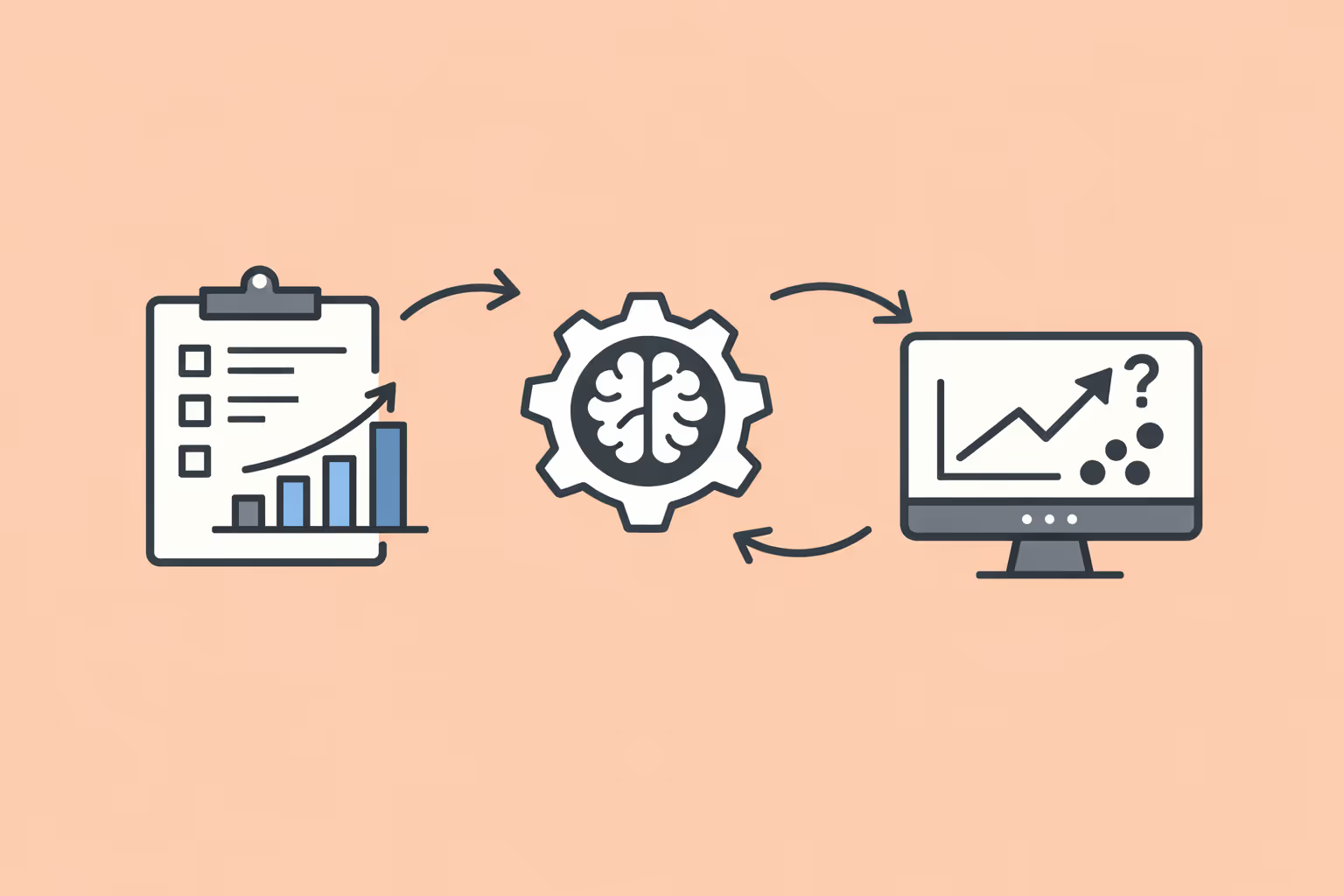
A data scientist working on a predictive modeling project typically moves through a defined sequence: framing the problem, collecting and preparing data, selecting and training a model, evaluating its accuracy, and deploying it into a production environment.
The distinction between predictive modeling and descriptive analytics is worth clarifying. Descriptive analytics summarizes what has already happened. Predictive modeling estimates what will happen. The two are complementary. Descriptive analysis often reveals the patterns that a predictive model then formalizes and operationalizes for forward-looking decisions.
How Predictive Modeling Works
The predictive modeling workflow follows a structured pipeline. Each stage builds on the previous one, and shortcuts at any point tend to degrade the final model's reliability.
Problem Definition and Data Collection
Every predictive modeling project begins with a clearly stated question. "Which customers will churn in the next 90 days?" is a well-defined problem. "Make our business better" is not. The question determines the target variable, the type of model needed (classification or regression), and the success metric.
Once the question is defined, relevant data must be gathered. This typically includes structured data from databases, spreadsheets, and transactional systems. It may also include semi-structured data from logs, APIs, or text fields. The quality and relevance of the input data set an upper bound on model performance. No algorithm can compensate for data that is missing key variables, riddled with errors, or fundamentally unrepresentative of the problem.
Data Preparation and Feature Engineering
Raw data rarely arrives in a form suitable for modeling. Preparation involves handling missing values, removing duplicates, correcting inconsistencies, and encoding categorical variables into numerical formats. Outliers must be examined to determine whether they represent genuine extremes or data entry errors.
Feature engineering transforms raw variables into more informative inputs. A timestamp, for instance, can be decomposed into day of the week, hour of the day, and time since last event. A transaction amount can be converted into a ratio relative to a customer's average spend. Well-engineered features often contribute more to model accuracy than switching to a more sophisticated algorithm.
Data splitting is a critical step in this phase. The dataset is typically divided into a training set, a validation set, and a test set. The training set teaches the model. The validation set guides hyperparameter tuning and model selection. The test set provides an unbiased final evaluation. Using the same data for both training and evaluation produces misleadingly optimistic accuracy estimates.
Model Selection and Training
With prepared data in hand, the next step is choosing an algorithm. The choice depends on the nature of the problem, the size and structure of the data, and the trade-off between interpretability and accuracy. A linear regression model might suffice for a simple forecasting task with a clear linear relationship.
A decision tree or random forest provides a good balance of accuracy and transparency for tabular data. A neural network may be necessary for high-dimensional or unstructured inputs.
Training is the process by which the algorithm adjusts its internal parameters to minimize the difference between its predictions and the actual outcomes in the training data. For a regression model, this typically means minimizing a loss function such as mean squared error. For a classification model, the objective might be minimizing cross-entropy loss or maximizing the area under the ROC curve.
Hyperparameter tuning refines the model further. Hyperparameters are settings that govern the training process itself, such as the learning rate, the number of trees in an ensemble, or the maximum depth of a decision tree. Systematic tuning through grid search, random search, or Bayesian optimization helps find the configuration that generalizes best to unseen data.
Evaluation and Deployment
Model evaluation compares the model's predictions against actual outcomes on the held-out test set. Common classification metrics include accuracy, precision, recall, F1 score, and the area under the ROC curve. Regression metrics include mean absolute error, mean squared error, and R-squared. The choice of metric should align with the business context. In fraud detection, for example, recall (catching all fraudulent transactions) typically matters more than precision (avoiding false alarms).
Once validated, the model moves into production. Deployment can take many forms: a real-time API that scores incoming data, a batch process that generates predictions on a schedule, or an embedded component within a larger application. Monitoring is essential after deployment. Models degrade over time as the underlying data distribution shifts. Regular retraining and performance tracking keep predictions reliable.
Types of Predictive Models
Predictive models fall into several families, each suited to different data characteristics and business requirements.
Regression Models
Regression models predict continuous numerical outcomes. Linear regression is the simplest form, fitting a straight line (or hyperplane in higher dimensions) through the data to minimize prediction error. It works well when the relationship between predictors and the target is approximately linear and the dataset is not excessively large or complex.
Polynomial regression extends linear regression by adding higher-order terms, allowing the model to capture curved relationships. Ridge and lasso regression add regularization penalties that prevent overfitting by discouraging excessively large coefficient values. These regularized variants are particularly useful when the number of features is large relative to the number of observations.
Classification Models
Classification models assign inputs to discrete categories. Logistic regression, despite its name, is a classification algorithm that outputs probabilities for binary outcomes. It remains one of the most widely used models in healthcare, finance, and marketing because of its transparency and efficiency.
Decision trees split data through a sequence of feature-based rules, producing an easily interpretable tree structure. Random forests and gradient boosting machines extend single trees into ensembles that achieve substantially higher accuracy. Gradient boosted trees, implemented in libraries like XGBoost and LightGBM, dominate competitive benchmarks on structured data and are a standard choice for production systems.
Support vector machines find the optimal boundary between classes by maximizing the margin of separation. They perform well on small to medium datasets with clear class boundaries but scale less efficiently to very large datasets.
Time Series Models
Time series models are designed for data where observations are ordered in time and temporal patterns matter. ARIMA (AutoRegressive Integrated Moving Average) captures trends, seasonality, and autocorrelation in univariate time series. Prophet, developed for business forecasting, handles missing data and holidays automatically.
Recurrent neural networks and their variants (LSTM and GRU architectures) capture long-range temporal dependencies in sequential data. These deep learning approaches are particularly effective when the time series exhibits complex, non-linear dynamics that simpler statistical models cannot represent.
Clustering-Based and Bayesian Models
Clustering methods group similar data points together and can serve a predictive function when combined with classification rules. For example, customer segments identified through clustering can be used as features in a downstream predictive model, or new customers can be assigned to the cluster whose members historically exhibited specific behaviors.
Bayesian models, grounded in Bayes' theorem, treat predictions as probability distributions rather than point estimates. Naive Bayes classifiers are fast and effective for text classification and spam detection. Bayesian neural networks and Gaussian processes extend this probabilistic framework to more complex problems.
The key advantage is that Bayesian models quantify uncertainty, providing not just a prediction but a measure of confidence in that prediction.
Neural Network and Deep Learning Models
Neural networks consist of layers of interconnected nodes that learn hierarchical representations of data. Shallow networks with one or two hidden layers handle moderately complex tabular data. Deep learning architectures with many layers excel at processing images, text, audio, and other unstructured inputs.
Convolutional neural networks dominate image-based prediction tasks such as medical imaging analysis and quality inspection. Transformer architectures have become the standard for natural language processing tasks, including sentiment prediction and document classification. While powerful, deep learning models require large datasets, significant computational resources, and careful tuning. They also sacrifice interpretability, which limits their use in regulated settings.
| Type | Description | Best For |
|---|---|---|
| Regression Models | Regression models predict continuous numerical outcomes. | Linear regression is the simplest form |
| Classification Models | Classification models assign inputs to discrete categories. | Logistic regression, despite its name |
| Time Series Models | Time series models are designed for data where observations are ordered in time and. | Data where observations are ordered in time |
| Clustering-Based and Bayesian Models | Clustering methods group similar data points together and can serve a predictive function. | Text classification and spam detection |
| Neural Network and Deep Learning Models | Neural networks consist of layers of interconnected nodes that learn hierarchical. | Medical imaging analysis and quality inspection |
Predictive Modeling Use Cases
Predictive modeling has become a foundational capability across industries. The following examples illustrate how organizations apply it to drive decisions.
Healthcare and clinical outcomes. Hospitals use predictive models to estimate patient readmission risk, forecast emergency department volume, and identify patients who may develop complications after surgery. Early warning systems built on predictive models alert clinicians to deteriorating conditions, enabling timely intervention. The models typically combine electronic health record data with lab results and vital sign trends.
Financial services and credit risk. Banks and lenders use predictive models to assess loan applicant creditworthiness, detect fraudulent transactions, and forecast portfolio risk. Credit scoring models evaluate income stability, repayment history, and debt ratios to produce a probability of default. Anomaly detection models flag transactions that deviate significantly from a customer's established patterns.
Retail and demand forecasting. Retailers use predictive models to optimize inventory levels, personalize product recommendations, and forecast sales across locations and channels. Accurate demand forecasting reduces both stockouts and excess inventory, directly impacting profitability. These models often incorporate external signals like weather data, promotional calendars, and economic indicators.
Manufacturing and predictive maintenance. Sensor data from industrial equipment feeds into models that predict when a machine component is likely to fail. Predictive maintenance replaces both reactive repair (fixing things after they break) and scheduled maintenance (replacing parts on a fixed calendar) with condition-based maintenance that targets interventions precisely when they are needed. This reduces downtime and extends asset life.
Marketing and customer behavior. Marketing teams use predictive models to score leads, estimate customer lifetime value, and predict churn. A churn model might identify that customers who reduce their login frequency, stop opening emails, and contact support more often have a high probability of canceling within 60 days. This enables proactive retention campaigns targeted at the right segment.
Education and learner success. Educational institutions apply predictive modeling to identify students at risk of dropping out, personalize learning pathways, and forecast enrollment trends. Models trained on engagement data, assessment scores, and attendance patterns can flag struggling learners early enough for advisors to intervene.
Understanding how predictive AI and generative AI differ helps educators choose the right tools for analytics versus content creation.
Insurance and actuarial analysis. Insurers use predictive models to price policies, estimate claim likelihood, and detect fraudulent claims. Actuarial models combine demographic data, historical loss data, and risk factors to set premiums that reflect each applicant's expected cost.
Challenges and Limitations
Predictive modeling is powerful but not without constraints. Understanding these limitations is essential for responsible deployment.
Data Quality and Availability
Models are only as good as the data they learn from. Incomplete records, inconsistent labeling, measurement errors, and sampling biases all degrade predictive accuracy. In many organizations, the most time-consuming part of a modeling project is not algorithm selection but data cleaning and integration. Sensitive domains like healthcare and finance add regulatory requirements around data privacy that further constrain what data can be collected and used.
Overfitting and Generalization
A model that performs brilliantly on training data but poorly on new data has overfit. This happens when the model learns noise and idiosyncrasies in the training set rather than the genuine underlying patterns. Regularization, cross-validation, and ensemble methods all help mitigate overfitting, but the risk is always present, especially with complex models and small datasets.
Bias and Fairness
Predictive models can perpetuate and amplify existing biases present in historical data. If past lending decisions were influenced by discriminatory practices, a model trained on that data will learn to replicate those patterns. Bias auditing, fairness-aware algorithms, and diverse training data help address this problem, but eliminating bias entirely requires ongoing vigilance and domain awareness.
Interpretability and Trust
There is an inherent tension between model complexity and interpretability. A gradient boosted ensemble of thousands of trees may achieve 95% accuracy, but explaining why it flagged a specific transaction as fraudulent is challenging. Regulations in sectors like finance and healthcare often require that automated decisions be explainable. Techniques like SHAP values, LIME, and feature importance rankings help bridge the gap, but interpretability remains a trade-off against raw performance.
Concept Drift
The real world changes. Customer preferences shift, markets evolve, and the conditions that defined the training data may no longer hold. This phenomenon, called concept drift, means that a model's accuracy decays over time unless it is periodically retrained on fresh data. Monitoring systems that track prediction accuracy and data distribution shifts are essential for maintaining model reliability in production.
Computational Cost
Training complex predictive models, especially deep learning architectures, demands substantial computational resources. GPU clusters, cloud computing budgets, and long training times can make sophisticated models impractical for smaller organizations. The trade-off between model sophistication and resource constraints often guides the final choice of algorithm.
How to Get Started
Building a predictive modeling capability does not require a massive team or budget. A structured approach and clear priorities matter more than tooling.
Define a Specific Business Question
Start with a concrete, measurable question that connects to a real decision. "Which support tickets will escalate to a manager?" is actionable. "Predict everything about our customers" is not. Specificity determines what data you need, which metrics matter, and how you will know the model is useful.
Audit and Prepare Your Data
Before selecting any algorithm, examine the data you have. Identify gaps, inconsistencies, and potential biases. Understand what each variable represents and how it was collected. Invest time in cleaning and structuring the dataset. This step typically consumes 60 to 80 percent of the total project effort, but it pays the largest dividends in model quality.
Choose an Appropriate Model
Match the model to the problem. For binary outcomes with structured data, logistic regression or gradient boosted trees are strong starting points. For continuous outcomes, linear regression or random forests work well. For sequential or time-dependent data, ARIMA or LSTM models are appropriate. Begin with a simple model, establish a baseline, and increase complexity only if the baseline is insufficient.
Practitioners new to the field benefit from understanding the foundational concepts of supervised learning and unsupervised learning, as these paradigms determine which algorithms apply to a given problem type.
Train, Evaluate, and Iterate
Split your data into training, validation, and test sets. Train the model, evaluate it against the validation set, tune hyperparameters, and repeat. Use the test set only for final evaluation. Track metrics that reflect the actual business impact, not just statistical accuracy. A model with 98% accuracy that misses 90% of the rare but critical events is not useful.
Deploy and Monitor
Put the model into production with clear logging and monitoring. Track prediction accuracy over time. Set up alerts for significant performance degradation. Establish a retraining schedule that reflects how quickly your data distribution changes. A model that was accurate six months ago may no longer reflect current conditions.
Invest in Skills
Predictive modeling requires a blend of statistical knowledge, programming ability, and domain understanding. Online courses, bootcamps, and structured learning programs help teams build these capabilities. Understanding related fields such as reinforcement learning and deep learning broadens the range of problems a team can tackle.
FAQ
What is the difference between predictive modeling and machine learning?
Predictive modeling is a specific application of machine learning focused on forecasting future outcomes from historical data. Machine learning is the broader discipline that encompasses predictive modeling alongside other tasks such as clustering, recommendation systems, and generative models. All predictive models use machine learning techniques, but not all machine learning applications are predictive in nature.
How much data do I need for predictive modeling?
The required data volume depends on the complexity of the problem, the number of features, and the chosen algorithm. Simple linear models can produce useful results with a few hundred observations. Complex deep learning models may require tens of thousands or more. As a general rule, more data improves model robustness, but data quality matters as much as quantity. A small, clean, well-labeled dataset often outperforms a large, noisy one.
Can predictive models be wrong?
Yes. Predictive models produce probabilistic estimates, not certainties. They can be wrong for individual predictions even when their aggregate accuracy is high. Errors arise from insufficient data, poor feature selection, concept drift, or inherent randomness in the phenomenon being modeled. Responsible use of predictive models involves understanding their error rates, communicating uncertainty, and building decision processes that account for the possibility of incorrect predictions.
What tools are commonly used for predictive modeling?
Python and R are the dominant programming languages. Python libraries such as scikit-learn, XGBoost, LightGBM, TensorFlow, and PyTorch cover the full range of modeling approaches. R provides packages like caret, randomForest, and tidymodels. Cloud platforms including AWS SageMaker, Google Vertex AI, and Azure Machine Learning offer managed environments for training and deploying models at scale.
No-code and low-code platforms also exist for teams that need predictive capability without deep programming expertise.
How is predictive modeling different from predictive analytics?
Predictive analytics is the broader practice that includes predictive modeling as a core technique. It also encompasses data visualization, statistical analysis, scenario planning, and decision support. Predictive modeling is the engine that powers predictive analytics. The analytics layer adds interpretation, communication, and integration with business processes around the model's outputs.
Further reading

BERT Language Model: What It Is, How It Works, and Use Cases
Learn what BERT is, how masked language modeling and transformers enable bidirectional understanding, and explore practical use cases from search to NER.

Artificial General Intelligence (AGI): What It Is and Why It Matters
Artificial general intelligence (AGI) refers to AI that matches human-level reasoning across any domain. Learn what AGI is, how it differs from narrow AI, and why it matters.
Q-Learning Explained: How It Works, Use Cases, and Implementation
Q-learning is a model-free reinforcement learning algorithm that teaches agents to make optimal decisions. Learn how it works, where it's used, and how to implement it.
Recurrent Neural Network (RNN): How It Works, Architectures, and Use Cases
Learn what a recurrent neural network is, how RNNs process sequential data, the main architecture variants, practical applications, and key limitations compared to transformers.
What Is Computational Linguistics? Definition, Careers, and Practical Guide
Learn what computational linguistics is, how it bridges language and computer science, its core techniques, real-world applications, and career paths.

Create a Course Using ChatGPT - A Guide to AI Course Design
Learn how to create an online course, design curricula, and produce marketing copies using ChatGPT in simple steps with this guide.