Home Machine Teaching: How Humans Guide AI to Learn Faster
Machine Teaching: How Humans Guide AI to Learn Faster
Machine teaching is the practice of designing optimal training data and curricula so AI models learn faster and more accurately. Explore how it works, key use cases, and how it compares to machine learning.
What Is Machine Teaching?
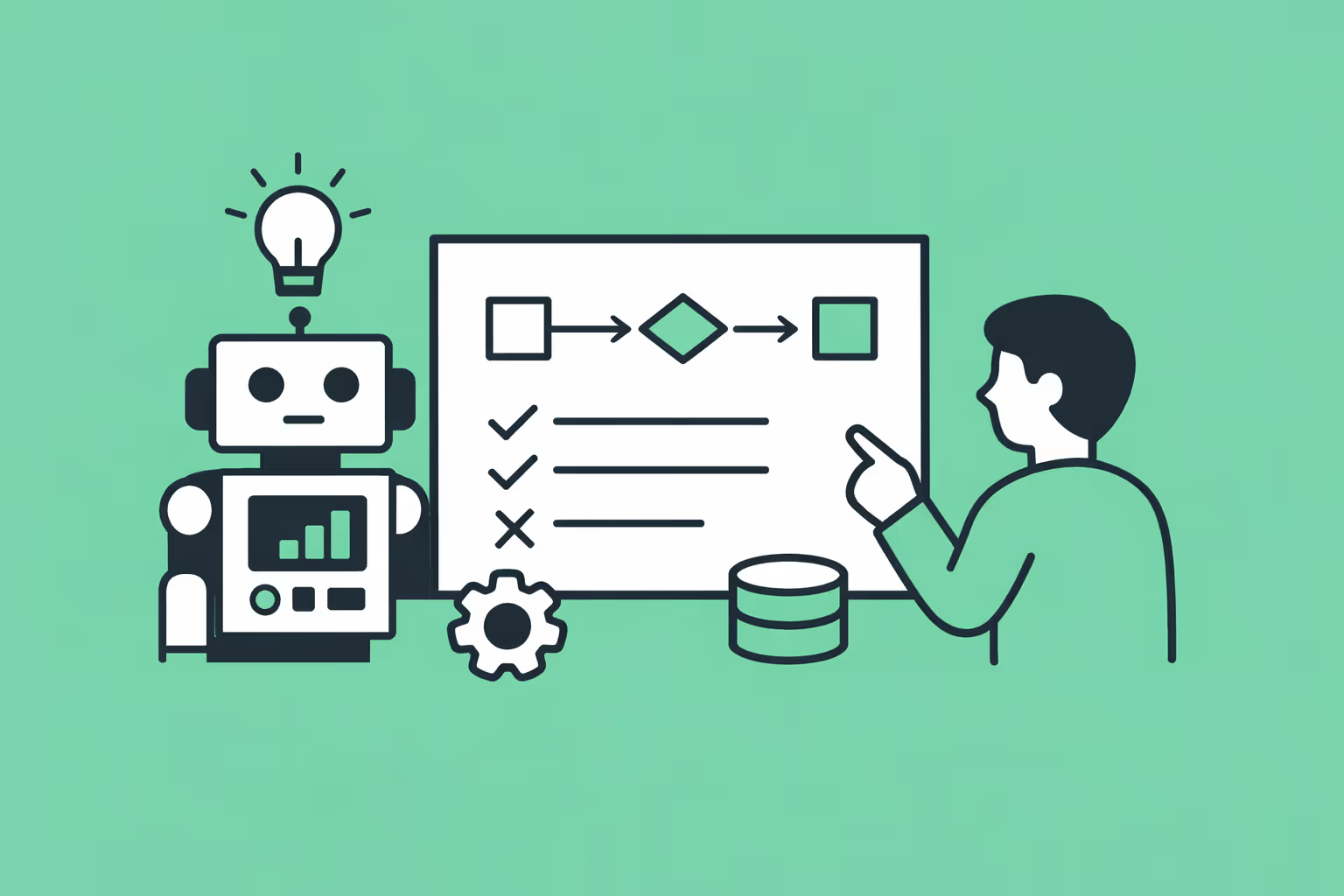
Machine teaching is a discipline within artificial intelligence that focuses on the role of the human teacher in guiding a machine learning model toward desired behavior. Rather than asking the model to discover patterns from massive, unstructured datasets on its own, machine teaching puts a domain expert in control of selecting, organizing, and sequencing the training data so the model learns efficiently and accurately.
The core idea is straightforward. In traditional machine learning, the emphasis falls on the learner: the algorithm, the architecture, the optimization process. Machine teaching shifts that emphasis to the teacher. It asks a different question. Instead of "how can we build a better learner?" it asks "how can we build a better lesson?"
This distinction matters because many real-world AI projects fail not because of algorithmic weakness, but because of poorly curated training data. Subject matter experts understand which examples are informative, which edge cases the model needs to see, and which concepts should be introduced in sequence.
Machine teaching provides the frameworks and tools that let those experts transfer their knowledge into a format a model can consume without requiring them to write code or understand gradient descent.
The term was formalized in research by Xiaojin Zhu and others, drawing from computational learning theory to study the minimum set of training examples a teacher needs to provide for a learner to arrive at the correct hypothesis. This theoretical foundation separates machine teaching from informal data curation. It treats the design of training sets as a rigorous optimization problem with provable bounds on sample complexity.
How Machine Teaching Works
Defining the Teaching Objective
The process begins with a clear specification of what the model should learn. A domain expert defines the target concept, the conditions under which it applies, and the boundaries that separate it from related concepts. In a manufacturing quality-control scenario, for example, a process engineer would specify exactly what constitutes a defective part, including the types of defects, their severity thresholds, and any acceptable tolerances.
This step is more structured than typical data labeling. The expert does not simply tag thousands of images as "defective" or "acceptable." Instead, they decompose the problem into meaningful subconcepts and define how those subconcepts relate to the overall decision. The goal is to create a teaching curriculum, not just a labeled dataset.
Selecting and Sequencing Training Examples
With the teaching objective defined, the expert selects training examples that maximally reduce the model's uncertainty. This is where machine teaching diverges most sharply from conventional data collection. Instead of gathering as much data as possible and hoping the algorithm finds the patterns, the teacher deliberately chooses examples that illustrate key distinctions.
Effective teaching sets are often surprisingly small. Research in computational teaching theory shows that a well-chosen set of examples can teach a concept in far fewer samples than random sampling requires. The teacher might include obvious positive and negative cases first, then introduce progressively harder boundary cases that force the model to refine its decision surface.
Sequencing also matters. Presenting easy examples before hard ones, a strategy borrowed from curriculum learning in deep learning, helps the model build stable internal representations before confronting ambiguity. The teacher controls this progression based on their understanding of the domain, not based on random shuffling of training batches.
Iterative Feedback and Refinement
Machine teaching is inherently iterative. After the model trains on an initial set of examples, the teacher evaluates its behavior on held-out cases, identifies systematic errors, and designs new teaching examples that target those specific weaknesses. This feedback loop is tighter and more intentional than standard model retraining.
The teacher might notice that the model consistently confuses two similar categories. Rather than adding hundreds of random examples from both categories, the teacher selects a handful of carefully constructed contrastive pairs that highlight the distinguishing features. This targeted intervention is more data-efficient and produces faster convergence.
Some machine teaching platforms visualize model behavior to make this feedback loop accessible to non-technical experts. The teacher sees which examples the model gets wrong, why its confidence is miscalibrated, and where its decision boundaries need adjustment. This transparency aligns with broader goals around responsible AI, because the human remains in the loop throughout the training process.
Integration with Machine Learning Pipelines
Machine teaching does not replace the underlying machine learning algorithms. It operates as an upstream process that feeds better-designed training data into standard learning pipelines. The model still uses gradient descent, loss functions, and backpropagation. What changes is the quality and structure of the data it trains on.
This means machine teaching is compatible with a wide range of model architectures, from simple classifiers to complex neural networks. The teaching framework sits between the domain expert and the learning algorithm, translating human knowledge into the mathematical format the algorithm requires.
| Component | Function | Key Detail |
|---|---|---|
| Defining the Teaching Objective | The process begins with a clear specification of what the model should learn. | The types of defects, their severity thresholds |
| Selecting and Sequencing Training Examples | With the teaching objective defined. | — |
| Iterative Feedback and Refinement | Machine teaching is inherently iterative. | After the model trains on an initial set of examples |
| Integration with Machine Learning Pipelines | Machine teaching does not replace the underlying machine learning algorithms. | — |
Machine Teaching vs Machine Learning
Machine teaching and machine learning address the same fundamental goal, building models that perform well on real-world tasks, but they approach it from opposite directions. Understanding the distinction is essential for teams deciding how to structure their AI development process.
Machine learning is algorithm-centric. The focus is on designing better architectures, more efficient optimizers, and more powerful regularization techniques. The assumption is that given enough data and compute, the algorithm will discover the relevant patterns. This approach has produced remarkable results, particularly in domains like image recognition and natural language processing where massive datasets are available.
Machine teaching is teacher-centric. The focus is on designing better training data, more informative examples, and more effective curricula. The assumption is that the right data, presented in the right order, can achieve the same or better performance with far fewer examples and less compute. This approach is particularly valuable in domains where labeled data is scarce, expensive, or requires specialized expertise.
In supervised learning, the standard workflow involves collecting a large labeled dataset, splitting it into training and test sets, and optimizing the model's parameters. The data scientist tunes hyperparameters and architecture but has limited control over which specific examples the model learns from.
In machine teaching, the domain expert actively controls which examples enter the training set and in what order, making the data itself a tunable parameter.
The two approaches are complementary, not competing. A team might use machine teaching to curate a high-quality initial training set, then apply standard machine learning techniques like fine-tuning and hyperparameter optimization to extract maximum performance. The result is a model that benefits from both expert knowledge and algorithmic power.
One important practical difference is who drives the process. Machine learning workflows are typically led by a machine learning engineer or data scientist. Machine teaching workflows are led by domain experts, with the ML engineer providing tooling and infrastructure.
This shift in ownership makes AI accessible to organizations that have deep domain knowledge but limited ML expertise.
Machine Teaching Use Cases
Manufacturing and Quality Control
Manufacturing is one of the strongest domains for machine teaching because quality-control knowledge is highly specialized and difficult to encode in raw data alone. A veteran inspector can identify subtle defects that a general-purpose model would miss without targeted guidance.
Using machine teaching, the inspector designs a training curriculum that starts with clear-cut defects, introduces borderline cases, and explicitly teaches the model about acceptable variations. This approach reduces the number of labeled samples needed from thousands to hundreds, while producing models that match or exceed the inspector's own accuracy on production lines.
Healthcare and Clinical Decision Support
Clinical knowledge is notoriously difficult to capture in training data. A radiologist reading a chest X-ray draws on years of training and thousands of prior cases to distinguish a benign finding from a concerning one. Machine teaching allows that radiologist to encode their diagnostic reasoning into the model's training data.
The clinician selects cases that illustrate critical diagnostic distinctions, sequences them to build the model's understanding progressively, and provides targeted corrections when the model makes errors that reveal conceptual gaps. This produces models that are more aligned with clinical reasoning and easier for other clinicians to trust, addressing a key concern in responsible AI deployment.
Autonomous Systems and Robotics
Training autonomous systems through pure reinforcement learning or imitation learning can be sample-inefficient and unsafe. Machine teaching allows engineers to design training scenarios that efficiently cover the space of situations the system will encounter.
A robotics engineer might use machine teaching to train a warehouse robot by creating a structured set of pick-and-place scenarios that progress from simple to complex. Instead of letting the robot explore randomly and learn from millions of trial-and-error episodes, the engineer provides a curated curriculum that accelerates learning and avoids dangerous failure modes.
Enterprise Knowledge Capture
Organizations possess vast institutional knowledge that lives in the heads of experienced employees. When those employees retire or leave, the knowledge often goes with them. Machine teaching provides a structured way to capture that expertise in AI models.
An expert system historically required extensive manual rule encoding. Machine teaching achieves a similar goal through a more natural process: the expert demonstrates their decision-making through carefully chosen examples rather than explicitly writing rules. The resulting model captures nuanced judgment that resists formalization.
Reducing Bias in AI Models
Machine teaching gives domain experts direct control over what a model learns, which makes it a powerful tool for addressing machine learning bias. When a teacher designs the training set, they can deliberately include examples that counteract known biases, ensure representation across demographic groups, and test the model's behavior on sensitive edge cases.
This proactive approach to fairness contrasts with the reactive approach common in standard ML pipelines, where bias is typically detected only after training through statistical audits. Machine teaching integrates fairness considerations from the start, making it a practical complement to broader responsible AI strategies.
Challenges and Limitations
Teacher Expertise Bottleneck
Machine teaching depends on the availability and quality of human experts. If the expert's understanding is incomplete or biased, those limitations transfer directly to the model. Unlike data-driven approaches that can discover patterns the expert has not considered, machine teaching is bounded by what the teacher knows.
Finding experts who can articulate their knowledge in the structured format machine teaching requires is not straightforward. Many forms of expertise are tacit, meaning the expert makes correct decisions but cannot easily explain the reasoning. Bridging this gap between tacit knowledge and explicit teaching examples remains a practical challenge.
Scalability Constraints
Machine teaching works best for well-defined, decomposable problems. When the concept space is very large or the relationships between variables are highly nonlinear, designing an effective teaching curriculum becomes exponentially harder. The teacher may not be able to anticipate all the edge cases the model will encounter in production.
For problems where unsupervised learning or self-supervised approaches excel, such as discovering structure in massive unlabeled datasets, machine teaching offers limited advantage. The approach is most effective when the target concept is known and the challenge is teaching it efficiently, not when the concept itself must be discovered.
Tooling and Platform Maturity
While interest in machine teaching has grown, the ecosystem of tools and platforms is less mature than the ecosystem for standard machine learning. Most ML frameworks are built around the algorithm-centric paradigm, with extensive support for model architecture design, hyperparameter tuning, and automated training pipelines.
Machine teaching requires a different kind of tooling: interfaces for domain experts to select and annotate examples, visualization tools for understanding model behavior, and curriculum management systems for sequencing training data. Microsoft's Machine Teaching platform, integrated with Project Bonsai, represents one of the more developed commercial offerings, but the space is still emerging.
Theoretical Gaps
The theoretical foundations of machine teaching are well-established for simple hypothesis classes, such as linear classifiers and decision trees. For complex models like deep neural networks, optimal teaching strategies are harder to derive. The combinatorial explosion of possible training sets makes it infeasible to compute the truly optimal teaching set for large, high-dimensional problems.
Current research explores approximation algorithms, heuristic teaching strategies, and connections to active learning and curriculum learning. The field draws on knowledge engineering principles as well as computational learning theory, but a unified framework that covers all model classes does not yet exist.
How to Get Started with Machine Teaching
Getting started with machine teaching requires a shift in mindset. Instead of asking "how much data can we collect?" the question becomes "what does the model need to see to learn this concept correctly?"
- Identify a well-defined problem. Machine teaching works best when you can clearly articulate the target concept and decompose it into subconcepts. Start with a classification or decision task where domain expertise is available and labeled data is limited or expensive.
- Engage the right domain expert. The teacher should have deep knowledge of the target domain and the ability to explain their reasoning. Look for experts who can describe not just what the right answer is, but why it is right and what makes borderline cases difficult.
- Start with a small, curated teaching set. Resist the urge to collect thousands of examples up front. Design an initial teaching set of 50 to 200 carefully chosen examples that cover the core concept, its boundaries, and the most common confusions. Quality matters far more than quantity.
- Iterate based on model behavior. Train your model on the initial teaching set, evaluate it on held-out data, and analyze the errors. Ask the domain expert to design new examples that target the specific failure modes. Repeat this cycle until performance stabilizes.
- Use available platforms. Microsoft's Project Bonsai and related tools offer machine teaching workflows for industrial applications. For custom implementations, frameworks that support active learning and curriculum learning provide useful building blocks.
- Combine with standard ML practices. Machine teaching is not a replacement for data science best practices. Continue to use proper train/test splits, cross-validation, and performance metrics. The difference is that your training data is intentionally designed rather than passively collected.
- Document the teaching rationale. Record why each example was included in the teaching set and what concept it is meant to illustrate. This documentation supports reproducibility, enables other experts to review and improve the curriculum, and aligns with augmented intelligence principles that keep human judgment visible in the AI development process.
Teams exploring machine teaching should also familiarize themselves with adjacent fields. Automated reasoning provides formal methods for encoding and verifying domain knowledge. Understanding how deep learning models learn internal representations helps teachers design more effective curricula for complex problems.
FAQ
How is machine teaching different from data labeling?
Data labeling assigns categories to existing data points. Machine teaching goes further by selecting which data points to label, in what order to present them, and how to structure them into a curriculum. A data labeler answers the question "what is this example?" A machine teacher answers the question "which examples will most efficiently teach this concept?" The distinction is between passive annotation and active instructional design.
Can machine teaching work with deep learning models?
Yes. Machine teaching is compatible with any learning algorithm, including deep neural networks. The teaching framework operates on the training data, not on the model architecture. In practice, machine teaching often incorporates curriculum learning strategies that are well-suited to deep models, presenting easier examples early in training and progressively increasing difficulty.
Does machine teaching eliminate the need for large datasets?
Machine teaching reduces the amount of data needed by making each example more informative. Research shows that an optimally designed teaching set can be orders of magnitude smaller than a randomly sampled dataset while achieving equivalent model performance. However, it does not eliminate data requirements entirely. Complex concepts with high-dimensional inputs still need a meaningful volume of examples to capture the full range of variation.
Who should lead a machine teaching project?
The domain expert leads the teaching process, supported by a machine learning engineer who provides the technical infrastructure. This is a deliberate inversion of the typical ML workflow where the engineer leads and the domain expert provides occasional input. The success of machine teaching depends on the teacher's ability to decompose concepts, select informative examples, and interpret model behavior.
What industries benefit most from machine teaching?
Industries where domain expertise is deep, labeled data is expensive, and errors carry significant consequences benefit most from machine teaching. Manufacturing, healthcare, energy, defense, and financial services are strong candidates. Education and training organizations also benefit because the pedagogical principles underlying machine teaching align naturally with instructional design practices.
Further reading

Variational Autoencoder (VAE): How It Works, Use Cases, and Limitations
Learn what a variational autoencoder is, how VAEs encode and decode data through a probabilistic latent space, and where they are used in generative AI.
Gradient Descent: How It Works, Types, and Practical Implementation
Learn what gradient descent is, how it optimizes machine learning models, its main variants, and how to implement it in practice.
%201.avif)
AI Watermarking: What It Is, Benefits, and Limits
Understand AI watermarking, how it works for text and images, its benefits for content authenticity, and the practical limits that affect real-world deployment.

AI Winter: What It Was and Why It Happened
Learn what the AI winter was, why AI funding collapsed twice, the structural causes behind each period, and what today's AI landscape can learn from the pattern.
Gemma: Google's Open-Source Language Model Family Explained
Gemma is Google's family of open-source language models built on the same research behind Gemini. Learn how Gemma works, its model variants, use cases, and how to get started.
What Is an Expert System? Definition, Architecture, and Examples
Learn what an expert system is, how it works, its core architecture, real-world examples across industries, and how it compares to machine learning.