Home Machine Learning Bias: How It Happens, Types, and How to Fix It
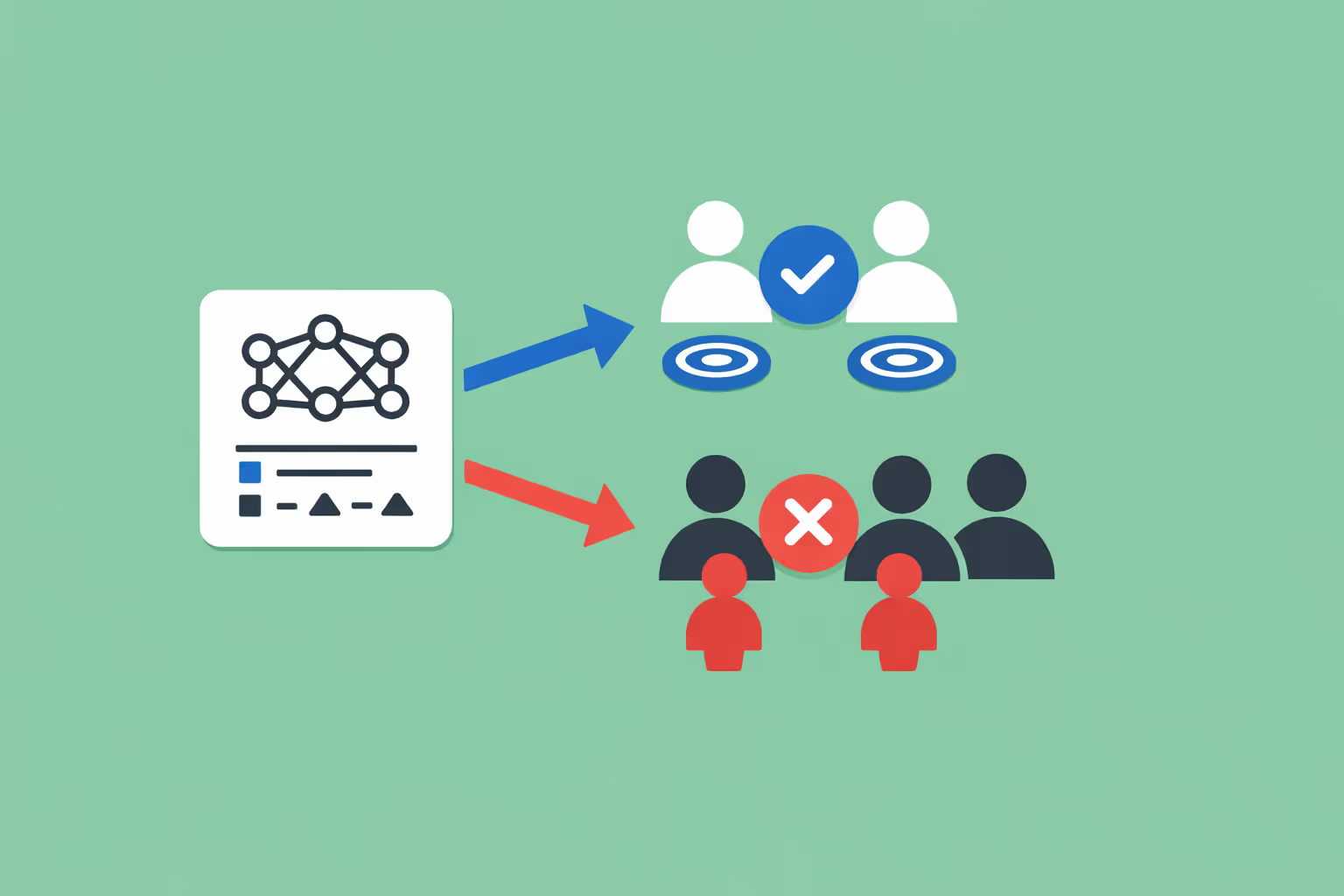
Machine Learning Bias: How It Happens, Types, and How to Fix It
Machine learning bias is a systematic error in ML models that produces unfair or inaccurate outcomes for certain groups. Learn the types, real-world examples, and proven strategies for detection and mitigation.
What Is Machine Learning Bias?
Machine learning bias is a systematic error in a machine learning model that causes it to produce outcomes that are consistently skewed, unfair, or inaccurate for certain groups of people or categories of input.
It occurs when the data used to train a model, the design choices made by its developers, or the feedback loops created during deployment lead the system to favor some outcomes over others in ways that do not reflect reality.
Bias in machine learning is not the same as a random error. Random errors average out over time. Machine learning bias is directional and repeatable: the model consistently gets it wrong in the same way, for the same groups, under the same conditions. A credit scoring model that systematically underestimates the creditworthiness of applicants from particular demographic backgrounds is not making random mistakes. It has learned a biased pattern and applies it reliably.
The term draws a clear parallel to cognitive bias in human psychology, where mental shortcuts produce predictable errors in judgment. The difference is scale. A biased human decision maker affects the cases they personally handle. A biased machine learning model can process millions of decisions per day, amplifying the bias to a degree that would be impossible through manual processes alone.
Understanding machine learning bias matters because artificial intelligence systems now influence consequential decisions in hiring, lending, healthcare, criminal justice, and education. When these systems carry embedded bias, they do not simply reflect existing inequalities. They automate and entrench them.
Addressing machine learning bias is a core concern of responsible AI and a growing regulatory requirement across industries.
How Bias Enters Machine Learning Systems
Bias does not appear in a machine learning model by accident, and it is rarely introduced at a single point. It accumulates across the entire lifecycle of a model, from problem definition through deployment and monitoring.
Understanding where bias enters the pipeline is essential for any machine learning engineer or data science team building production systems.
Problem framing and objective selection. Bias can enter before a single line of code is written. The choice of what to optimize for, what success looks like, and which variables to include all reflect assumptions. A recidivism prediction model that defines "risk" based on re-arrest rates rather than re-offense rates encodes the biases of policing patterns into its objective function. The model learns to predict who gets arrested, not who commits crimes, and those two things are not the same.
Training data collection. Machine learning models learn patterns from historical data. If that data reflects past discrimination, the model will learn to discriminate. Hiring data from a company that historically favored certain demographics will train a model to continue that pattern. Medical datasets that underrepresent certain populations will produce models that perform poorly for those groups.
The data does not need to contain explicit demographic labels for this to happen. Proxy variables such as zip code, language patterns, or educational institution can carry the same signal.
Feature engineering and selection. The variables chosen as inputs to the model shape what it can learn. Including features that correlate with protected characteristics, even indirectly, creates pathways for bias. Excluding relevant features can also introduce bias by forcing the model to rely on less informative proxies.
Decisions made during data splitting affect which patterns the model encounters during training versus evaluation, potentially masking bias in certain subgroups.
Model architecture and training. The structure of the model itself influences bias. Complex architectures such as deep learning networks and neural networks can learn subtle patterns in data that simpler models would miss, including biased correlations.
The optimization process rewards the model for accuracy on the overall dataset, which means it may sacrifice performance on underrepresented groups if doing so improves aggregate metrics.
Deployment and feedback loops. Once deployed, a model's predictions influence real-world outcomes that then become future training data. A predictive modeling system used in policing that directs officers to certain neighborhoods will generate more arrests in those areas, producing data that reinforces the model's original predictions.
These feedback loops cause bias to compound over time, making the model more confident in its biased outputs with each cycle.
Types of Machine Learning Bias
Machine learning bias takes several distinct forms, each with different causes and requiring different mitigation strategies. Recognizing which type of bias is present determines the appropriate response.
Historical Bias
Historical bias exists in the real world before any data is collected. It reflects genuine inequities and prejudices that have shaped the data-generating process over time. Even a perfectly collected, perfectly representative dataset will contain historical bias if the underlying reality it captures is unequal.
A supervised learning model trained on historical loan approval data will learn patterns from decades of discriminatory lending practices. The model is not "wrong" about the data. It accurately reflects what happened. The bias lies in the fact that what happened was unjust, and replicating those patterns perpetuates injustice.
Representation Bias
Representation bias occurs when the training data does not accurately reflect the population the model will serve. Certain groups are overrepresented while others are underrepresented or entirely absent. This is one of the most common and most studied forms of ML bias.
Facial recognition systems trained primarily on images of lighter-skinned individuals perform significantly worse on darker-skinned faces. The model is not inherently incapable of recognizing diverse faces. It simply never had adequate opportunity to learn those patterns because the training data did not include them in sufficient quantity.
Measurement Bias
Measurement bias arises when the features used to train a model are imperfect proxies for the concepts they are intended to represent. The gap between what the model measures and what it is supposed to measure creates systematic errors.
Using standardized test scores as the sole measure of academic potential introduces measurement bias because test scores correlate with socioeconomic factors, access to preparation resources, and language background. A model trained to predict student success based on these scores will systematically underestimate the potential of students from disadvantaged backgrounds.
Aggregation Bias
Aggregation bias happens when a single model is applied to groups that have fundamentally different characteristics or relationships between variables. The model learns an "average" pattern that does not accurately represent any individual group.
A clinical model trained on combined data from multiple demographic groups may learn that a particular symptom indicates a low-risk condition. For one subgroup, however, that same symptom may be a strong predictor of a serious condition. The aggregated model misses the subgroup-specific pattern because it is diluted by the overall data.
Evaluation Bias
Evaluation bias occurs during model testing and validation when the benchmark datasets or performance metrics used do not adequately represent the conditions under which the model will operate. A model may appear to perform well overall while performing poorly for specific subgroups that are underrepresented in the evaluation data.
This form of bias is particularly dangerous because it creates false confidence. Teams believe the model is ready for deployment based on aggregate metrics while disparate performance across groups goes undetected.
Automation Bias
Automation bias is a human behavioral pattern rather than a technical flaw in the model itself. It refers to the tendency of users to over-rely on automated outputs, accepting machine-generated decisions without sufficient critical review. Even when human oversight is formally required, decision makers often defer to the model's recommendation.
In practice, automation bias means that a moderately biased model can produce severely biased outcomes because the human review layer that was supposed to catch errors effectively rubber-stamps the model's outputs.
| Type | Description | Best For |
|---|---|---|
| Historical Bias | Historical bias exists in the real world before any data is collected. | — |
| Representation Bias | Representation bias occurs when the training data does not accurately reflect the. | — |
| Measurement Bias | Measurement bias arises when the features used to train a model are imperfect proxies for. | — |
| Aggregation Bias | Aggregation bias happens when a single model is applied to groups that have fundamentally. | — |
| Evaluation Bias | Evaluation bias occurs during model testing and validation when the benchmark datasets or. | — |
| Automation Bias | Automation bias is a human behavioral pattern rather than a technical flaw in the model. | Even when human oversight is formally required |
Real-World Examples of ML Bias
The consequences of machine learning bias are not theoretical. Documented cases across multiple industries illustrate how biased models produce tangible harm at scale.
Hiring algorithms. A major technology company developed an ML-based resume screening tool trained on a decade of hiring data. The company's historical hiring had skewed heavily male. The model learned to penalize resumes containing terms associated with women, including references to women's colleges and women's organizations.
The company abandoned the tool after internal testing revealed the systematic discrimination, but the case demonstrated how quickly historical bias can be encoded and amplified by automation.
Criminal risk assessment. Recidivism prediction tools used in the US criminal justice system have been found to assign higher risk scores to Black defendants compared to white defendants with similar criminal histories. Analysis showed that these tools had significantly different false positive rates across racial groups, meaning Black defendants were far more likely to be incorrectly classified as high risk. These scores influenced bail, sentencing, and parole decisions.
Healthcare resource allocation. A widely used healthcare algorithm for identifying patients who would benefit from additional care management used healthcare spending as a proxy for healthcare need. Because systemic disparities meant that less was spent on Black patients even when they had equivalent or greater medical needs, the algorithm systematically underestimated the care needs of Black patients.
Correcting the proxy variable from spending to actual health measures dramatically changed the model's recommendations.
Facial recognition accuracy. Independent audits of commercial facial recognition systems found error rates up to 34 percent for darker-skinned women compared to error rates below 1 percent for lighter-skinned men. These systems were being used or considered for use in law enforcement, airport security, and identity verification. The performance disparity traced directly to representation bias in the training datasets.
Language models and stereotypes. Large language models trained through deep learning on internet text data have been shown to associate certain professions with specific genders and to produce stereotypical or harmful outputs for queries related to race, religion, and nationality. Because these models absorb the statistical patterns in their training data, they reproduce the biases embedded in human-generated text at scale.
How to Detect and Mitigate ML Bias
Addressing machine learning bias requires systematic approaches applied throughout the model lifecycle. No single technique eliminates bias entirely, but a combination of detection and mitigation strategies can significantly reduce its impact.
Detection Methods
Disaggregated performance analysis. The most fundamental detection method is breaking down model performance metrics by subgroup rather than relying on aggregate scores. Accuracy, precision, recall, and false positive/negative rates should be evaluated separately for each relevant demographic group. Disparities in these metrics reveal where bias is concentrated.
Fairness metrics. Multiple mathematical definitions of fairness have been developed, each capturing a different aspect of equitable model behavior. Demographic parity requires equal prediction rates across groups. Equalized odds requires equal true positive and false positive rates. Predictive parity requires equal precision. Importantly, these definitions can conflict with each other mathematically, meaning teams must make deliberate choices about which form of fairness to prioritize.
Bias auditing tools. Open-source toolkits such as IBM's AI Fairness 360, Google's What-If Tool, and Microsoft's Fairlearn provide automated methods for measuring bias across multiple dimensions. These tools make bias detection more accessible, but they require informed human interpretation to be useful.
Adversarial testing. Dedicated testing teams attempt to find inputs or scenarios that expose biased behavior. This approach, related to algorithmic transparency practices, goes beyond standard testing by actively searching for failure modes rather than confirming expected behavior.
Mitigation Strategies
Pre-processing techniques. These methods address bias in the training data before the model is built. Approaches include resampling underrepresented groups, reweighting data points to balance group influence, and using synthetic data generation to fill representation gaps. Careful data splitting ensures that evaluation sets represent all relevant subgroups.
In-processing techniques. These modify the model's training procedure itself. Constraint-based optimization adds fairness requirements directly to the model's objective function, forcing it to balance accuracy with equity. Adversarial debiasing trains a secondary model to detect protected attributes in the primary model's outputs and penalizes the primary model when those attributes are detectable.
Post-processing techniques. These adjust the model's outputs after prediction. Threshold adjustment sets different decision boundaries for different groups to equalize error rates. Calibration methods ensure that confidence scores mean the same thing across groups. These techniques are useful when the model itself cannot be modified but carry the trade-off of potentially reducing overall accuracy.
Organizational and governance practices. Technical mitigation alone is insufficient without strong ai governance structures. This includes establishing diverse model development teams, requiring bias impact assessments before deployment, creating external review processes, and building monitoring systems that track model behavior in production.
Organizations practicing responsible AI embed these governance practices into their standard development workflows.
Continuous monitoring. Bias is not a problem that can be solved once at launch. Models operating in dynamic environments encounter shifting data distributions, changing user populations, and evolving social contexts. Continuous monitoring of fairness metrics in production, combined with clear triggers for retraining or intervention, is essential for maintaining equitable model behavior over time.
Challenges and Limitations
Despite growing awareness and increasingly sophisticated tools, addressing machine learning bias remains fundamentally difficult. Several structural challenges limit even well-intentioned efforts.
Competing fairness definitions. It has been mathematically proven that certain definitions of fairness cannot be simultaneously satisfied except in trivial cases. Demographic parity, equalized odds, and predictive parity can conflict, forcing teams to make value judgments about which form of fairness matters most in a given context. There is no universal, mathematically neutral definition of "fair."
Lack of ground truth. In many applications, the "correct" outcome is unknown or contested. A hiring model cannot be evaluated against a perfect record of who "should" have been hired because that ground truth does not exist. Without a clear baseline, measuring bias requires carefully constructed proxies and assumptions that are themselves subject to debate.
Data availability constraints. Detecting bias requires demographic data, but collecting and storing such data raises privacy, legal, and ethical concerns. In some jurisdictions, collecting certain demographic information is restricted by law. Organizations face a genuine tension between the data they need to audit for bias and the privacy obligations they owe to individuals.
Bias transfer and emergence. Mitigating bias along one dimension can inadvertently introduce or amplify bias along another. A model corrected for racial bias in lending might develop new patterns of geographic or age-based discrimination. Unsupervised learning models present particular challenges because their learned representations are difficult to inspect and may encode bias in ways that are not immediately visible.
Scalability of human oversight. Many bias mitigation strategies rely on human review, but the volume of decisions made by ML systems far exceeds human capacity for case-by-case review. Automation bias further undermines oversight even when it is formally in place. The gap between the scale of automated decision-making and the bandwidth of human review creates a persistent vulnerability.
Incentive misalignment. Organizations deploying ML models are often evaluated on aggregate performance metrics, speed, and cost reduction. Fairness auditing adds time, cost, and complexity to the development process. Without strong regulatory pressure or genuine organizational commitment, bias mitigation can be deprioritized in favor of faster deployment.
Robust ai governance frameworks are necessary to counteract these incentive structures.
The problem of data poisoning. Adversarial actors can deliberately introduce biased data into training pipelines to manipulate model behavior. This targeted form of bias introduction is difficult to detect and can undermine even well-designed systems. As ML systems become more prevalent in high-stakes decisions, the security of training data becomes a bias concern as well as a cybersecurity concern.
FAQ
What is the difference between bias and variance in machine learning?
Bias and variance are both sources of model error, but they describe different problems. Bias refers to systematic error caused by incorrect assumptions in the learning algorithm, leading a model to consistently miss the target in the same direction. Variance refers to a model's sensitivity to fluctuations in the training data, causing it to produce different results with different data samples.
In the context of fairness, "machine learning bias" specifically refers to systematic unfairness in model outcomes across groups, which is a distinct concept from the statistical bias-variance trade-off.
Can removing demographic data from training sets eliminate ML bias?
No. Simply removing protected attributes such as race, gender, or age from the training data does not eliminate bias. Other features in the dataset often serve as proxies for those attributes. Zip code, name patterns, purchasing history, and educational background can all correlate strongly with demographic characteristics. Models learn these proxy relationships and reproduce biased patterns even without explicit access to demographic variables.
Effective mitigation requires addressing the underlying correlations, not just removing surface-level labels.
How does machine learning bias differ from human bias?
Machine learning bias and human cognitive bias share the fundamental characteristic of producing systematic, non-random errors. The critical differences are scale and consistency. A biased human decision maker might be inconsistent, applying bias unevenly depending on mood, workload, or context. A biased ML model applies its bias uniformly across every case it processes, potentially millions per day.
Machine learning bias is also more difficult to detect because it is embedded in mathematical operations rather than observable behavior. On the other hand, ML bias is in principle more fixable because models can be retrained, adjusted, and audited in ways that human cognition cannot.
What role does regulation play in addressing ML bias?
Regulatory frameworks are increasingly requiring organizations to assess and mitigate bias in automated decision-making systems. The EU AI Act classifies AI systems by risk level and imposes strict requirements on high-risk applications including bias testing, transparency, and human oversight.
In the United States, existing civil rights laws apply to algorithmic decisions in lending, hiring, and housing, and new federal and state-level guidance continues to emerge. Algorithmic transparency requirements are becoming standard in regulated industries, compelling organizations to document and explain how their models reach decisions.
Is it possible to build a completely unbiased machine learning model?
Building a completely unbiased machine learning model is not currently achievable. Every dataset reflects the conditions and inequities of the world that produced it. Every modeling choice involves trade-offs that can favor one group or metric over another. The mathematical incompatibility between different fairness definitions means that perfect fairness by all measures simultaneously is impossible in non-trivial cases.
The practical goal is to build models that are as fair as possible within a clearly defined framework, with robust monitoring and governance to catch and correct bias as it emerges.
Further reading
Robo-Advisor: Definition, How It Works, and Key Use Cases
A robo-advisor is an automated digital platform that provides algorithm-driven financial planning and investment management. Learn how robo-advisors work, their benefits, limitations, and real-world applications.

Google Gemini: What It Is, How It Works, and Key Use Cases
Google Gemini is Google's multimodal AI model family. Learn how Gemini works, explore its model variants, practical use cases, limitations, and how to get started.

Dropout in Neural Networks: How Regularization Prevents Overfitting
Learn what dropout is, how it prevents overfitting in neural networks, practical implementation guidelines, and when to use alternative regularization methods.
.avif)
25+ Best ChatGPT Prompts for Instructional Designers
Discover over 25 best ChatGPT prompts tailored for instructional designers to enhance learning experiences and creativity.
The Turing Test: What It Is, How It Works, and Why It Still Matters
The Turing Test evaluates whether a machine can exhibit intelligent behavior indistinguishable from a human. Explore how it works, its history, criticisms, and relevance to modern AI.

Diffusion Models: How They Work, Types, and Use Cases
Learn how diffusion models generate images, audio, and video by adding and removing noise. Explore types, use cases, and practical guidance.