Home Language Modeling: What It Is, How It Works, and Why It Matters
Language Modeling: What It Is, How It Works, and Why It Matters
Language modeling is the foundation of modern NLP. Learn how language models work, the main types, real-world use cases, and how to get started building with them.
What Is Language Modeling?
Language modeling is the task of assigning probabilities to sequences of words in a language. A language model learns the statistical structure of text so it can predict the likelihood of a word or token appearing in a given context. This capability forms the foundation of nearly every modern natural language processing system.
At its simplest, a language model answers a single question: given a sequence of words that came before, what word is most likely to come next? A model trained on large volumes of English text, for example, would assign a high probability to the word "morning" following "good" and a much lower probability to the word "volcano." This prediction task, repeated across millions of sequences, forces the model to learn grammar, vocabulary, factual associations, and even rudimentary reasoning patterns.
Language modeling is not a single algorithm. It is a broad framework that spans decades of research, from early n-gram statistical methods to the massive neural network architectures that power today's chatbots, translation engines, and code generators.
The field sits at the intersection of machine learning, linguistics, and information theory, and its recent advances have reshaped how organizations approach everything from customer support to scientific research.
The practical significance of language modeling extends well beyond academic interest. Modern language models are the engines behind generative AI applications that draft emails, summarize documents, translate between languages, and write software. Understanding what language modeling is, how it works, and where it struggles is essential for anyone building or evaluating AI-driven products.
How Language Models Work
The Prediction Task
Every language model, regardless of architecture, is trained on some variation of the same objective: predict missing or upcoming text. During training, the model sees enormous quantities of written language and adjusts its internal parameters to minimize prediction errors. The training data might include books, websites, scientific papers, and conversation transcripts, giving the model broad exposure to how language is used.
The model processes text as a sequence of tokens. A token can be a word, a subword fragment, or even a single character, depending on the tokenization scheme. The model then computes a probability distribution over all possible next tokens.
Training involves comparing the model's predicted distribution against the actual next token and using the difference to update the model's weights through backpropagation and gradient descent.
Representing Words as Numbers
Before a language model can process text, it must convert words into numerical representations. This is accomplished through vector embeddings, which map each token to a dense vector in a high-dimensional space. Words with similar meanings or usage patterns end up with vectors that are close together, while unrelated words are far apart.
These embeddings are not fixed lookup tables. They are learned during training, meaning the model discovers useful representations on its own. The quality of these embeddings directly affects the model's ability to capture nuance, handle synonyms, and distinguish between multiple meanings of the same word. Early methods like Word2Vec and GloVe produced static embeddings.
Modern approaches produce contextual embeddings, where the same word receives different vectors depending on its surrounding context.
Training at Scale
Training a language model requires vast computational resources. Large models process hundreds of billions of tokens during training, using clusters of specialized hardware such as GPUs and TPUs. The training procedure is a form of unsupervised learning because the model learns from raw text without human-annotated labels. The text itself provides the supervision: the next word in a sentence is the label.
The scale of training data and model parameters has proven to be one of the most important factors in model capability. Research has shown that increasing both the dataset size and the number of parameters produces models that perform better across a wide range of tasks, often in surprising and emergent ways. This scaling behavior is one reason why organizations invest millions of dollars in training runs for frontier language models.
Types of Language Models
Statistical Language Models
Statistical language models were the dominant approach before deep learning transformed the field. The most common type is the n-gram model, which estimates the probability of a word based on the previous n minus one words. A bigram model considers only the previous word. A trigram model considers the previous two words.
N-gram models are computationally efficient and straightforward to implement. They work by counting word sequences in a training corpus and normalizing these counts into probabilities. Smoothing techniques such as Laplace smoothing and Kneser-Ney smoothing address the problem of unseen word combinations.
The fundamental limitation of n-gram models is their inability to capture long-range dependencies. A trigram model has no knowledge of words that appeared four positions earlier in the sentence. For many practical tasks, this makes n-gram models insufficient on their own, though they still serve as useful baselines and components in hybrid systems.
Neural Language Models
Neural language models use neural networks to learn continuous representations of words and predict upcoming tokens. Early neural language models used feed-forward architectures that, like n-grams, operated on a fixed-size context window.
The breakthrough came with recurrent neural networks, which maintain a hidden state that theoretically allows them to consider the entire preceding context.
RNN-based language models, especially those using Long Short-Term Memory (LSTM) cells, represented a significant step forward. They could model dependencies across longer spans of text and produced embeddings that captured more linguistic structure than statistical methods. However, they suffered from slow training due to sequential processing and practical limitations in capturing very long-range dependencies.
Transformer-Based Language Models
The transformer model architecture, introduced in 2017, replaced recurrence with self-attention mechanisms that process all positions in a sequence simultaneously. This parallel processing capability allowed transformers to train much faster on large datasets and to capture dependencies across thousands of tokens.
Transformer-based language models fall into two broad families. Autoregressive models, such as GPT-3 and its successors, generate text left to right by predicting one token at a time. Each new token is conditioned on all previously generated tokens.
This autoregressive model design makes them naturally suited for natural language generation tasks such as writing, summarization, and dialogue.
Masked language models, such as BERT, take a different approach. During training, random tokens in the input are replaced with a special mask token, and the model learns to predict the original token based on surrounding context from both directions.
This bidirectional training makes masked language models particularly strong for tasks that require understanding an entire passage, such as question answering, sentiment analysis, and information retrieval.
The distinction between these two families reflects a fundamental trade-off. Autoregressive models excel at generation because they produce text sequentially. Masked models excel at comprehension because they can attend to context in both directions. Many modern systems combine insights from both approaches.
| Type | Description | Best For |
|---|---|---|
| Statistical Language Models | Statistical language models were the dominant approach before deep learning transformed. | Laplace smoothing |
| Neural Language Models | Neural language models use neural networks to learn continuous representations of words. | Early neural language models used feed-forward architectures that |
| Transformer-Based Language Models | The transformer model architecture, introduced in 2017. | GPT-3 and its successors |
Language Modeling Use Cases
Text Generation and Content Creation
Language models power tools that draft articles, compose marketing copy, generate product descriptions, and write code. These generative AI applications work by prompting a trained language model with an instruction or partial text and letting it generate a continuation. The quality of the output depends on the model's training data, its size, and the specificity of the prompt.
Content generation has become one of the most visible applications of language modeling. Writers use language models to overcome creative blocks, iterate on drafts, and produce variations of existing content. Developers use them to generate boilerplate code, write documentation, and debug programs. The key to effective use is treating the model as a drafting assistant, not an infallible author.
Machine Translation
Translation was one of the first areas where neural language models demonstrated clear superiority over rule-based and statistical approaches. Modern translation systems use encoder-decoder transformer architectures that learn to map sentences from one language to another. The encoder produces a representation of the source sentence, and the decoder generates the translation token by token.
These systems handle idiomatic expressions, context-dependent word choices, and grammatical restructuring far more effectively than earlier methods. Services like Google Translate and DeepL rely on transformer-based language models trained on billions of parallel sentence pairs.
Conversational AI and Chatbots
Language models are the core technology behind conversational AI systems that handle customer support, virtual assistance, and interactive tutoring. By training or fine-tuning a language model on dialogue data, developers can create systems that carry on multi-turn conversations, answer questions, and follow instructions.
Fine-tuning involves taking a pre-trained language model and continuing its training on a smaller, task-specific dataset. This process adapts the general language knowledge the model acquired during pre-training to the specific patterns and vocabulary of a target domain. It is far more efficient than training a model from scratch and has become the standard method for deploying language models in production.
Search and Information Retrieval
Language models improve search engines by understanding the intent behind a query rather than just matching keywords. Embedding-based retrieval uses a language model to encode both queries and documents as vectors, then retrieves documents whose vectors are closest to the query vector. This semantic search approach finds relevant results even when the query and document share no exact words.
Sentiment Analysis and Text Classification
By analyzing the patterns in text, language models can classify documents by topic, detect sentiment, flag toxic content, and extract named entities. These classification tasks typically use the representations produced by a pre-trained language model as input features for a downstream classifier, leveraging the rich linguistic knowledge encoded during pre-training.
Education and E-Learning
Language models are increasingly integrated into educational platforms. They power intelligent tutoring systems, generate quiz questions, provide personalized feedback on student writing, and summarize learning materials. For course creators and instructional designers, understanding language modeling helps in evaluating AI tools and designing curricula that prepare learners for an AI-augmented workforce.
Challenges and Limitations
Hallucination and Factual Errors
Language models generate text by predicting the most probable next token, not by consulting a verified knowledge base. This means they can produce fluent, confident text that is factually wrong. These hallucinations are a fundamental property of the architecture: the model optimizes for plausibility, not truth. Mitigating hallucination remains one of the most active areas of research in artificial intelligence.
Bias and Fairness
Language models absorb the biases present in their training data. If the data contains stereotypes, under-representation, or culturally skewed perspectives, the model will reproduce and sometimes amplify those patterns. Addressing bias requires careful curation of training data, evaluation across demographic groups, and post-training interventions, but no method eliminates the problem entirely.
Computational Cost
Training and running large language models demands significant energy and hardware. A single training run for a frontier model can cost tens of millions of dollars and consume the energy equivalent of hundreds of households over a year. Inference costs are lower but still substantial at scale, which creates access barriers for smaller organizations and raises environmental concerns.
Context Window Limitations
Every language model has a finite context window, the maximum number of tokens it can consider at once. Text that exceeds this window is either truncated or requires specialized techniques such as chunking and retrieval augmentation. While context windows have grown dramatically, from 512 tokens in early BERT models to over 100,000 in recent architectures, they still impose practical constraints on tasks that involve very long documents or extended conversations.
Security and Misuse
Language models can be used to generate disinformation, phishing emails, malicious code, and convincing impersonations. The same fluency that makes them useful for legitimate purposes also makes them effective tools for bad actors. Organizations deploying language models must implement safeguards including content filtering, usage monitoring, and access controls.
Interpretability
Language models are opaque systems. It is difficult to explain why a model produced a particular output or to trace a specific prediction back to the training data that influenced it. This lack of interpretability creates challenges for regulated industries where decision explanations are required and for debugging unexpected model behavior.
How to Get Started
Understand the Foundations
Before working with language models, build a solid understanding of the underlying concepts. Study the basics of machine learning, including how models learn from data, what loss functions measure, and how optimization algorithms like gradient descent work.
Then explore the architecture of neural networks, focusing on how layers, weights, and activation functions combine to approximate complex functions.
Learn the Key Architectures
Focus your study on the transformer model, which is the backbone of modern language modeling. Understand self-attention, positional encoding, and the encoder-decoder structure.
Read the original "Attention Is All You Need" paper and then explore how specific models like BERT and GPT-3 adapt the transformer architecture for different tasks.
Experiment with Pre-Trained Models
The fastest way to gain practical experience is by using pre-trained models through libraries like Hugging Face Transformers. Start with a pre-trained model, run inference to generate text or classify documents, and then try fine-tuning the model on a small custom dataset. This hands-on experimentation builds intuition about how models behave, what they do well, and where they fail.
Build a Project
Choose a concrete project that uses language modeling. Build a simple chatbot, create a text classifier for a domain you know well, or develop a summarization tool for a specific document type. Working on a real problem forces you to confront practical decisions about data preparation, model selection, evaluation metrics, and deployment.
Stay Current
The field of language modeling evolves rapidly. Follow key research venues such as NeurIPS, ACL, and EMNLP. Read technical blogs from organizations like Google DeepMind, OpenAI, and Anthropic. Join communities on platforms like Hugging Face and Reddit's r/MachineLearning. Staying informed helps you distinguish genuine advances from hype and make sound decisions about which tools and techniques to adopt.
FAQ
What is the difference between a language model and a chatbot?
A language model is the underlying technology that predicts and generates text. A chatbot is an application built on top of a language model, typically with additional components like dialogue management, safety filters, and a user interface. All modern chatbots use language models, but not all language models are deployed as chatbots.
Do language models understand language?
Language models learn statistical patterns in text and can perform tasks that appear to require understanding. However, whether they truly "understand" language in the way humans do remains an open question in AI research. They lack sensory experience, grounding in the physical world, and the ability to reason from first principles, though they can simulate many aspects of comprehension within the scope of their training data.
How much data is needed to train a language model?
It depends on the model's size and intended capability. Small models can be trained on millions of tokens for specific tasks. Large frontier models like GPT-3 are trained on hundreds of billions of tokens from diverse sources. Fine-tuning an existing model for a specific task can require as few as a few thousand labeled examples.
Can I train my own language model?
Yes, but the resources required vary enormously. Training a model from scratch at the scale of frontier systems requires millions of dollars in compute. However, fine-tuning a pre-trained model on a custom dataset is accessible with a single GPU and basic programming skills. For most practical purposes, fine-tuning a pre-trained model is the recommended approach.
What is the difference between autoregressive and masked language models?
Autoregressive models predict the next token in a sequence from left to right. They are optimized for generation tasks. Masked language models predict randomly hidden tokens using context from both directions. They are optimized for comprehension tasks like classification and question answering.
Are language models only for English?
No. Language models can be trained on any language or multiple languages simultaneously. Multilingual models like mBERT and XLM-R support over 100 languages. However, model performance tends to be stronger for languages that are well-represented in the training data, which means high-resource languages like English, Chinese, and Spanish typically see better results than lower-resource languages.
How are language models evaluated?
Common evaluation metrics include perplexity, which measures how well the model predicts a test set, and task-specific benchmarks for translation, summarization, question answering, and reasoning. Human evaluation is also used to assess qualities like fluency, coherence, and factual accuracy that automated metrics struggle to capture fully.
Further reading
Gemma: Google's Open-Source Language Model Family Explained
Gemma is Google's family of open-source language models built on the same research behind Gemini. Learn how Gemma works, its model variants, use cases, and how to get started.

Frechet Inception Distance (FID): What It Is and How It Works
Learn what Frechet Inception Distance (FID) is, how it measures the quality of generated images, how to calculate it, and why it matters for evaluating generative AI models.
%201.avif)
AI Watermarking: What It Is, Benefits, and Limits
Understand AI watermarking, how it works for text and images, its benefits for content authenticity, and the practical limits that affect real-world deployment.
What Is Case-Based Reasoning? Definition, Examples, and Practical Guide
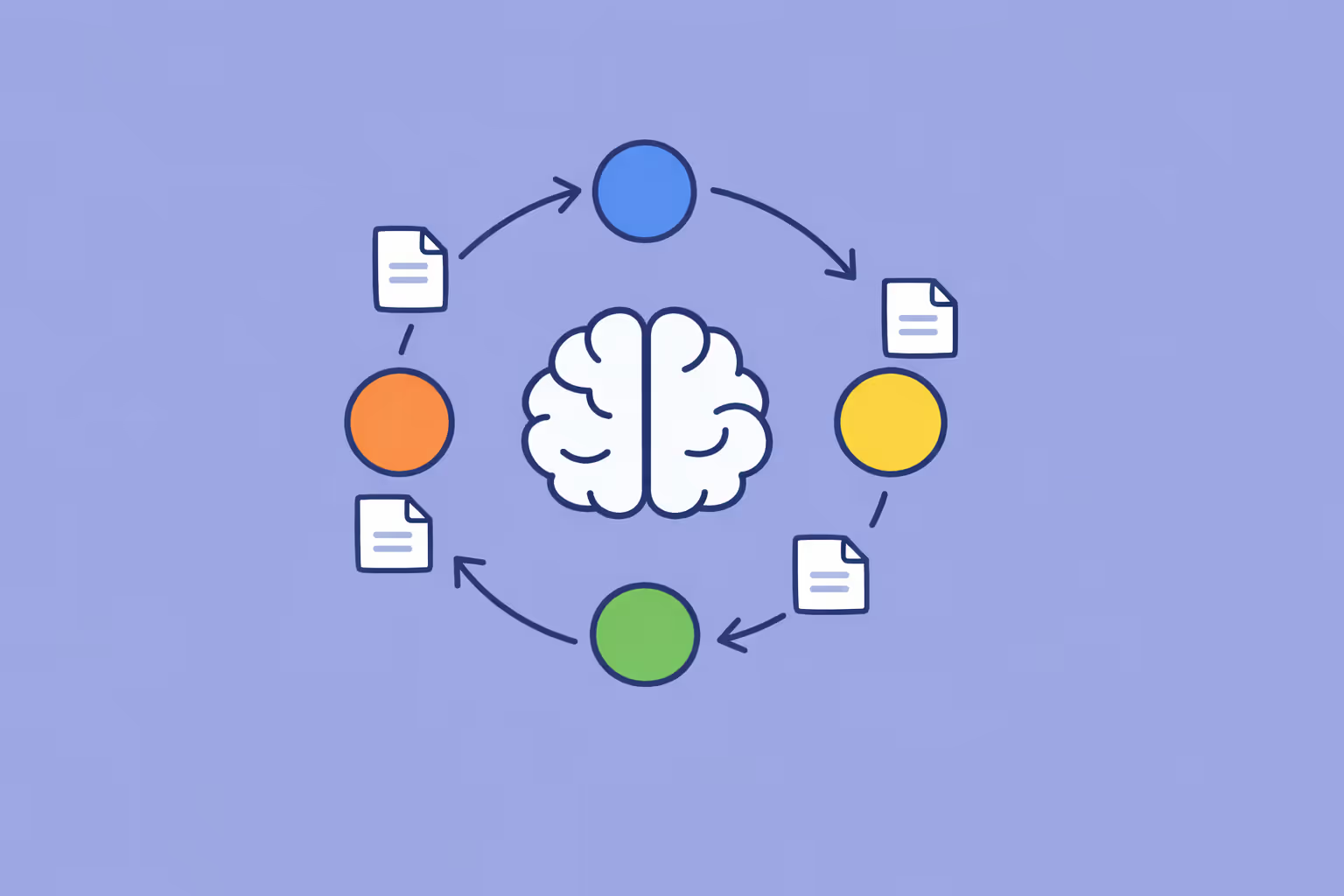
Learn what case-based reasoning (CBR) is, how the retrieve-reuse-revise-retain cycle works, and see real examples across industries.
What Is Cognitive Computing? Definition, Examples, and Use Cases
Learn what cognitive computing is, how it works, and where it applies. Explore real use cases, key benefits, and how it differs from traditional AI.
Graph Neural Networks (GNNs): How They Work, Types, and Practical Applications
Learn what graph neural networks are, how GNNs process graph-structured data through message passing, their main types, real-world use cases, and how to get started.