Home What Is LangChain? How It Works, Components, and Use Cases
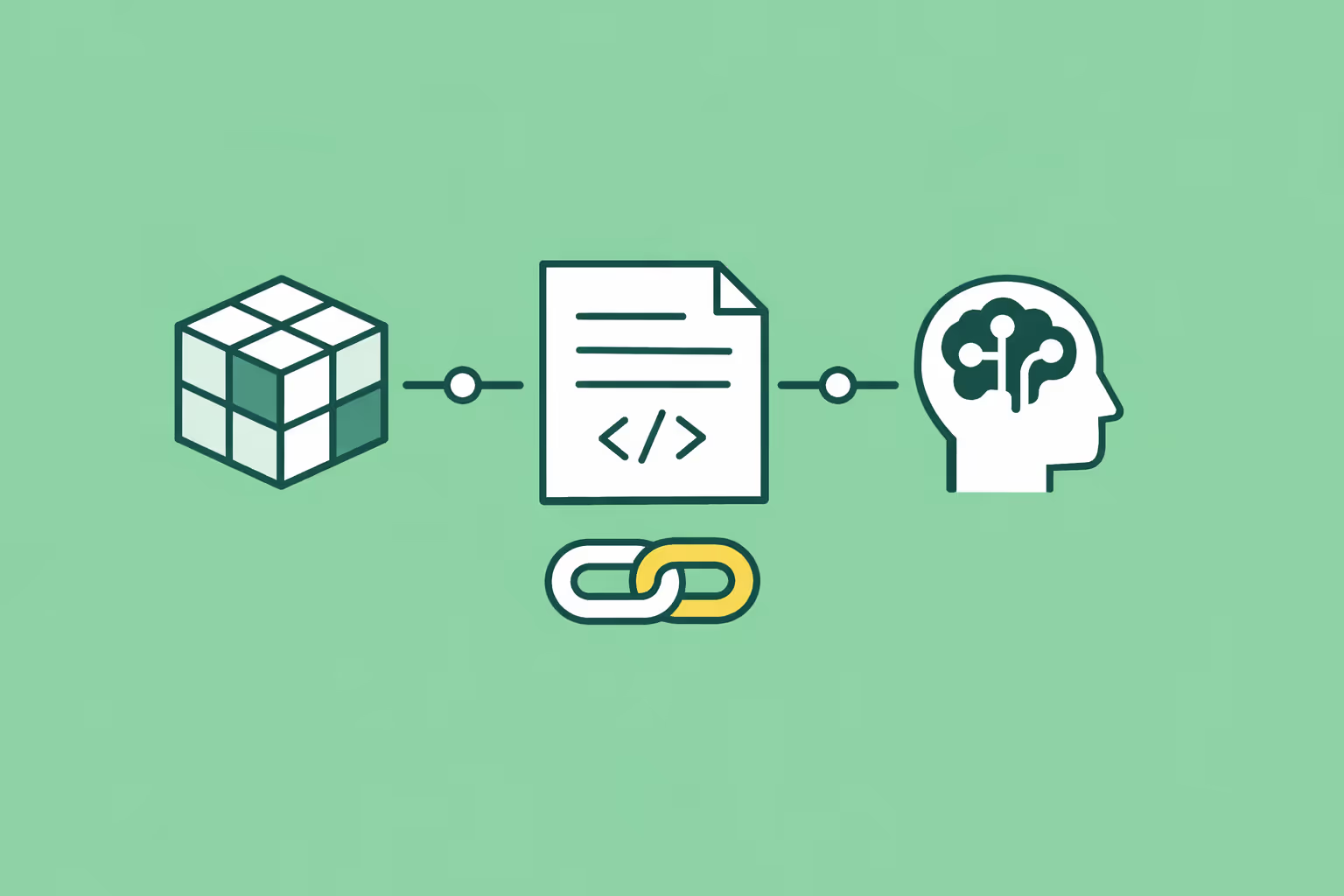
What Is LangChain? How It Works, Components, and Use Cases
Learn what LangChain is, how it works, its core components including chains, agents, and memory, practical use cases in AI application development, and how to get started building with it.
What Is LangChain?
LangChain is an open-source framework designed to simplify the development of applications powered by large language models (LLMs). It provides a standardized set of interfaces, components, and integration tools that allow developers to connect language models to external data sources, build multi-step reasoning workflows, and create AI agents capable of taking actions in the real world.
Rather than requiring developers to write custom integration code for every LLM interaction, LangChain abstracts common patterns into reusable building blocks.
The framework was created by Harrison Chase and released in October 2022.
It gained rapid adoption because it addressed a fundamental challenge in generative AI development: while language models like GPT-3 and its successors are powerful on their own, building production-grade applications around them requires connecting models to databases, APIs, documents, memory systems, and other tools.
LangChain provides the connective tissue that turns a standalone model into a functioning application.
LangChain supports both Python and JavaScript/TypeScript, making it accessible across the two most common stacks for AI development. It is model-agnostic, meaning it works with providers including OpenAI, Anthropic, Google, Hugging Face, and open-source models running locally. This flexibility allows developers to switch between models or use multiple models within the same application without rewriting their core logic.
How LangChain Works
LangChain operates on a modular architecture where individual components can be composed into increasingly sophisticated workflows. At its foundation, the framework wraps LLM API calls in a standardized interface, so switching from one model provider to another requires changing a single configuration rather than restructuring an entire application.
The simplest use of LangChain involves sending a prompt to a language model and receiving a response. But the framework's value becomes clear when developers need more than basic input and output. LangChain enables prompt chaining, where the output of one model call becomes the input for the next, allowing developers to break complex tasks into sequential steps that each handle a manageable piece of the problem.
Beyond sequential chains, LangChain supports branching logic, conditional routing, and parallel execution. A single user query might trigger a chain that first classifies the intent, then routes to a specialized handler, retrieves relevant documents from a vector database, synthesizes an answer using retrieval-augmented generation, and formats the final response.
Each of these steps is a discrete component that can be developed, tested, and improved independently.
LangChain also introduces the concept of agents, which are systems that use a language model as a reasoning engine to decide which actions to take. Instead of following a fixed sequence, an agent receives a goal, evaluates available tools, and dynamically selects the appropriate tool at each step.
This is the pattern behind agentic AI applications that can browse the web, query databases, execute code, and interact with external services autonomously.
The framework handles state management through memory modules that persist conversation history, user context, and intermediate results across interactions. Without memory, each call to a language model is stateless, meaning the model has no awareness of previous exchanges. LangChain's memory components solve this by injecting relevant history into each prompt, enabling coherent multi-turn conversations and long-running workflows.
Key LangChain Components
LangChain is organized around several core components, each addressing a specific layer of AI application development.
Models and Model I/O
The Models component provides a unified interface for interacting with different types of language models. LangChain distinguishes between LLMs (models that take a string and return a string) and Chat Models (models that operate on sequences of messages). This abstraction means developers write their application logic once and can plug in any compatible model.
Model I/O also includes prompt templates, which are structured formats for constructing prompts dynamically. Rather than hardcoding prompt text, developers define templates with variables that get populated at runtime. This is a core practice in prompt engineering, and LangChain makes it systematic by separating prompt design from application logic.
Output parsers, another part of Model I/O, convert raw model responses into structured data types like JSON, lists, or custom objects, making downstream processing reliable.
Chains
Chains are sequences of operations that combine model calls, data transformations, and tool invocations into a single executable workflow. The simplest chain connects a prompt template to a model call. More advanced chains link multiple model calls together, pass outputs through validation steps, or incorporate external data retrieval between reasoning stages.
LangChain Expression Language (LCEL) provides a declarative syntax for defining chains. It allows developers to compose components using a pipe operator, making chain definitions readable and modular. LCEL also supports streaming, batch processing, and async execution out of the box, which matters for production applications that need to handle concurrent requests efficiently.
Retrieval and Document Loaders
Retrieval components connect language models to external knowledge sources. Document loaders import data from PDFs, web pages, databases, APIs, Notion, Slack, Google Drive, and dozens of other sources. Text splitters break large documents into chunks sized appropriately for model context windows and vector embeddings.
Vector stores integrate with databases like Pinecone, Weaviate, Chroma, and FAISS to enable semantic search over document collections. When a user submits a query, the retrieval system converts it into a vector, searches for semantically similar document chunks, and passes the most relevant results to the language model as context.
This retrieval-augmented generation pattern allows applications to answer questions about proprietary data that the model was never trained on.
Memory
Memory modules give LangChain applications the ability to maintain state across interactions. Conversation buffer memory stores the full history of an exchange. Conversation summary memory compresses older interactions into summaries to fit within model context limits. Entity memory tracks specific facts about people, places, and concepts mentioned in a conversation.
The choice of memory type depends on the application's requirements. A customer support chatbot might need full conversation history for a single session. A research assistant that operates across multiple sessions might need summary memory combined with a persistent knowledge store. LangChain's memory system is pluggable, so developers can swap memory strategies without restructuring their application.
Agents and Tools
Agents are LangChain components that use a language model to decide what actions to take in pursuit of a goal. Unlike chains, which follow a predetermined sequence, agents dynamically choose from a set of available tools at each step based on the current context and the results of previous actions.
Tools are functions that agents can invoke. LangChain provides built-in tools for web search, mathematical computation, code execution, database queries, and API calls. Developers can also define custom tools that wrap any function or service.
The agent receives a description of each available tool and uses natural language processing to determine which tool is most appropriate for the current step, what inputs to provide, and how to interpret the results.
Agent types in LangChain include ReAct agents (which alternate between reasoning and acting), plan-and-execute agents (which create a full plan before taking any action), and OpenAI function-calling agents (which leverage model-native tool use capabilities). Each type suits different problem structures and reliability requirements.
Callbacks and Observability
Callbacks allow developers to hook into the execution lifecycle of LangChain components. They enable logging, monitoring, tracing, and debugging at every stage of a chain or agent's operation. This observability is essential for LLMOps, the practice of managing language model applications in production.
LangSmith, a companion platform to LangChain, provides tracing, evaluation, and monitoring capabilities specifically designed for LLM applications. It captures detailed execution traces, allowing developers to inspect exactly what happened at each step, which prompts were sent, what the model returned, and how long each operation took. This visibility is critical for diagnosing failures, optimizing performance, and ensuring quality in production deployments.
LangChain Use Cases
LangChain's flexibility supports a wide range of applications across industries and domains.
Conversational AI and Chatbots
LangChain enables the development of sophisticated conversational systems that go beyond simple question-and-answer patterns. By combining memory, retrieval, and agent capabilities, developers build chatbots that maintain context across long conversations, access company knowledge bases, and take actions like booking appointments or updating records.
These implementations move beyond what basic ChatGPT Enterprise deployments can offer by incorporating proprietary data and custom business logic.
Question Answering Over Documents
One of the most common LangChain use cases is building systems that answer questions about specific document collections. Legal teams use it to query case law databases. Research organizations use it to synthesize findings across thousands of papers. Companies use it to make internal documentation searchable through natural language queries rather than keyword matching. The retrieval-augmented generation pattern ensures answers are grounded in source material rather than model hallucination.
Autonomous Research and Analysis Agents
LangChain agents can perform multi-step research tasks that would take a human analyst hours. An agent might receive a research question, search the web for relevant sources, extract key findings, cross-reference data points, and compile a structured report. Each step uses a different tool, and the agent determines the optimal sequence based on what it discovers along the way.
This represents the practical application of agentic AI principles in knowledge work.
Data Extraction and Transformation
LangChain simplifies the extraction of structured data from unstructured sources. Invoice processing, resume parsing, contract analysis, and regulatory document review all follow a similar pattern: load the document, send relevant sections to a language model with extraction instructions, and parse the output into structured fields. LangChain's document loaders and output parsers make this workflow repeatable and scalable.
Educational and Training Applications
LangChain powers personalized learning experiences by enabling AI tutors that adapt to individual learner needs. These systems retrieve relevant course material, assess learner understanding through conversational interaction, and adjust their explanations based on the learner's level and progress.
The framework's memory capabilities allow tutoring agents to track what concepts a student has mastered and where they need additional practice, making artificial intelligence a practical tool in education at scale.
Code Generation and Developer Tools
Developer-focused applications use LangChain to build code generation assistants, documentation generators, and debugging tools. These applications retrieve relevant code context from repositories, understand project conventions, and generate code that fits within existing architectures.
The chain pattern is particularly useful here, as code generation often requires multiple steps: understanding the requirement, retrieving relevant existing code, generating a solution, and validating it against tests.
Challenges and Limitations
LangChain addresses many integration challenges, but it introduces its own set of considerations that developers and organizations should understand before committing to the framework.
Complexity and Abstraction Overhead
LangChain's abstraction layers can obscure what is happening at the model interaction level. For simple applications, the framework may introduce unnecessary complexity compared to making direct API calls. Developers who do not understand the underlying model behavior may struggle to debug unexpected outputs because the abstraction hides the actual prompts being sent and received.
This is particularly relevant for teams new to deep learning concepts and LLM behavior patterns.
Rapid API Changes
LangChain has evolved quickly since its release, and its API surface has changed significantly across versions. Code written for one version may not work with the next. The framework underwent a major restructuring with the introduction of LangChain Expression Language and the separation of core functionality from integrations. Teams that built applications on earlier versions have faced migration challenges. Staying current with the framework requires ongoing attention to changelog and migration guides.
Latency and Cost
Chaining multiple LLM calls together multiplies both latency and cost. A chain that makes three sequential model calls takes roughly three times as long and costs three times as much as a single call. Agent workflows that make an unpredictable number of tool calls can produce highly variable response times and costs. Developers need to design chains and agents with cost and latency budgets in mind, using caching, smaller models for intermediate steps, and parallel execution where possible.
Debugging and Testing
Testing LLM-based applications is inherently challenging because model outputs are non-deterministic. Two identical prompts may produce different responses.
LangChain provides some testing utilities, but comprehensive testing of chains and agents requires strategies for handling output variability, including evaluation frameworks that assess output quality rather than exact match. Fine-tuning individual model components and using structured output formats can improve consistency but does not eliminate the fundamental challenge.
Vendor Lock-in Considerations
While LangChain is model-agnostic in principle, applications that use LangChain-specific abstractions heavily can become dependent on the framework itself. If LangChain's development direction diverges from an organization's needs, migrating away requires rewriting significant portions of the application.
Some teams mitigate this by using LangChain for prototyping and building custom integration layers for production, while others accept the dependency as a reasonable trade-off for development speed.
Security Concerns
Applications that connect language models to external tools and data sources through LangChain introduce security considerations. Prompt injection attacks, where malicious input causes the model to execute unintended tool calls, are a real risk in agent-based systems. Data exposure can occur if retrieval systems surface sensitive documents without proper access controls.
LangChain itself does not enforce security policies, so developers must implement authentication, authorization, and input validation at the application level.
| Challenge | Impact | Mitigation |
|---|---|---|
| Complexity and Abstraction Overhead | LangChain's abstraction layers can obscure what is happening at the model interaction. | — |
| Rapid API Changes | LangChain has evolved quickly since its release. | Code written for one version may not work with the next |
| Latency and Cost | Chaining multiple LLM calls together multiplies both latency and cost. | — |
| Debugging and Testing | Testing LLM-based applications is inherently challenging because model outputs are. | Evaluation frameworks that assess output quality rather than exact |
| Vendor Lock-in Considerations | While LangChain is model-agnostic in principle. | — |
| Security Concerns | Applications that connect language models to external tools and data sources through. | — |
How to Get Started with LangChain
Getting started with LangChain requires a basic understanding of Python or JavaScript/TypeScript and familiarity with how language models work. Prior experience with machine learning is helpful but not strictly required, as LangChain abstracts most model internals behind high-level interfaces.
Installation and Setup
Install LangChain using pip (Python) or npm (JavaScript/TypeScript). The framework is modular, so you install the core package and add integration packages for specific model providers or tools as needed. You will need API keys for your chosen model provider, such as OpenAI, Anthropic, or Google.
- Install the core package: pip install langchain for Python or npm install langchain for JavaScript
- Install a model provider integration: pip install langchain-openai for OpenAI models
- Set your API key as an environment variable
- Verify your installation by running a simple model call
Build a Simple Chain
Start with a basic chain that connects a prompt template to a model call. Define a prompt template with a variable, pass it through the model, and print the result. This exercise introduces the core pattern of composing components and helps verify that your environment is configured correctly.
Progress to a chain that includes an output parser. Send a prompt that asks the model to produce structured output (like a JSON object), and use LangChain's built-in parsers to convert the raw text response into a usable data structure. This pattern is foundational for building applications that need to process model outputs programmatically.
Add Retrieval
Load a set of documents using one of LangChain's document loaders. Split them into chunks, generate vector embeddings using an embedding model, and store them in a vector database. Build a retrieval chain that takes a user question, searches the vector store for relevant context, and generates an answer grounded in the retrieved documents.
This is the retrieval-augmented generation pattern, and it demonstrates one of LangChain's most practical capabilities.
Experiment with Agents
Define a set of tools and create an agent that can use them to accomplish a goal. Start with built-in tools like web search and a calculator. Give the agent a task that requires multiple tool calls and observe how it reasons about which tool to use at each step. Agent development requires careful attention to tool descriptions, error handling, and guardrails to prevent runaway execution.
This is where the concepts from the transformer model architecture that powers these language models become practically relevant.
Learn from the Ecosystem
LangChain has extensive documentation, a large community, and a growing collection of templates and tutorials. LangSmith provides a free tier for tracing and evaluating applications during development. LangGraph, a related project, extends LangChain with support for building stateful, multi-actor applications using graph-based workflows. Engaging with these resources accelerates the learning curve and exposes developers to production patterns they might not discover independently.
FAQ
What programming languages does LangChain support?
LangChain has full implementations in Python and JavaScript/TypeScript. The Python version is the most mature and has the widest range of integrations. The JavaScript/TypeScript version covers the core functionality and is well-suited for applications built with Node.js or browser-based environments. Both versions follow similar architectural patterns, so skills transfer between them.
Is LangChain free to use?
LangChain is open-source and free under the MIT license. However, building applications with LangChain typically incurs costs from the model providers whose APIs you use (such as OpenAI or Anthropic) and from infrastructure like vector databases and hosting. LangSmith, the companion observability platform, offers a free tier with paid plans for higher usage.
How is LangChain different from calling an LLM API directly?
Calling an LLM API directly is sufficient for simple, single-turn interactions. LangChain adds value when applications require multi-step workflows, integration with external data sources, memory across conversations, or agent-based reasoning. It provides standardized patterns for these common requirements so developers do not need to build them from scratch. For straightforward use cases, direct API calls may be simpler and more appropriate.
Can LangChain work with open-source models?
LangChain integrates with open-source models running locally through frameworks like Ollama, Hugging Face Transformers, and llama.cpp. This allows developers to build applications that run entirely on local infrastructure without sending data to third-party APIs. Local models may have different performance characteristics than hosted commercial models, so applications may need adjustment when switching between them.
Frameworks like PyTorch underpin many of these open-source model implementations.
What is LangGraph and how does it relate to LangChain?
LangGraph is a library built on top of LangChain that enables the construction of stateful, multi-step agent workflows using a graph-based paradigm. While LangChain chains are primarily linear or branching sequences, LangGraph supports cycles, conditional edges, and persistent state, making it suitable for complex agent architectures that need to loop, backtrack, or maintain state across long-running tasks.
LangGraph is the recommended approach for building production-grade agent applications within the LangChain ecosystem.
Is LangChain suitable for production applications?
LangChain is used in production by companies ranging from startups to enterprises. The framework itself is mature enough for production use, but the reliability of LangChain applications depends heavily on implementation quality, error handling, monitoring, and the underlying model's behavior. Production deployments require robust LLMOps practices including tracing, evaluation, fallback strategies, and cost management. LangSmith provides the observability layer that most production deployments need.
Further reading

Augmented Intelligence: Definition, Benefits, and Use Cases
Augmented intelligence enhances human decision-making with AI-powered insights. Learn the definition, key benefits, and real-world use cases across industries.

AI Communication Skills: Learn Prompting Techniques for Success
Learn the art of prompting to communicate with AI effectively. Follow the article to generate a perfect prompt for precise results.

AI Readiness: Assessment Checklist for Teams
Evaluate your team's AI readiness with a practical checklist covering data, infrastructure, skills, governance, and culture. Actionable criteria for every dimension.
Deconvolutional Networks: Definition, Uses, and Practical Guide
Deconvolutional networks reverse the convolution process to reconstruct spatial detail. Learn how they work, key use cases, and practical implementation guidance.
What Is Conversational AI? Definition, Examples, and Use Cases
Learn what conversational AI is, how it works, and where it applies. Explore real use cases, key benefits, and how to evaluate solutions for your organization.

AI Art: How It Works, Top Tools, and What Creators Should Know
Learn how AI art is made using text-to-image generation and style transfer, compare top AI art tools, and understand the ethical and legal considerations for creators.