Home Intelligent Agent in AI: Types, Architecture, and Use Cases
Intelligent Agent in AI: Types, Architecture, and Use Cases
Learn what an intelligent agent is in artificial intelligence, how the perception-reasoning-action cycle works, the five agent types from simple reflex to learning agents, and real-world applications across industries.
What Is an Intelligent Agent?
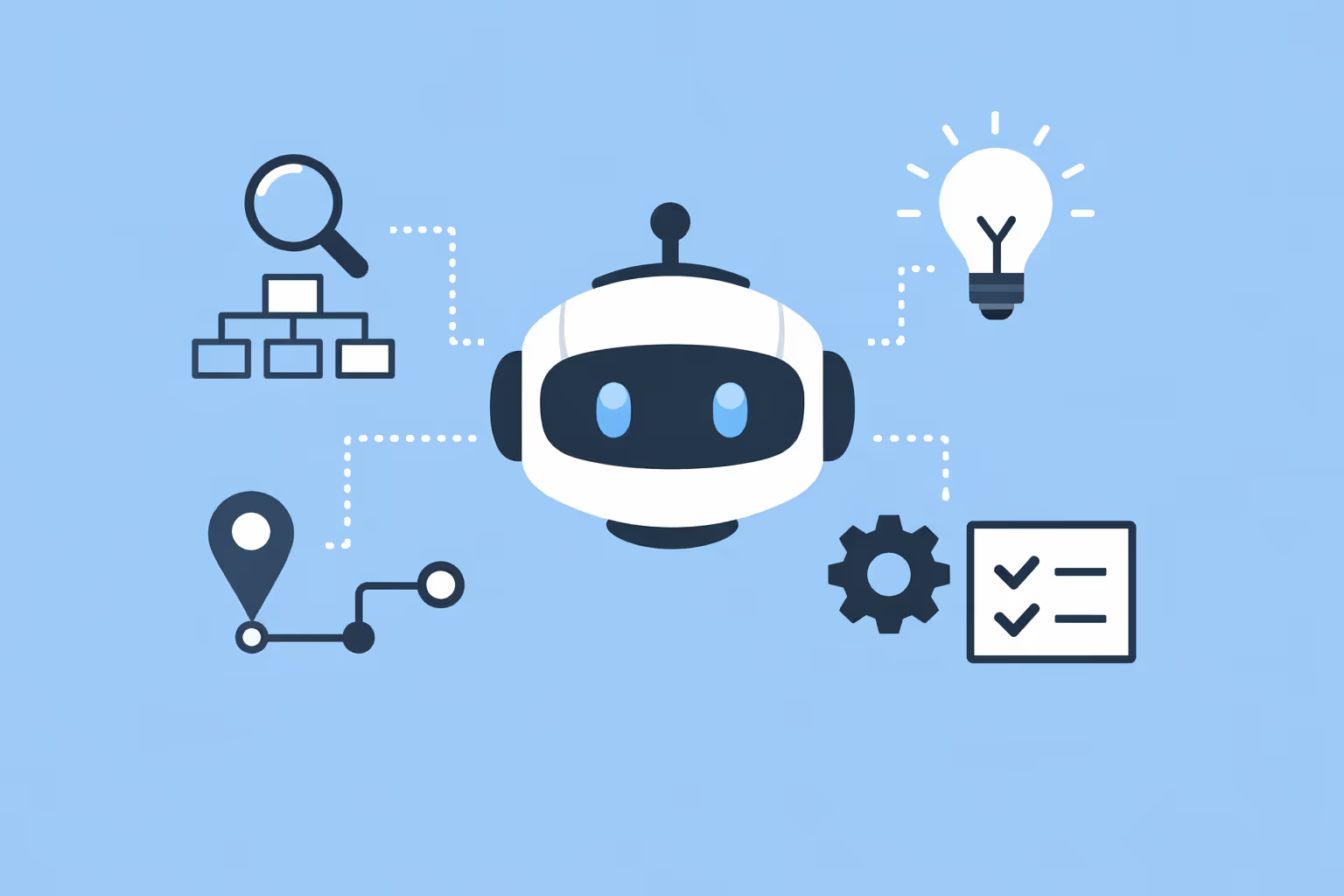
An intelligent agent is a software or hardware entity that perceives its environment through sensors, processes that information using internal reasoning, and takes actions through actuators to achieve a defined goal.
The concept originates from the foundational work of Stuart Russell and Peter Norvig, whose textbook Artificial Intelligence: A Modern Approach established the agent-based view as the organizing framework for the entire field of artificial intelligence.
What separates an intelligent agent from ordinary software is its capacity to operate with a degree of autonomy, adaptability, and goal-directed behavior. A traditional program receives explicit instructions and follows them in sequence. An intelligent agent, by contrast, evaluates the current state of its environment, selects actions that maximize its chances of success, and adjusts its strategy when conditions change.
This makes intelligent agents suited for dynamic, uncertain, or partially observable environments where rigid programming would fail.
Every intelligent agent operates within what is called the PEAS framework: Performance measure, Environment, Actuators, and Sensors. The performance measure defines what counts as success. The environment is everything outside the agent that it interacts with. Actuators are the mechanisms through which the agent affects its environment. Sensors are the channels through which the agent gathers information. Designing an intelligent agent begins with specifying each element of this framework clearly.
The term "intelligent agent" is sometimes used interchangeably with AI agent, but there is a useful distinction. Intelligent agent is the broader theoretical concept from computer science and artificial intelligence research. AI agent typically refers to modern software implementations, often powered by machine learning or large language models.
Every AI agent is an intelligent agent, but not every intelligent agent relies on machine learning. A thermostat that reads temperature and adjusts heating qualifies as a simple intelligent agent even though it uses no learning algorithm.
How Intelligent Agents Work
The core operating cycle of an intelligent agent follows three stages: perception, reasoning, and action. This cycle repeats continuously, allowing the agent to respond to a changing environment in real time.
Perception
Perception is the process by which the agent gathers information about the current state of its environment. For a software agent, sensors might include data feeds, API endpoints, user inputs, or document parsers. For a physical agent such as a robot, sensors include cameras, microphones, LiDAR, and tactile arrays. The quality and completeness of perception directly determines how well the agent can reason and act.
Environments vary in how much information they reveal. A fully observable environment lets the agent see the complete state at every step. A partially observable environment hides some information, forcing the agent to maintain beliefs about unobserved states. Most real-world environments are partially observable, which means intelligent agents must handle uncertainty as a core part of their design.
Reasoning
Reasoning is where the agent decides what to do next. The agent maps its current percept, along with any stored history or internal model, to an action. The mechanism for this mapping is called the agent function, and its concrete software implementation is the agent program.
Simple agents use condition-action rules: if the floor is dirty, vacuum it. More advanced agents use search algorithms, planning systems, or deep learning models to evaluate possible actions and their consequences before committing. The reasoning stage is where the bulk of the agent's intelligence resides, and it is the component that differs most dramatically across agent types.
Some agents reason using symbolic logic and explicit knowledge bases, an approach central to knowledge engineering and expert systems.
Others rely on statistical models trained through supervised learning or reinforcement learning. Many modern agents combine both approaches, using learned models for perception and pattern recognition while applying structured reasoning for planning and decision-making.
Action
Action is the agent's output: the step it takes to influence its environment. Actions can be physical (moving a robotic arm), digital (sending an API request), or communicative (generating a natural language response). The quality of an action is measured by how much it advances the agent toward its goal, as defined by the performance measure.
A well-designed agent selects actions that are rational. Rationality in this context does not mean perfection. It means the agent chooses the action that is expected to maximize its performance measure, given the information available at the time. An agent that lacks full information may take a suboptimal action, but if it chose the best available option based on what it perceived, that action is still rational.
The Role of Memory and State
Not all intelligent agents maintain memory. Simple reflex agents respond only to the current percept. More capable agents maintain an internal state that tracks aspects of the environment not directly visible in the current input. This internal state allows the agent to handle sequential decisions, maintain context across interactions, and learn from past experience.
State management becomes particularly important in multi-agent environments, where each agent must track not only the external environment but also the actions and intentions of other agents operating in the same space.
Types of Intelligent Agents
Russell and Norvig define five types of intelligent agents, arranged by increasing complexity and capability. Each type builds on the one before it, adding new mechanisms for handling more challenging environments.
Simple Reflex Agents
Simple reflex agents select actions based solely on the current percept, ignoring all past history. They operate using condition-action rules: if condition X is true right now, do Y. A motion-sensor light that turns on when it detects movement is a simple reflex agent.
These agents work reliably in fully observable environments where the correct action depends only on the present state. They fail in partially observable environments because they cannot maintain context. If a simple reflex agent encounters a situation not covered by its rules, it has no mechanism to reason about alternatives.
Model-Based Reflex Agents
Model-based reflex agents maintain an internal model of the world that tracks aspects of the environment not visible in the current percept. This internal state is updated at each step using two types of knowledge: how the environment evolves independently and how the agent's own actions affect the environment.
A self-driving car that tracks the positions and velocities of nearby vehicles, even when they momentarily disappear behind an obstacle, functions as a model-based agent. The internal model allows the agent to handle partial observability, making it far more capable than a simple reflex agent in real-world conditions.
Goal-Based Agents
Goal-based agents extend the model-based approach by adding an explicit goal representation. Rather than relying on fixed rules, the agent evaluates potential actions by asking which ones will bring it closer to its goal. This requires the agent to consider the future consequences of its actions, which typically involves search or planning algorithms.
Goal-based agents are more flexible than reflex agents because the same goal can be achieved through different action sequences depending on the situation. A navigation agent that re-routes around a road closure demonstrates this flexibility. The goal (reach the destination) remains constant, but the plan adapts to new information.
Utility-Based Agents
Utility-based agents go one step further by assigning a numerical utility value to different world states. Where a goal-based agent asks "will this action achieve my goal?", a utility-based agent asks "how desirable is the resulting state?" This allows the agent to compare outcomes when multiple action sequences all achieve the goal but with different trade-offs.
A portfolio optimization agent that balances expected return against risk is a utility-based agent. Both a conservative and an aggressive strategy might achieve the goal of generating positive returns, but the utility function determines which balance of return and risk the agent prefers. Utility-based reasoning is closely related to decision theory and is often implemented using probability and fuzzy logic to handle uncertainty.
Learning Agents
Learning agents include a learning component that allows them to improve their performance over time based on experience. The learning element observes the agent's outcomes and modifies the performance element to make better decisions in the future. A critic component evaluates how well the agent is doing relative to a fixed performance standard.
Learning agents are essential in environments where the designer cannot anticipate all possible situations the agent will encounter.
Rather than pre-programming every rule, the designer gives the agent a learning mechanism and a performance measure, then lets the agent develop its own strategies. Q-learning and other reinforcement learning methods are widely used to train learning agents in game playing, robotics, and resource optimization.
| Type | Description | Best For |
|---|---|---|
| Simple Reflex Agents | Simple reflex agents select actions based solely on the current percept. | — |
| Model-Based Reflex Agents | Model-based reflex agents maintain an internal model of the world that tracks aspects of. | — |
| Goal-Based Agents | Goal-based agents extend the model-based approach by adding an explicit goal. | Rather than relying on fixed rules |
| Utility-Based Agents | Utility-based agents go one step further by assigning a numerical utility value to. | Where a goal-based agent asks "will this action achieve my goal?" |
| Learning Agents | Learning agents include a learning component that allows them to improve their performance. | — |
Intelligent Agent Use Cases
Intelligent agents are deployed across industries wherever tasks require perception, reasoning, and adaptive action.
Education and Training
Intelligent tutoring systems are among the most established applications of intelligent agents. These agents assess a learner's current knowledge, identify gaps, select appropriate content, and adjust difficulty in real time. The agent perceives the learner's responses (answers, time spent, error patterns), reasons about what the learner understands and where confusion exists, and acts by presenting new material, hints, or alternative explanations.
AI agents in education are expanding beyond tutoring into enrollment automation, scheduling, and learner engagement monitoring. Adaptive learning platforms use intelligent agents to personalize the learning path for each student, adjusting pacing and content format based on ongoing performance data.
These agents represent a practical application of agentic AI principles in settings where individualized attention at scale was previously impossible.
Healthcare
Clinical decision support agents analyze patient data, lab results, imaging, and medical literature to suggest possible diagnoses or treatment options. These agents do not replace the physician. They augment clinical judgment by surfacing relevant information and flagging patterns that might be missed in a manual review.
Patient monitoring agents track vital signs in real time and alert clinical staff when readings deviate from expected ranges. Administrative agents handle appointment scheduling, insurance verification, and records management, reducing the operational burden on healthcare workers.
Finance
Trading agents analyze market data, execute strategies, and manage risk using utility-based reasoning. Fraud detection agents monitor transaction streams in real time, identifying anomalies that may indicate unauthorized activity. These agents combine pattern recognition through neural networks with rule-based compliance checks.
Customer-facing agents in banking handle account inquiries, loan applications, and financial guidance through natural language processing. The agent understands the customer's request, retrieves relevant account information, and either resolves the issue or routes the case to a human specialist.
Manufacturing and Robotics
Intelligent agents control robotic systems on production lines, managing quality inspection, assembly, and material handling. These agents perceive their environment through cameras and sensors, reason about the current state of the production process, and take actions to maintain throughput and quality standards.
Predictive maintenance agents monitor equipment sensor data to identify early signs of mechanical failure. By detecting anomalies before they escalate, these agents reduce unplanned downtime and extend equipment lifespan. Supply chain agents coordinate procurement, inventory, and logistics decisions across complex global networks.
Customer Service and Conversational AI
Conversational agents powered by large language models handle customer inquiries with a level of language understanding that goes well beyond scripted chatbots. These agents perceive natural language input, reason about intent and context using cognitive computing techniques, and generate responses that address the customer's specific situation.
Modern conversational agents maintain context across multiple turns, access external databases and tools, and learn from interaction history to improve response quality. They handle routine requests independently while escalating complex or sensitive issues to human agents.
Challenges and Limitations
Partial Observability and Uncertainty
Most real-world environments are partially observable, stochastic, and dynamic. Intelligent agents must make decisions with incomplete information, and the consequences of those decisions may not be immediately apparent. Designing agents that handle uncertainty gracefully remains one of the hardest problems in AI, particularly in high-stakes domains such as healthcare and autonomous driving.
Approaches like probabilistic reasoning and case-based reasoning help agents manage uncertainty, but no method eliminates it entirely. The gap between laboratory performance and real-world reliability continues to be a practical barrier to deployment.
Alignment and Goal Specification
Specifying the right performance measure is deceptively difficult. An agent that optimizes exactly what it is told to optimize may produce unintended and harmful outcomes if the performance measure does not fully capture human values and intentions. This alignment problem is a central concern in responsible AI research.
A customer service agent optimized purely for resolution speed might rush customers or provide incomplete answers. A content recommendation agent optimized for engagement might promote sensational or misleading material. The challenge is designing performance measures that capture not just the primary objective but also the broader constraints of safety, fairness, and user well-being.
Scalability and Coordination
As intelligent agents are deployed in larger and more complex environments, scalability becomes a significant constraint. A single agent reasoning about millions of possible states can face computational bottlenecks. Multi-agent systems introduce coordination challenges: how do multiple agents share information, avoid conflicts, and align their actions toward a shared objective?
Communication overhead, conflicting sub-goals, and emergent behavior in multi-agent systems can produce outcomes that no individual agent intended. Designing coordination protocols that remain effective as the number of agents grows is an active area of research.
Explainability and Trust
Many intelligent agents, particularly those using deep learning, operate as black boxes. They produce accurate outputs but cannot explain their reasoning in terms that humans can verify. In domains where accountability matters, such as medicine, law, and finance, this lack of explainability limits adoption.
Building agents that can explain their decisions, justify their actions, and provide confidence estimates for their outputs is essential for establishing trust between human users and intelligent systems. Efforts in autonomous AI development increasingly focus on interpretability alongside performance.
How to Build an Intelligent Agent
Building an intelligent agent follows a structured process that begins with clear problem definition and progresses through design, implementation, training, and evaluation.
Step 1: Define the PEAS Framework
Start by specifying the Performance measure, Environment, Actuators, and Sensors. What does success look like? What environment will the agent operate in, and what are its properties (fully or partially observable, deterministic or stochastic, static or dynamic)? What actions can the agent take? What information can it access?
This step determines the entire architecture. A fully observable, deterministic environment might only need a simple reflex agent. A partially observable, stochastic, multi-agent environment will require a learning agent with a sophisticated internal model.
Step 2: Select the Agent Architecture
Choose the agent type that matches the complexity of the problem. For straightforward rule-based tasks, a simple reflex or model-based agent may suffice. For problems that require planning and trade-off analysis, a goal-based or utility-based agent is appropriate. For environments where conditions change unpredictably, a learning agent provides the necessary adaptability.
Consider whether the task requires a single agent or a multi-agent system. Tasks that involve coordination across multiple domains, distributed information, or competing objectives often benefit from multi-agent architectures.
Step 3: Design the Perception Pipeline
Build the system through which the agent will gather and process environmental information. For software agents, this typically involves API integrations, data parsers, and input validation. For physical agents, this involves sensor hardware and signal processing.
The perception pipeline should filter noise, handle missing data, and present information in a format that the reasoning component can use efficiently. Techniques from natural language processing and computer vision are commonly used in the perception layer.
Step 4: Implement the Reasoning Engine
This is the core of the agent. Implement the agent function that maps percepts to actions. For rule-based agents, this means encoding condition-action rules. For learning agents, this means selecting a training algorithm, preparing training data, and defining the reward structure.
Modern intelligent agents often use hybrid approaches. A large language model may handle natural language understanding and generation, while a separate planning module handles multi-step task decomposition. Retrieval systems may provide the agent with access to external knowledge bases and documentation.
Step 5: Train, Test, and Evaluate
Train the agent using representative data or simulated environments. Evaluate performance against the metrics defined in the PEAS framework. Test the agent in edge cases, adversarial conditions, and scenarios that differ from the training distribution.
Evaluation should include not only task success rates but also response time, resource consumption, error handling, and behavior in ambiguous or novel situations. Agents intended for deployment in sensitive domains should undergo evaluation for bias, safety, and alignment with responsible AI principles.
Step 6: Deploy with Monitoring and Feedback Loops
Deploy the agent with monitoring infrastructure that tracks performance over time. Establish feedback loops that allow the agent to learn from real-world interactions and flag situations where human review is needed.
Successful deployment requires clear escalation paths for edge cases, regular performance audits, and mechanisms for updating the agent's knowledge and behavior as the environment changes. The goal is a system that improves continuously while maintaining reliability and alignment with its intended purpose.
FAQ
What is the difference between an intelligent agent and a regular program?
A regular program follows a fixed sequence of instructions regardless of environmental conditions. An intelligent agent perceives its environment, reasons about the current state, and selects actions that maximize a performance measure. The key differences are autonomy, adaptability, and goal-directed behavior. An intelligent agent can adjust its actions based on new information, while a regular program cannot deviate from its predefined logic without being rewritten.
What are the five types of intelligent agents?
The five types, as defined by Russell and Norvig, are simple reflex agents, model-based reflex agents, goal-based agents, utility-based agents, and learning agents. Each type adds a new capability: internal state tracking, goal representation, utility evaluation, or learning from experience. The appropriate type depends on the complexity and observability of the environment.
Are chatbots intelligent agents?
Basic scripted chatbots function as simple reflex agents. They match user input to predefined responses using condition-action rules. Modern conversational AI systems built on large language models are more sophisticated. They maintain conversation context, reason about user intent, access external tools, and improve through feedback.
These qualify as learning agents and represent a significant advancement in autonomous AI agents.
What is the PEAS framework in AI?
PEAS stands for Performance measure, Environment, Actuators, and Sensors. It is a standard framework for specifying the design requirements of an intelligent agent. The performance measure defines success criteria. The environment describes the world the agent operates in. Actuators are the mechanisms the agent uses to act. Sensors are the channels it uses to perceive. Every intelligent agent design should begin with a clear PEAS specification.
How do intelligent agents learn?
Learning agents use a dedicated learning component that observes outcomes and modifies the agent's decision-making to improve future performance. Common learning methods include supervised learning (learning from labeled examples), reinforcement learning (learning from rewards and penalties), and unsupervised learning (finding patterns in unlabeled data).
The learning element works alongside a performance element that selects actions and a critic that evaluates results against a performance standard.
Can intelligent agents work together?
Yes. Multi-agent systems coordinate multiple intelligent agents to solve problems that exceed the capability of any single agent. Agents in these systems may cooperate, compete, or negotiate depending on the task. Applications include supply chain optimization, traffic management, distributed robotics, and collaborative research. The challenge in multi-agent systems is designing communication and coordination protocols that produce coherent group behavior.
Further reading

Agentic AI Explained: Definition and Use Cases
Learn what agentic AI means, how it differs from generative AI, and where goal-directed AI agents create value across industries. Clear definition and examples.
What Is Case-Based Reasoning? Definition, Examples, and Practical Guide
Learn what case-based reasoning (CBR) is, how the retrieve-reuse-revise-retain cycle works, and see real examples across industries.
Fine-Tuning in Machine Learning: How It Works, Use Cases, and Best Practices
Fine-tuning adapts a pre-trained machine learning model to a specific task using targeted training on a smaller dataset. Learn how it works, common use cases, and how to get started.

Data Dignity: What It Is and Why It Matters
Data dignity is the principle that people should have agency, transparency, and fair compensation for the personal data they generate. Learn how it works and why it matters.

AI Readiness: Assessment Checklist for Teams
Evaluate your team's AI readiness with a practical checklist covering data, infrastructure, skills, governance, and culture. Actionable criteria for every dimension.
.avif)
11 Best AI Video Generator for Education in 2025
Discover the best AI video generator tools for education in 2025, enhancing teaching efficiency with engaging, cost-effective video content creation