Home Generative AI Explained: How It Works, Types, and Real-World Use Cases
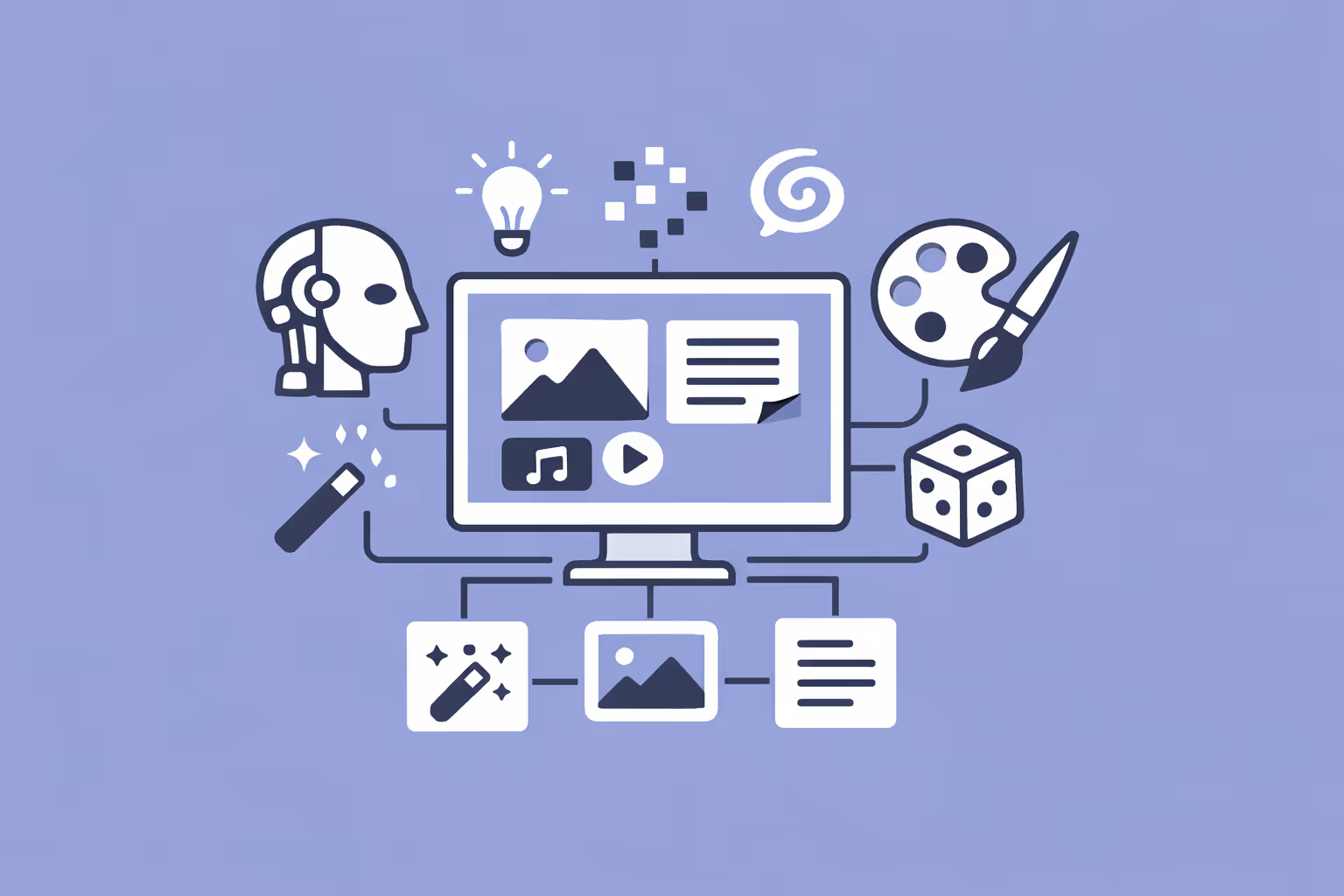
Generative AI Explained: How It Works, Types, and Real-World Use Cases
Generative AI creates new content from learned patterns. Explore how it works, the main model types, practical use cases, key challenges, and how to get started.
What Is Generative AI?
Generative AI is a category of artificial intelligence that creates new content, including text, images, audio, video, and code, by learning statistical patterns from existing data. Rather than classifying inputs or predicting numerical values, a generative model produces original outputs that resemble the data it was trained on.
The core idea is straightforward. A generative AI system ingests large volumes of training data, learns the underlying structure and distribution of that data, and then samples from that learned distribution to produce something new. When a large language model writes a paragraph, it is generating a sequence of words based on probabilities it derived from billions of sentences.
When an image model creates a photograph of a landscape that never existed, it is drawing from patterns it absorbed across millions of real images.
Generative AI is distinct from discriminative AI, which focuses on drawing boundaries between categories. A spam filter classifies emails as spam or not spam. A generative model could write an entirely new email. This distinction matters because the ability to produce novel content rather than merely sort existing content is what makes generative AI useful for creative, educational, and productivity applications.
For a deeper comparison, see how AI differs from generative AI at a foundational level.
The field has accelerated rapidly. Models like GPT-3 and its successors demonstrated that scaling language modeling produces systems capable of writing coherent essays, translating languages, summarizing documents, and answering questions with fluency that approaches human output.
Image generators like DALL-E and Midjourney showed that similar principles apply to visual content. The result is a technology layer that is reshaping how people create, learn, and work.
How Generative AI Works
Training on Large Datasets
Every generative AI model begins with data. Language models train on massive text corpora scraped from the web, books, academic papers, and code repositories. Image models train on millions of image-text pairs. Audio models train on speech recordings and music libraries. The scale of training data is a defining characteristic. Modern generative models routinely train on datasets measured in terabytes.
During training, the model learns to represent the statistical relationships within its data. A language model learns that certain words follow other words with high probability. An image model learns that skies tend to be blue, faces have symmetrical features, and shadows fall in predictable directions. These relationships are encoded in the model's parameters, the millions or billions of numerical weights that define its behavior.
Neural Network Architectures
The backbone of modern generative AI is the transformer model, an architecture built on self-attention mechanisms that allow the model to weigh the relevance of every element in an input sequence relative to every other element. Transformers replaced earlier recurrent architectures because they parallelize efficiently and capture long-range dependencies in data.
For text generation, autoregressive models like the GPT series predict one token at a time, using the full context of all previously generated tokens to inform each prediction. This sequential process produces fluent, contextually coherent text.
Models like BERT take a different approach, masking portions of input and predicting the missing tokens, which makes them powerful for understanding tasks like classification and extraction.
For image generation, diffusion models have emerged as the dominant approach. They work by gradually adding noise to training images until the data is pure randomness, then training a neural network to reverse this process step by step.
At generation time, the model starts with random noise and iteratively refines it into a coherent image guided by a text prompt or other conditioning signal.
Fine-Tuning and Alignment
Pre-training gives a model broad knowledge, but raw pre-trained models are not immediately useful for specific tasks. Fine-tuning adapts a pre-trained model to a narrower domain or task using a smaller, curated dataset. A general language model can be fine-tuned on medical literature to produce a model that excels at clinical question answering, or on legal documents to improve contract analysis.
Alignment is a related process that shapes model behavior to follow instructions and avoid harmful outputs. Techniques like Reinforcement Learning from Human Feedback (RLHF) train the model to prefer responses that human evaluators rate as helpful, accurate, and safe. This step is what transforms a raw text predictor into a useful assistant that follows directions and declines inappropriate requests.
Types of Generative AI
Generative AI spans multiple modalities and model architectures. The main categories reflect both the type of content produced and the underlying technical approach.
Large Language Models (LLMs)
Large language models are the most widely deployed form of generative AI.
They generate text by predicting the next token in a sequence, and their capabilities scale with model size and training data volume. OpenAI's GPT series, Google Gemini, Anthropic's Claude, and open-weight models like Llama and Gemma represent the current landscape.
LLMs handle tasks including text generation, summarization, translation, question answering, code generation, and structured data extraction. Their versatility comes from prompt engineering, the practice of crafting input instructions that guide the model toward a desired output format and quality level.
Image Generation Models
Image generators create visual content from text descriptions, reference images, or both.
Diffusion models like Stable Diffusion and DALL-E 3 dominate this space. Generative adversarial networks (GANs) remain relevant for specific tasks like style transfer and super-resolution, while variational autoencoders (VAEs) serve as components within larger generation pipelines.
Image-to-image translation models transform existing images based on instructions, enabling tasks like colorization, style transfer, inpainting, and resolution enhancement. These tools have found practical applications in design, marketing, and content production workflows.
Audio and Music Generation
Audio generation models produce speech, music, and sound effects. Text-to-speech systems convert written text into natural-sounding audio with controllable voice characteristics, pacing, and emotional tone. Music generation models compose original tracks in specified genres, moods, or styles.
Voice cloning technology can replicate a specific speaker's voice from a short audio sample, enabling personalized narration and dubbing. These capabilities raise significant ethical questions about consent and deepfake potential, which the industry is still working to address through watermarking and provenance standards.
Video Generation
Video generation models produce motion content from text prompts, still images, or existing video clips. These systems extend image generation principles into the temporal dimension, maintaining visual coherence across frames while introducing movement, camera angles, and scene transitions.
Video generation is computationally expensive and less mature than text or image generation, but it is advancing quickly. Applications range from short-form marketing content to animated explainers and synthetic training data for computer vision systems.
Multimodal Models
Multimodal AI systems process and generate content across multiple formats simultaneously.
A multimodal model can accept an image and a text question, then produce a text answer that demonstrates visual understanding. Vision-language models combine image perception with language reasoning, enabling applications like visual question answering, image captioning, and document understanding.
The trend toward multimodality reflects a broader shift in the field. Rather than building separate specialist models for each format, researchers are converging on unified architectures that handle text, images, audio, and video within a single framework.
| Type | Description | Best For |
|---|---|---|
| Large Language Models (LLMs) | Large language models are the most widely deployed form of generative AI. | Text generation, summarization, translation, question answering |
| Image Generation Models | Image generators create visual content from text descriptions, reference images, or both. | Design, marketing, and content production workflows |
| Audio and Music Generation | Audio generation models produce speech, music, and sound effects. | — |
| Video Generation | Video generation models produce motion content from text prompts, still images. | — |
| Multimodal Models | Multimodal AI systems process and generate content across multiple formats simultaneously. | Visual question answering, image captioning |
Generative AI Use Cases
Content Creation and Marketing
Generative AI has become a standard tool in content workflows. Marketing teams use language models to draft blog posts, social media copy, email campaigns, and ad variants. Image generators produce custom visuals for campaigns without the turnaround time and cost of traditional photography or illustration.
The value is not in replacing human creativity but in accelerating it. A writer can generate a first draft in minutes, then spend their time refining voice, verifying facts, and adding nuance. A designer can explore dozens of visual concepts before committing to a direction. The economics of content production shift when the marginal cost of generating a draft approaches zero.
Software Development
Code generation models assist developers by autocompleting functions, generating boilerplate, writing tests, and translating between programming languages. Tools like GitHub Copilot and similar assistants operate as pair programmers that reduce the mechanical effort of writing code.
Beyond line-by-line completion, generative AI helps with code review, documentation generation, bug identification, and architecture suggestions. Development teams that adopt these tools report productivity gains, particularly for repetitive tasks and unfamiliar codebases where the model's broad training provides useful context.
Education and Training
Generative AI is reshaping how educational content is created and delivered. Instructors use language models to generate lesson plans, quiz questions, rubrics, and explanatory materials tailored to specific learning objectives. Deep learning techniques power adaptive learning systems that personalize content difficulty and pacing based on individual learner performance.
For learners, generative AI serves as an on-demand tutor that can explain concepts in multiple ways, provide worked examples, and offer immediate feedback on practice exercises. Language models can simplify complex material for beginners or elaborate on advanced topics for experienced practitioners. The technology is particularly valuable in cohort-based and self-paced learning environments where instructor availability is limited.
Healthcare and Life Sciences
In healthcare, generative AI assists with clinical documentation, patient communication, and medical literature synthesis. Language models can draft discharge summaries, translate clinical notes into patient-friendly language, and surface relevant research findings for clinicians.
In drug discovery, generative models design novel molecular structures with desired pharmacological properties. Rather than screening millions of existing compounds, these models generate candidates that optimize for efficacy, safety, and synthesizability simultaneously. This approach compresses timelines that historically stretched across years of trial-and-error experimentation.
Customer Service and Operations
Generative AI powers conversational agents that handle customer inquiries with natural, context-aware responses. Unlike rule-based chatbots that follow rigid decision trees, generative systems understand intent, maintain conversation history, and produce responses that feel human. Retrieval-augmented generation (RAG) grounds these responses in verified knowledge bases, reducing the risk of fabricated answers.
Operationally, generative AI automates report generation, data summarization, and internal knowledge management. Teams use it to extract insights from meeting transcripts, generate executive briefings from raw data, and maintain living documentation that updates as processes evolve.
Challenges and Limitations
Hallucination and Factual Accuracy
Generative AI models produce outputs that sound confident regardless of whether they are correct. Language models can fabricate citations, invent statistics, and present plausible but entirely fictional information. This tendency, called hallucination, is a fundamental property of how these models work. They optimize for fluency and coherence, not truth.
Mitigating hallucination requires external verification layers. Retrieval-augmented generation attaches the model to a factual knowledge base. Human review catches errors before they reach end users. Confidence scoring and citation systems help users assess reliability. None of these solutions eliminate the problem entirely, which is why human oversight remains essential for any high-stakes application.
Bias and Fairness
Generative models inherit the biases present in their training data. A model trained predominantly on English-language web text will reflect the perspectives, stereotypes, and blind spots of that corpus. This manifests as biased language, underrepresentation of minority perspectives, and outputs that reinforce existing social inequalities.
Addressing bias requires deliberate effort at every stage: curating balanced training data, evaluating model outputs across demographic groups, and implementing guardrails that detect and redirect biased responses. The challenge is compounded by the scale of training data, which makes comprehensive auditing difficult.
Intellectual Property and Copyright
Generative AI raises unresolved legal questions about training data rights and output ownership. Models trained on copyrighted material may produce outputs that closely resemble specific works, creating potential infringement issues. The legal frameworks governing these situations are still developing across jurisdictions.
Organizations deploying generative AI must consider licensing terms, attribution requirements, and the provenance of training data. Some providers offer indemnification for enterprise customers, while others publish transparency reports detailing their training data sources. Understanding these legal dynamics is critical for any organization that relies on generative AI for commercial output.
Computational Costs and Environmental Impact
Training and running large generative models requires substantial computational infrastructure. Training a frontier language model can cost millions of dollars in compute and consume energy equivalent to the annual electricity usage of hundreds of households. Inference costs scale linearly with usage, making generative AI expensive to operate at scale.
Efficiency research is active and productive. Techniques like model distillation, quantization, and sparse inference reduce resource requirements without proportional accuracy loss. Open-weight models allow organizations to self-host smaller models that meet their specific needs without the overhead of frontier-scale systems. Managing these operational costs connects directly to the practices described in LLMOps frameworks.
Security and Misuse
Generative AI can be misused to produce deepfakes, disinformation, phishing content, and synthetic media designed to deceive. The same capabilities that make these models useful for legitimate content creation also lower the barrier for producing convincing fabrications.
Defensive measures include AI-generated content watermarking, detection classifiers that identify synthetic media, and provenance tracking that records how content was created. Organizations like the Content Authenticity Initiative are developing industry standards for content verification.
The difference between generative AI and predictive AI becomes especially important in this context, as generative capabilities introduce risk categories that predictive systems do not.
How to Get Started with Generative AI
Adopting generative AI effectively requires a practical understanding of available tools, clear use case definition, and appropriate safeguards.
- Identify a specific use case. Generative AI performs best when applied to well-defined tasks with clear success criteria. Rather than adopting the technology broadly, start with a single workflow where it can deliver measurable value, such as drafting customer support responses, generating first-pass content, or summarizing meeting notes.
- Choose the right model tier. Not every task requires a frontier model. Smaller, specialized models often outperform larger general-purpose models on narrow tasks while costing a fraction to operate. Evaluate whether an open-weight model fine-tuned on your data might serve better than an API call to the largest available system.
- Learn prompt engineering. The quality of generative AI output depends heavily on how you frame the input. Clear, specific instructions with examples and constraints consistently produce better results than vague prompts. Investing time in understanding how to communicate with these models pays immediate dividends.
- Build evaluation frameworks. Define how you will measure output quality before deployment. For text, this might involve human ratings on accuracy, relevance, and tone. For code, it might mean test pass rates. For images, it could be brand consistency scores. Without structured evaluation, it is impossible to distinguish genuine improvement from perceived novelty.
- Implement human oversight. Generative AI should augment human judgment, not replace it. Establish review processes that catch errors, enforce quality standards, and provide feedback loops that improve performance over time. The appropriate level of oversight depends on the stakes involved. Customer-facing content demands more review than internal brainstorming.
- Explore orchestration frameworks. Tools like LangChain simplify the process of building applications that combine generative models with external data sources, APIs, and business logic. These frameworks handle the plumbing of connecting models to real-world systems, allowing teams to focus on application design rather than infrastructure.
- Stay current with the ecosystem. The generative AI field moves quickly. New models, techniques, and tools emerge regularly. Allocate time for ongoing learning, and build systems flexible enough to swap underlying models as the technology improves. Machine learning fundamentals remain stable, but the application layer evolves month to month.
FAQ
What is the difference between generative AI and traditional AI?
Traditional AI systems are typically designed to classify, predict, or optimize based on existing data. A spam filter, a recommendation engine, and a fraud detection system are all traditional AI applications. Generative AI, by contrast, creates new content that did not exist in the training data. It produces text, images, audio, and video rather than sorting or scoring existing information.
The technical distinction is that generative models learn the full data distribution, while discriminative models learn only the decision boundaries between categories.
Is generative AI the same as deep learning?
No. Deep learning is a broader category of machine learning that uses multi-layered neural networks to learn from data. Generative AI is one application of deep learning. Many deep learning systems are not generative.
A convolutional neural network that classifies images as cats or dogs is a deep learning model, but it is not generative AI because it does not produce new images. Generative AI relies on deep learning architectures, but the two terms are not interchangeable.
Can generative AI replace human workers?
Generative AI automates specific tasks, not entire jobs. It excels at producing first drafts, handling repetitive content generation, summarizing large volumes of information, and assisting with routine coding. It does not replicate the judgment, contextual understanding, ethical reasoning, or creative vision that human professionals bring to their work.
The most effective deployments treat generative AI as a productivity tool that handles mechanical work while humans focus on strategy, quality, and decision-making.
How accurate is generative AI?
Accuracy varies significantly by task, model, and prompt quality. For well-defined tasks with clear patterns in the training data, modern generative models produce highly accurate outputs. For tasks requiring factual precision, specialized knowledge, or nuanced reasoning, outputs require human verification.
Retrieval-augmented generation and domain-specific fine-tuning improve accuracy for targeted applications, but no current generative model is reliably factual across all domains without external grounding.
What are the costs of implementing generative AI?
Costs depend on the approach. API access to commercial models like GPT-4 or Claude charges per token, with typical costs ranging from fractions of a cent to several cents per thousand tokens depending on the model tier. Self-hosting open-weight models requires GPU infrastructure, which can run from hundreds to thousands of dollars per month depending on scale. Fine-tuning adds additional compute costs.
For most organizations, starting with API-based access and migrating to self-hosted solutions as usage grows is the most practical path.
Further reading
What Is a Neurosynaptic Chip? Definition, Architecture, and Applications
Learn what a neurosynaptic chip is, how it mimics biological neural networks in silicon, why it matters for AI efficiency, and where it is used across industries.

What Is Unsupervised Learning? Types, Methods, and Use Cases
Unsupervised learning finds hidden patterns in unlabeled data. Learn how clustering, dimensionality reduction, and association methods work across real-world applications.

Artificial General Intelligence (AGI): What It Is and Why It Matters
Artificial general intelligence (AGI) refers to AI that matches human-level reasoning across any domain. Learn what AGI is, how it differs from narrow AI, and why it matters.

Kolmogorov-Arnold Network (KAN): How It Works and Why It Matters
A Kolmogorov-Arnold Network (KAN) places learnable activation functions on edges instead of nodes. Learn how KANs work, how they compare to MLPs, and where they excel.

Backpropagation Algorithm: How It Works, Why It Matters, and Practical Applications
Learn how the backpropagation algorithm trains neural networks, why it remains essential for deep learning, and where it applies in practice.
Data Splitting: Train, Validation, and Test Sets Explained
Data splitting divides datasets into train, validation, and test sets. Learn how each subset works, common methods, and mistakes to avoid.