Home Gemma: Google's Open-Source Language Model Family Explained
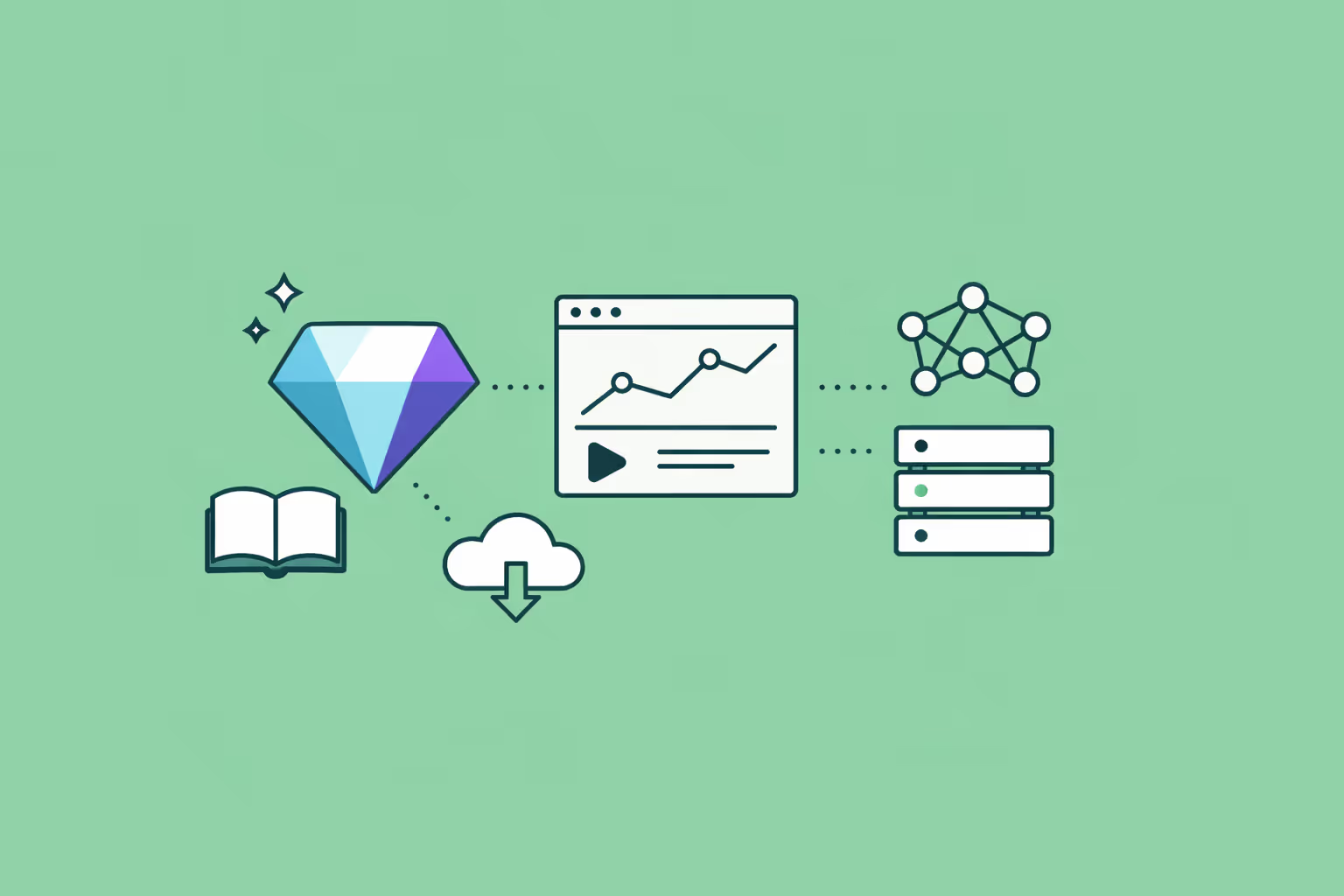
Gemma: Google's Open-Source Language Model Family Explained
Gemma is Google's family of open-source language models built on the same research behind Gemini. Learn how Gemma works, its model variants, use cases, and how to get started.
What Is Gemma?
Gemma is a family of lightweight, open-source language models developed by Google DeepMind. Built using the same research and technology that powers Google Gemini, Gemma models are designed to be accessible, efficient, and responsible.
They are released under permissive licensing terms that allow developers, researchers, and organizations to use, modify, and deploy them freely for both commercial and non-commercial purposes.
The name "Gemma" comes from the Latin word for "precious stone," reflecting Google's intent to deliver high-quality model capabilities in compact, usable packages. Unlike large proprietary models that require API access and cloud infrastructure, Gemma models are small enough to run on consumer hardware, including laptops and single GPUs.
This makes them a practical entry point for teams that want to integrate generative AI capabilities without the cost and complexity of running or renting massive model infrastructure.
Gemma's release represents a deliberate shift in Google's approach to artificial intelligence distribution. By open-sourcing capable models derived from its most advanced research, Google enables a broader community to build, study, and improve upon its work. This contrasts with fully closed approaches where model weights remain proprietary and access is limited to paid API endpoints.
Each Gemma release includes both pre-trained base models and instruction-tuned variants. The base models are trained on large text corpora and can be further customized through fine-tuning for specific domains or tasks. The instruction-tuned versions have already been optimized to follow user instructions and engage in dialogue, making them ready for conversational and task-completion applications out of the box.
How Gemma Works
Gemma models are built on the transformer architecture, the same foundational design that underpins virtually all modern large language models. Transformers process text by converting words into numerical representations called tokens, then applying layers of attention mechanisms that allow the model to weigh the relevance of every token relative to every other token in a sequence.
This architecture enables Gemma to capture complex linguistic patterns, long-range dependencies, and nuanced contextual meaning.
Specifically, Gemma uses a decoder-only transformer design. This means it generates text autoregressively, predicting one token at a time based on all preceding tokens. This is the same approach used by models in the GPT family and distinguishes Gemma from encoder-based models like BERT, which process text bidirectionally for understanding tasks rather than generation.
The training process follows standard practices in deep learning for language models. Gemma models are pre-trained on massive datasets comprising web documents, books, and code. During pre-training, the model learns general language understanding, factual knowledge, and reasoning patterns.
Google applied careful data filtering and quality controls to the training corpus, removing harmful content and reducing the likelihood of the model producing toxic or unsafe outputs.
After pre-training, Google creates instruction-tuned variants through supervised fine-tuning (SFT) and reinforcement learning from human feedback (RLHF). In the SFT phase, the model is trained on curated examples of high-quality instruction-response pairs. In the RLHF phase, human evaluators rank model outputs by quality, and the model is further optimized to produce responses that align with human preferences.
This two-stage process transforms the raw language model into an assistant that follows directions, answers questions accurately, and declines harmful requests.
Gemma also incorporates several technical innovations inherited from Gemini research. These include multi-query attention, which reduces memory overhead during inference by sharing key-value heads across attention queries, and RoPE (Rotary Position Embedding), which allows the model to generalize to sequence lengths beyond what it encountered during training.
The combination of these techniques allows Gemma to deliver strong performance relative to its parameter count, a key factor for models intended to run on resource-constrained hardware.
Gemma Model Variants
Google has released Gemma in multiple sizes and configurations to serve different use cases, hardware constraints, and performance requirements. Understanding the variant landscape is essential for selecting the right model for a given application.
Gemma 1 (Original Release)
The first generation of Gemma shipped in two parameter sizes:
- Gemma 2B. A 2-billion parameter model designed for on-device and edge deployment. Despite its small footprint, Gemma 2B performs competitively on text generation, summarization, and basic reasoning tasks. It can run on a single consumer GPU or even a high-end laptop CPU, making it suitable for embedded applications and local prototyping.
- Gemma 7B. A 7-billion parameter model offering stronger performance across a wider range of benchmarks. Gemma 7B handles more complex reasoning, longer context windows, and more nuanced text generation. It requires a modern GPU with at least 16 GB of VRAM for comfortable inference.
Both sizes were released as pre-trained (base) models and instruction-tuned (IT) variants.
Gemma 2
The second generation expanded the family with improved architecture and larger sizes:
- Gemma 2 2B. An improved 2-billion parameter model with better performance than its predecessor at the same size, thanks to architectural refinements and improved training data.
- Gemma 2 9B. A 9-billion parameter model that offers a strong balance between capability and efficiency. It outperforms many larger open-source models on standard natural language processing benchmarks while remaining practical to deploy on a single GPU.
- Gemma 2 27B. A 27-billion parameter model that pushes toward the performance levels of much larger models. It targets users who need higher accuracy and more sophisticated reasoning but have access to multi-GPU setups or cloud infrastructure.
Gemma 2 introduced architectural improvements including sliding window attention and logit soft-capping, both of which improve training stability and inference quality.
CodeGemma
CodeGemma is a specialized variant fine-tuned specifically for code generation and understanding. Built on top of the Gemma architecture, CodeGemma models are trained on large datasets of source code across multiple programming languages. They support code completion, code explanation, and code generation from natural language descriptions.
CodeGemma is available in 2B and 7B parameter sizes and is relevant for teams building coding assistants, automated documentation tools, or software development training platforms.
RecurrentGemma
RecurrentGemma replaces the standard transformer attention mechanism with a linear recurrence approach inspired by state-space models. This modification significantly reduces the memory required during inference, particularly for long sequences. RecurrentGemma is designed for environments where memory is the primary constraint, such as mobile devices or IoT applications, and achieves performance comparable to standard Gemma models at similar parameter counts.
PaliGemma
PaliGemma extends the Gemma family into multimodal territory. It combines a vision encoder (based on Google's SigLIP model) with a Gemma language model decoder, enabling the model to process both images and text. PaliGemma can perform image captioning, visual question answering, object detection, and image-text matching tasks. This variant is significant for applications that require understanding visual content alongside natural language.
Gemma Use Cases
Gemma's combination of open-source availability, compact size, and strong performance makes it applicable across a broad range of scenarios. Its versatility spans from individual developer projects to enterprise-scale deployments.
On-Device and Edge AI
Gemma's smaller variants, particularly the 2B models, are designed to run directly on consumer devices without cloud connectivity. This enables privacy-preserving applications where user data never leaves the device. Use cases include on-device text prediction, local document summarization, offline chatbots, and smart assistants embedded in hardware products. The ability to run a capable language model locally is especially valuable in sectors with strict data residency requirements.
Chatbots and Conversational Assistants
The instruction-tuned Gemma models serve as the foundation for building custom chatbots and virtual assistants. Organizations can deploy Gemma-based assistants for customer support, internal knowledge management, or educational tutoring.
Because Gemma is open-source, teams can customize the model's behavior through prompt engineering or further fine-tuning, tailoring responses to match specific brand voices, domain vocabularies, or compliance requirements.
Text Summarization and Content Generation
Gemma performs well on summarization tasks, condensing long documents into concise overviews while preserving key information. Content teams use Gemma to draft articles, product descriptions, email responses, and educational materials. When integrated into content management systems, Gemma can accelerate editorial workflows without requiring expensive API calls to proprietary models.
Code Generation and Developer Tools
CodeGemma specifically targets software development workflows. It can generate code from natural language prompts, explain existing code, suggest bug fixes, and complete partially written functions. Development teams integrate CodeGemma into IDE plugins, code review systems, and automated testing pipelines. For organizations building technical training programs, CodeGemma can power interactive coding exercises and provide real-time feedback to learners.
Research and Experimentation
The open-source nature of Gemma makes it an ideal platform for academic research and experimentation. Researchers can study the model's internal representations, test alignment techniques, develop new machine learning methods, and benchmark novel approaches against a well-documented baseline.
The availability of model weights allows research that is not possible with closed API-only models, such as probing neural network internals, testing adversarial robustness, and developing new fine-tuning strategies.
Retrieval-Augmented Generation (RAG) Pipelines
Gemma integrates naturally into retrieval-augmented generation architectures, where external knowledge bases are queried and the retrieved information is fed to the language model as context. This approach grounds Gemma's responses in verified, up-to-date data, reducing hallucination and improving factual accuracy.
RAG pipelines using Gemma can power enterprise search, customer support knowledge bases, and intelligent document retrieval systems. Tools like LangChain simplify the process of building these pipelines by providing pre-built integrations with Gemma and popular vector embedding databases.
Enterprise Deployment with LLMOps
For organizations deploying Gemma at scale, LLMOps practices provide the operational framework for managing model lifecycle, monitoring performance, handling versioning, and ensuring reliability. Gemma's open weights make it compatible with standard MLOps tooling, including model registries, deployment pipelines, and inference servers.
Enterprise teams can host Gemma on their own infrastructure, maintaining full control over data flow, latency, and compliance.
Challenges and Limitations
Gemma is a capable model family, but it operates within constraints that users should understand before committing to a deployment.
Smaller Context Windows Compared to Frontier Models
Gemma models, particularly the first-generation variants, support shorter context windows than the largest proprietary models. While proprietary models from OpenAI and Google's own Gemini line may support 100,000 tokens or more, Gemma's context length is more limited. This restricts the amount of text the model can process in a single pass and affects performance on tasks requiring long-document understanding.
Performance Gap on Complex Reasoning
While Gemma performs impressively relative to its size, it does not match the reasoning capabilities of the largest frontier models on the most demanding benchmarks. Tasks involving multi-step mathematical reasoning, complex logic chains, or deep domain expertise may require larger or more specialized models. Teams should benchmark Gemma on their specific use cases before replacing larger models.
Hallucination and Factual Accuracy
Like all generative language models, Gemma can produce plausible-sounding but factually incorrect outputs. This is an inherent property of autoregressive text generation and is not unique to Gemma. However, smaller models are generally more prone to hallucination than larger ones because they have less parametric capacity to store factual knowledge. Implementing retrieval-augmented generation or external fact-checking layers is advisable for applications where factual accuracy is critical.
Limited Multimodal Capabilities in Base Models
The core Gemma text models do not process images, audio, or video. While PaliGemma adds vision capabilities, the base Gemma family is text-only. Organizations requiring multimodal understanding need to either use PaliGemma specifically or combine Gemma with separate vision or audio models in a pipeline architecture.
Responsible AI Considerations
Google has implemented safety filters and responsible AI training practices in Gemma, but no model is perfectly aligned. Users who fine-tune Gemma on custom datasets may inadvertently introduce biases or remove safety guardrails. Google provides a Responsible Generative AI Toolkit alongside Gemma to help developers evaluate and mitigate potential harms, but the responsibility for safe deployment ultimately rests with the organization using the model.
Ongoing Maintenance and Updates
Open-source models require active management. Unlike a managed API service that receives continuous improvements, a self-hosted Gemma deployment stays fixed at the version that was downloaded. Organizations must track new releases, evaluate whether upgrades are warranted, and manage the operational overhead of swapping model versions in production systems. This maintenance burden is a real cost that should be factored into deployment planning.
| Challenge | Impact | Mitigation |
|---|---|---|
| Smaller Context Windows Compared to Frontier Models | Gemma models, particularly the first-generation variants. | — |
| Performance Gap on Complex Reasoning | While Gemma performs impressively relative to its size. | Tasks involving multi-step mathematical reasoning |
| Hallucination and Factual Accuracy | Like all generative language models. | — |
| Limited Multimodal Capabilities in Base Models | The core Gemma text models do not process images, audio, or video. | While PaliGemma adds vision capabilities |
| Responsible AI Considerations | Google has implemented safety filters and responsible AI training practices in Gemma. | — |
| Ongoing Maintenance and Updates | Open-source models require active management. | Unlike a managed API service that receives continuous improvements |
How to Get Started with Gemma
Getting started with Gemma is straightforward for developers with basic familiarity with PyTorch or similar deep learning frameworks. Google has made the models accessible through multiple channels to accommodate different skill levels and infrastructure preferences.
Access the Models
Gemma models are available through several platforms:
- Kaggle. Google hosts Gemma model weights on Kaggle, where users can download them after agreeing to the usage license. Kaggle also provides free notebook environments with GPU access for immediate experimentation.
- Hugging Face. Gemma is available on the Hugging Face Hub, the most widely used repository for open-source models. Users can load Gemma directly into their Python code using the Transformers library with just a few lines of code.
- Google AI Studio. For users who prefer a browser-based interface, Google AI Studio provides a way to interact with Gemma models without writing code, useful for prototyping prompts and evaluating model behavior before committing to a full development workflow.
- Vertex AI. For enterprise users, Google Cloud's Vertex AI platform offers managed Gemma deployment with production-grade infrastructure, monitoring, and scaling.
According to Google's official Gemma documentation, the models are designed to be accessible to developers at every skill level, from students to enterprise teams.
Run Gemma Locally
Running Gemma on a local machine requires a Python environment with PyTorch or JAX installed. The most common approach uses the Hugging Face Transformers library:
- Install the transformers and torch libraries via pip.
- Authenticate with Hugging Face and accept the Gemma license.
- Load the model and tokenizer with a few lines of Python code.
- Pass input text to the model and decode the output tokens.
For the 2B parameter variant, a machine with 8 GB of GPU VRAM is sufficient. The 7B and 9B variants benefit from 16 GB or more. Quantized versions of the models (using 4-bit or 8-bit precision) reduce memory requirements further, allowing larger models to run on more modest hardware.
Fine-Tune for Custom Applications
Gemma's open weights enable full or parameter-efficient fine-tuning. Teams can adapt Gemma to specialized domains, specific writing styles, or proprietary datasets. Popular approaches include:
- LoRA (Low-Rank Adaptation). Adds small trainable weight matrices to the model without modifying the original weights. This is memory-efficient and produces fine-tuned models quickly.
- QLoRA. Combines LoRA with quantization, enabling fine-tuning of larger Gemma variants on consumer GPUs with limited VRAM.
- Full fine-tuning. Updates all model weights for maximum customization. This requires more compute but can produce the strongest task-specific performance.
Google provides detailed fine-tuning guides and tutorials in the official Gemma documentation, including examples for both PyTorch and JAX workflows.
Integrate into Applications
Once a Gemma model is loaded or fine-tuned, it can be integrated into applications through several patterns:
- Direct integration. Embed the model in a Python application and call it directly for inference.
- API serving. Wrap the model in a REST API using frameworks like FastAPI or vLLM, enabling other services to call it over HTTP.
- LangChain integration. Use LangChain or similar orchestration frameworks to build complex pipelines that combine Gemma with retrieval systems, memory, and tool use.
- Ollama. Run Gemma locally using Ollama, which provides a simple command-line interface for downloading and interacting with open-source models without writing custom code.
FAQ
How does Gemma compare to Llama and Mistral?
Gemma, Meta's Llama, and Mistral's open models are the three most prominent families of open-weight language models. Gemma distinguishes itself through its direct lineage from Google's Gemini research, its inclusion of specialized variants like CodeGemma and PaliGemma, and its strong performance at smaller parameter counts. Llama models tend to be larger and offer broader community tooling due to Meta's earlier entry into the open-source LLM space.
Mistral models emphasize inference efficiency and have gained traction in European markets. The best choice depends on specific requirements around model size, task type, licensing terms, and ecosystem compatibility.
Is Gemma truly open source?
Gemma is released under Google's Gemma Terms of Use, which permits commercial and non-commercial use, redistribution, and modification. However, some open-source advocates note that Google's license includes specific restrictions, such as usage caps for very high-volume commercial deployments and prohibitions on certain harmful use cases. Gemma's model weights, architecture details, and training methodology are publicly available, which satisfies the practical definition of open weights.
Whether it meets the strictest definitions of "open source" as defined by organizations like the Open Source Initiative depends on how strictly those definitions are applied.
Can Gemma be used for commercial applications?
Yes. Gemma's license explicitly permits commercial use. Organizations can deploy Gemma in production applications, build commercial products on top of it, and fine-tune it on proprietary data. The license does include responsible use requirements, and users must comply with the terms of use, but there are no royalties or fees for commercial deployment.
What hardware do I need to run Gemma?
The hardware requirements depend on the model variant. Gemma 2B can run on a machine with 8 GB of GPU VRAM or even on a modern laptop CPU with adequate RAM, though inference will be slower without a GPU. Gemma 7B and 9B require at least 16 GB of GPU VRAM for comfortable inference at full precision. Gemma 27B benefits from multi-GPU setups or cloud instances with 40 GB or more of VRAM.
Quantized versions of all variants reduce memory requirements by 50 to 75 percent, making them accessible on more modest hardware.
How does Gemma relate to Google Gemini?
Gemma and Gemini share foundational research and architectural principles, but they are distinct product lines. Gemini is Google's flagship proprietary model family, available through API access and integrated into Google products. Gemma is a separate, open-source model family derived from the same underlying research.
Gemma models are smaller and less capable than the largest Gemini variants, but they offer the transparency, customizability, and local deployment options that open-source models provide. Think of Gemma as the open-source sibling built on lessons learned from developing Gemini.
Further reading

AI in Online Learning: What does the future look like with Artificial Intelligence?
Artificial Intelligence transforms how we learn and work, making e-learning smarter, faster, and cheaper. This article explores the future of AI in online learning, how it is shaping education and the potential drawbacks and risks associated with it.
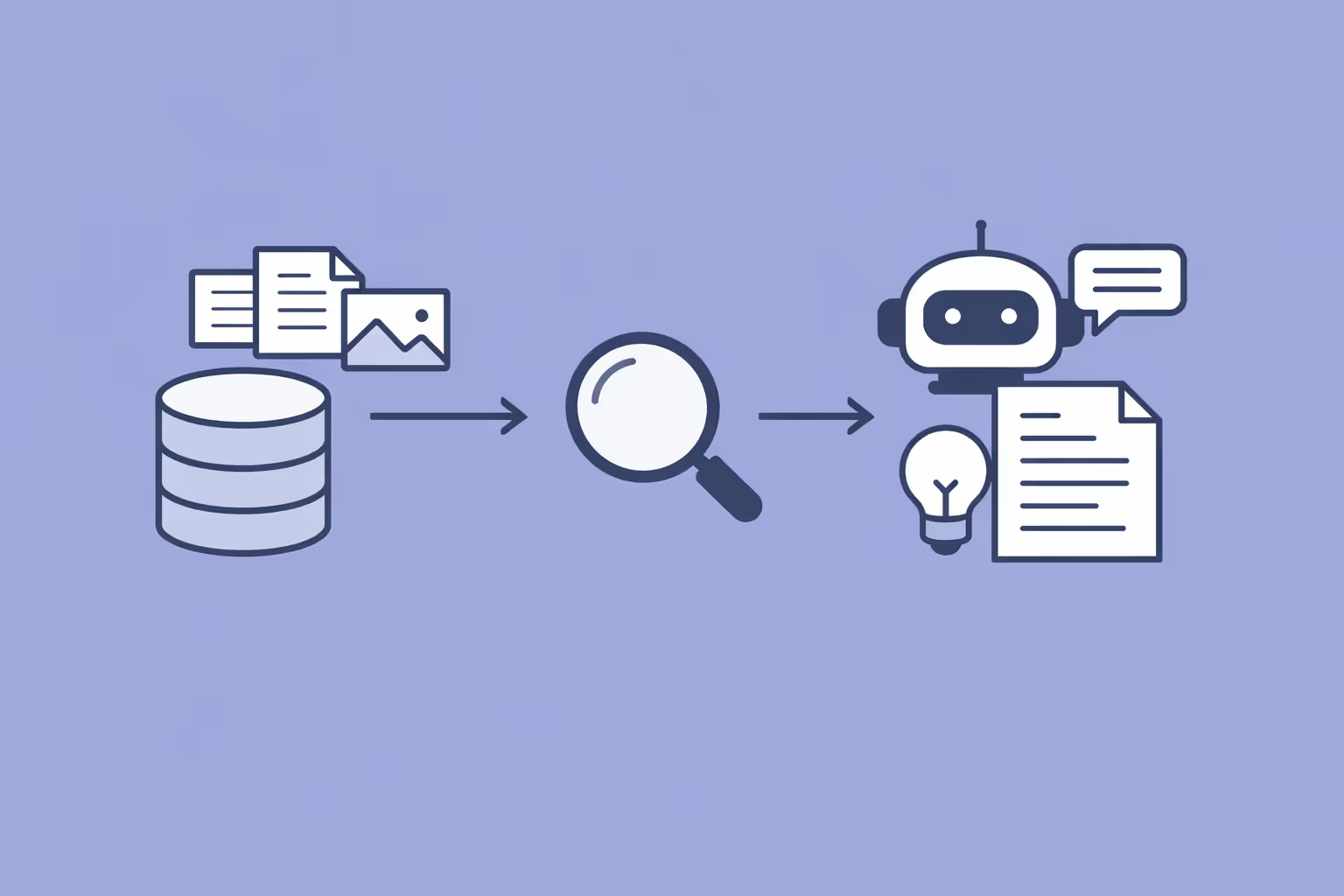
What Is Retrieval-Augmented Generation (RAG)? How It Works and Why It Matters
Retrieval-augmented generation (RAG) combines information retrieval with language model generation to produce accurate, grounded responses. Learn how RAG works, its use cases, and implementation strategies.
Language Modeling: What It Is, How It Works, and Why It Matters
Language modeling is the foundation of modern NLP. Learn how language models work, the main types, real-world use cases, and how to get started building with them.
%201.avif)
AI Watermarking: What It Is, Benefits, and Limits
Understand AI watermarking, how it works for text and images, its benefits for content authenticity, and the practical limits that affect real-world deployment.

Backpropagation Algorithm: How It Works, Why It Matters, and Practical Applications
Learn how the backpropagation algorithm trains neural networks, why it remains essential for deep learning, and where it applies in practice.
Reinforcement Learning: How It Works, Types, and Use Cases
Reinforcement learning trains AI agents through trial and error. Learn how it works, explore key types like Q-learning and policy gradient methods, and discover real-world use cases.