Home Dropout in Neural Networks: How Regularization Prevents Overfitting
Dropout in Neural Networks: How Regularization Prevents Overfitting
Learn what dropout is, how it prevents overfitting in neural networks, practical implementation guidelines, and when to use alternative regularization methods.
What Is Dropout?
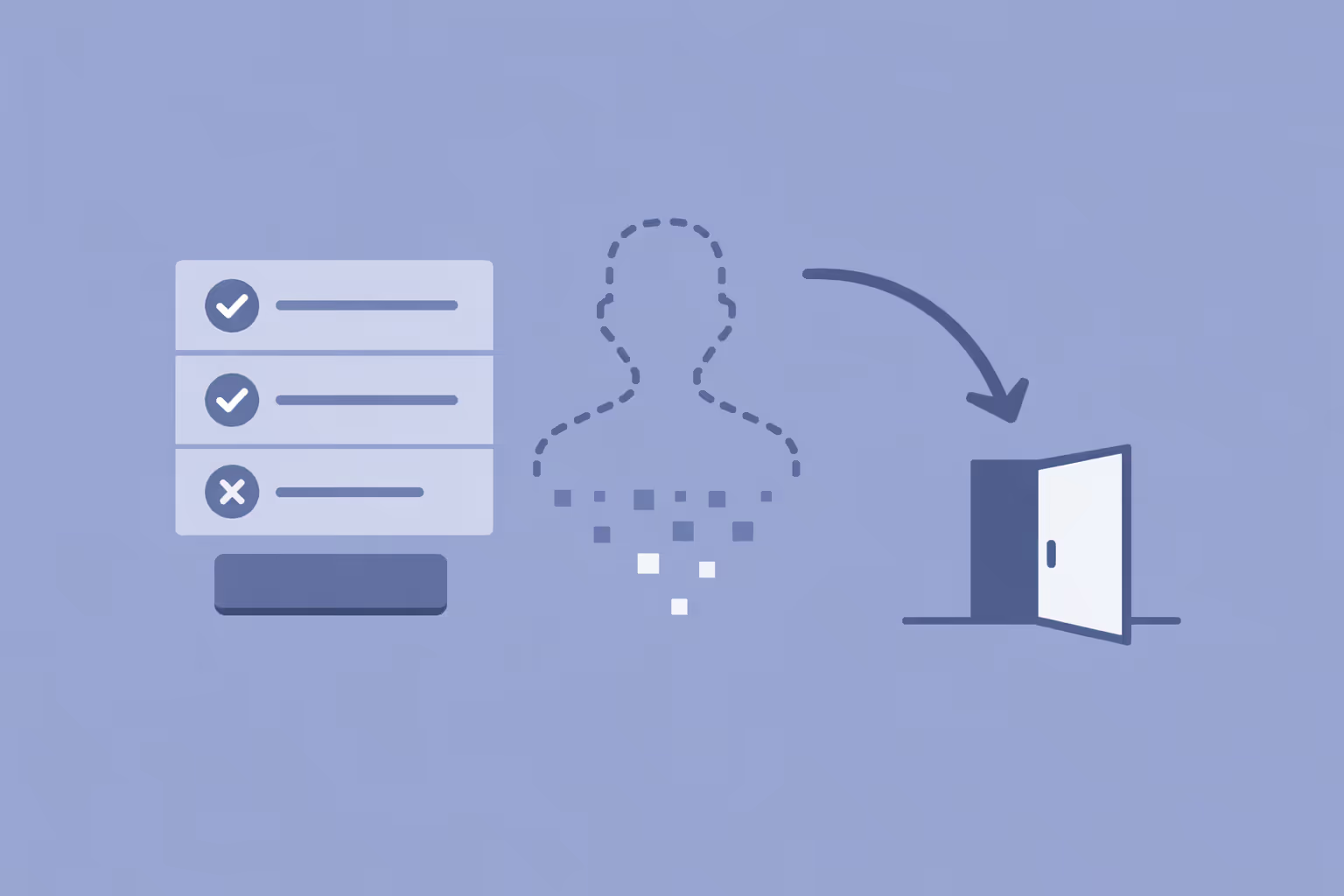
Dropout is a regularization technique for neural networks that randomly deactivates a fraction of neurons during each training step. By forcing the network to learn without relying on any single neuron or fixed combination of neurons, dropout reduces overfitting and improves the model's ability to generalize to new data.
The technique was introduced by Nitish Srivastava and colleagues in a 2014 paper published through the University of Toronto. The core insight is simple: if neurons cannot depend on specific partners being active, the network must distribute learned representations more broadly across its parameters. The result is a model that captures robust patterns rather than memorizing noise in the training set.
Dropout has since become one of the most widely adopted regularization methods in deep learning. Its popularity stems from ease of implementation, low computational overhead, and consistent effectiveness across a wide range of architectures and tasks.
How Dropout Works
The Training Phase
During training, dropout randomly sets a fraction of neuron activations to zero at each forward pass. The fraction is controlled by a single hyperparameter, typically called the dropout rate or probability p. A dropout rate of 0.5 means each neuron has a 50% chance of being temporarily removed from the network on any given training step.
Every training iteration produces a different "thinned" version of the full network. If a layer has 1,000 neurons and the dropout rate is 0.5, roughly 500 neurons participate in each forward pass, but the specific 500 change every time. Gradients flow only through active neurons during backpropagation, so inactive neurons receive no weight updates for that step.
This process creates an effect similar to training many different sub-networks simultaneously. Each sub-network sees the same data but uses a different subset of the model's capacity. The full network, once trained, represents an approximate average of all these sub-networks.
The Inference Phase
At inference time, dropout is turned off. All neurons are active for every prediction. To compensate for the increased number of active neurons compared to training, the activations are scaled by the dropout rate. If p was 0.5 during training, each neuron's output is multiplied by 0.5 at inference.
Many modern frameworks use "inverted dropout" instead, which scales activations during training rather than at inference. During training, active neurons have their outputs divided by (1 - p), so no scaling adjustment is needed at test time. The mathematical result is equivalent, but inverted dropout simplifies the inference pipeline.
A Concrete Example
Consider a fully connected layer with four neurons feeding into the next layer. Without dropout, all four contribute to every prediction. With a dropout rate of 0.25, one neuron is randomly zeroed out on each training step.
On step one, neuron 3 might be dropped. On step two, neuron 1. On step three, neurons 2 and 4. The network never relies on all four neurons being available simultaneously, which forces it to develop redundant pathways for important features.
| Component | Function | Key Detail |
|---|---|---|
| The Training Phase | During training, dropout randomly sets a fraction of neuron activations to zero at each. | The fraction is controlled by a single hyperparameter |
| The Inference Phase | At inference time, dropout is turned off. | All neurons are active for every prediction |
| A Concrete Example | Consider a fully connected layer with four neurons feeding into the next layer. | Without dropout, all four contribute to every prediction |
Why Dropout Prevents Overfitting
Breaking Co-Adaptation
Neural networks tend to develop co-adapted neurons, where specific neurons learn to work together in fixed patterns that are useful for the training data but fragile when applied to new inputs. Co-adaptation is a primary driver of overfitting because the network builds complex, brittle feature detectors instead of robust, generalizable ones.
Dropout breaks these dependencies directly. When a neuron's usual partners are randomly unavailable, it must learn features that are useful in combination with many different subsets of other neurons. The result is a network where individual neurons develop more independent, meaningful representations.
Implicit Ensemble Learning
Training with dropout is mathematically related to training an ensemble of models. A network with n neurons that can be dropped has 2^n possible sub-networks. Each training step samples one of these sub-networks, and the final model approximates the prediction of the entire ensemble.
Ensemble methods are one of the most reliable ways to improve generalization in machine learning. Training a true ensemble of separate models is expensive in both computation and memory. Dropout achieves a similar effect at a fraction of the cost, using shared weights across all sub-networks.
Encouraging Feature Redundancy
When neurons can be dropped at any time, the network cannot afford to encode critical information in a single neuron. It must distribute representations across multiple neurons, creating redundancy. If one feature detector is disabled, others capture similar information.
This redundancy is not wasted capacity. It creates a model that degrades gracefully when individual neurons produce noisy or incorrect outputs, which is precisely what happens when the model encounters data that differs from the training distribution.
Dropout in Practice
Where to Place Dropout Layers
Dropout is most commonly applied to fully connected (dense) layers, which are the most parameter-heavy parts of most architectures and therefore the most prone to overfitting. In a classification network with several dense layers followed by a softmax output, dropout is typically added after each hidden dense layer but not after the output layer.
For convolutional neural networks (CNNs), standard dropout is less common in convolutional layers because spatial features benefit from local correlations that dropout disrupts. Spatial dropout, which drops entire feature maps rather than individual activations, is better suited for convolutional architectures.
In recurrent neural networks (RNNs) and LSTMs, applying dropout naively to recurrent connections can harm the network's ability to maintain long-range dependencies. Variational dropout, which applies the same dropout mask across all time steps, addresses this by preserving the temporal structure of recurrent connections.
For transformer architectures, dropout is standard practice in attention layers and feed-forward sub-layers. Most transformer implementations apply dropout after the attention mechanism and after each feed-forward block, with typical rates between 0.1 and 0.3.
Choosing the Right Dropout Rate
The dropout rate is the most important hyperparameter to tune. Common guidelines include the following.
- Input layers. Rates of 0.1 to 0.2 are typical. Dropping too many input features removes information the network needs.
- Hidden layers. Rates of 0.2 to 0.5 are standard for fully connected layers. The original paper found 0.5 optimal for hidden units in many tasks.
- Convolutional layers. If dropout is used at all, rates of 0.1 to 0.25 are common. Higher rates tend to hurt spatial feature learning.
- Final layers before output. Rates of 0.3 to 0.5 are common, especially in large networks where the final layers have the most parameters.
Higher dropout rates provide stronger regularization but slow convergence and can underfit if set too aggressively. Lower rates offer lighter regularization that may not prevent overfitting in highly overparameterized networks.
Implementation Across Frameworks
Dropout is a standard component in all major deep learning frameworks. In PyTorch, a dropout layer is added with torch.nn.Dropout(p=0.5) and automatically handles training versus evaluation mode switching. TensorFlow and Keras provide tf.keras.layers.Dropout(rate=0.5) with the same automatic behavior.
The key implementation detail is ensuring dropout is active during training and disabled during evaluation. In PyTorch, this means calling model.train() before training loops and model.eval() before inference. Forgetting to switch modes is one of the most common bugs in neural network code and produces inconsistent or degraded predictions.
Limitations and Common Misconceptions
When Dropout Does Not Help
Dropout is not universally beneficial. Small models with limited capacity may already underfit the training data, and dropout will make underfitting worse by further restricting the effective model size. Before adding dropout, verify that the model can actually overfit the training set; if training loss is already high, the problem is capacity, not regularization.
Modern architectures with built-in regularization mechanisms, such as batch normalization, may see diminishing returns from dropout. Research has shown that combining batch normalization and dropout can sometimes produce worse results than using either technique alone, due to a variance shift between training and inference that affects batch statistics.
Dropout Does Not Replace Good Data Practices
A common misconception is that dropout can compensate for insufficient or low-quality training data. Dropout reduces overfitting by encouraging robust feature learning, but it cannot create information that is not in the data. If the training set is too small, unrepresentative, or noisy, dropout will slow down overfitting but will not produce a model that generalizes well.
Data quality and diversity remain the most important factors for model performance. Dropout is one tool in a broader regularization strategy, not a substitute for careful dataset construction.
Increased Training Time
Dropout increases the number of training iterations needed to converge. Because only a subset of neurons participates in each step, the effective learning rate per neuron is lower. Models trained with dropout typically require 2 to 3 times more epochs than the same architecture trained without it to reach comparable performance.
This tradeoff is usually acceptable because the resulting model generalizes better, but it is worth accounting for in compute budgets and experiment timelines.
The Variance Problem
Dropout introduces stochastic noise during training, which increases the variance of gradient estimates. For small batch sizes, this added noise can make training unstable. Using larger batch sizes or reducing the dropout rate can mitigate instability, but this requires additional tuning.
During inference, standard dropout (non-inverted) also introduces a discrepancy between training and test behavior. The scaling correction addresses the expected value but does not perfectly match the variance properties of the training regime. Inverted dropout reduces this discrepancy, which is why it has become the default implementation in most frameworks.
Dropout Variants and Alternatives
Variants of Dropout
Several modifications of the original dropout technique address specific architectural or performance needs.
- DropConnect. Instead of dropping neuron activations, DropConnect drops individual weight connections. This provides finer-grained regularization and can produce stronger ensembles, but is more computationally expensive.
- Spatial dropout. Designed for convolutional networks, spatial dropout drops entire feature maps rather than individual activations. This preserves spatial structure within each surviving feature map while still preventing co-adaptation across channels.
- Variational dropout. Applies the same dropout mask across time steps in recurrent networks. This preserves the temporal structure of hidden states while still regularizing the recurrent connections.
- Concrete dropout. Learns the optimal dropout rate during training rather than requiring manual tuning. The dropout probability is treated as a learnable parameter, optimized jointly with network weights using a continuous relaxation of the discrete drop/keep decision.
- Alpha dropout. Designed specifically for self-normalizing neural networks (those using SELU activation functions), alpha dropout maintains the mean and variance properties that SELU depends on, unlike standard dropout which disrupts them.
Alternative Regularization Techniques
Dropout is one of several regularization approaches available for neural networks. Each addresses overfitting through a different mechanism.
- L2 regularization (weight decay). Adds a penalty proportional to the squared magnitude of weights to the loss function. This encourages smaller weights and smoother decision boundaries. Unlike dropout, L2 regularization is deterministic and does not introduce stochastic noise during training.
- L1 regularization. Penalizes the absolute magnitude of weights, encouraging sparsity. Some weights are driven to exactly zero, effectively removing connections from the network. L1 regularization produces simpler models but can be harder to optimize than L2.
- Batch normalization. Normalizes layer inputs to have zero mean and unit variance, then applies learned scale and shift parameters. Batch normalization has a mild regularizing effect because the normalization depends on mini-batch statistics, introducing noise similar to dropout. In practice, networks using batch normalization often need less or no dropout.
- Early stopping. Monitors validation performance during training and stops when performance begins to degrade. Early stopping does not modify the model architecture or training procedure; it simply limits the number of optimization steps to avoid overfitting the training set.
- Data augmentation. Increases the effective size and diversity of the training set by applying transformations to existing data. For image classification tasks, this includes rotations, flips, color adjustments, and crops. Data augmentation addresses overfitting at the data level rather than the model level, and is often used alongside dropout.
When to Choose Dropout Over Alternatives
Dropout is strongest when the network has large fully connected layers with high parameter counts, when the training set is moderate in size relative to model capacity, and when the architecture does not already include strong built-in regularization like batch normalization.
For convolutional architectures used in vision tasks, batch normalization combined with data augmentation often provides sufficient regularization without dropout. For transformer-based language models, dropout remains a standard component, applied in attention and feed-forward layers.
The best approach is usually empirical: train the model with and without dropout, compare validation performance, and select the configuration that produces the best tradeoff between training fit and generalization.
Frequently Asked Questions
What is the difference between dropout and L2 regularization?
Dropout randomly disables neurons during training, forcing the network to develop redundant feature representations. L2 regularization adds a penalty to the loss function that discourages large weights. Both reduce overfitting but through different mechanisms. Dropout creates an implicit ensemble effect by training many sub-networks. L2 regularization smooths the model's decision boundaries by keeping weights small. They can be combined, and often are in practice, to provide complementary regularization.
Can dropout be used with batch normalization?
Yes, but the interaction requires careful handling. Batch normalization computes statistics from mini-batches during training, and dropout changes the distribution of activations that batch normalization normalizes. Placing dropout after batch normalization rather than before tends to produce more stable results.
Some architectures achieve better performance by using batch normalization without dropout, particularly in convolutional networks for vision tasks.
What dropout rate should I start with?
A dropout rate of 0.5 for hidden layers and 0.2 for input layers is a reasonable starting point for fully connected networks, based on the original research. For convolutional layers, start lower, around 0.1 to 0.2. For transformer models, 0.1 is a common default. Treat the dropout rate as a hyperparameter and tune it based on the gap between training and validation performance. A large gap suggests increasing the rate; training that fails to converge suggests decreasing it.
Does dropout work at inference time?
No. Dropout is applied only during training. At inference time, all neurons are active, and their outputs are scaled to account for the difference. In modern implementations using inverted dropout, the scaling happens during training, so inference requires no adjustment. This distinction between training and inference behavior is critical to implement correctly; leaving dropout active during inference produces noisy, suboptimal predictions.
Why does dropout slow down training convergence?
Dropout reduces the effective capacity of the network on each training step because only a fraction of neurons participate. Fewer active neurons means less gradient signal per step, which slows the rate at which the network learns. The model typically needs more epochs to reach the same training loss compared to an identical architecture without dropout.
The tradeoff is worthwhile because the converged model generalizes better, but practitioners should plan for longer training schedules when using aggressive dropout rates.
Further reading
%201.avif)
AI Prompt Engineer: Role, Skills, and Salary
AI prompt engineer role explained: daily responsibilities, core skills, salary ranges, career paths, and how organizations hire for this emerging position.
What Is Lemmatization? Definition, Process, and NLP Applications
Learn what lemmatization is, how it reduces words to their dictionary form, how it differs from stemming, and why it matters for NLP, search, and machine learning.
Decision Tree: Definition, How It Works, and ML Examples
A decision tree splits data through a sequence of rules to reach a prediction. Learn how it works, key algorithms, and real machine learning examples.

What Is Natural Language Understanding? Definition, How It Works, and Use Cases
Learn what natural language understanding (NLU) is, how it works, and where it applies. Explore the difference between NLU, NLP, and NLG, plus real use cases and how to get started.

AgentOps: Tools and Practices for Managing AI Agents in Production
Learn what AgentOps is, why it matters for AI agent deployments, the core components of observability, cost tracking, and governance, and how to implement AgentOps in your organization.

What Is Cognitive Modeling? Definition, Examples, and Practical Guide
Cognitive modeling uses computational methods to simulate human thought. Learn key approaches, architectures like ACT-R and Soar, and real-world applications.