Home Diffusion Models: How They Work, Types, and Use Cases
Diffusion Models: How They Work, Types, and Use Cases
Learn how diffusion models generate images, audio, and video by adding and removing noise. Explore types, use cases, and practical guidance.
What Are Diffusion Models?
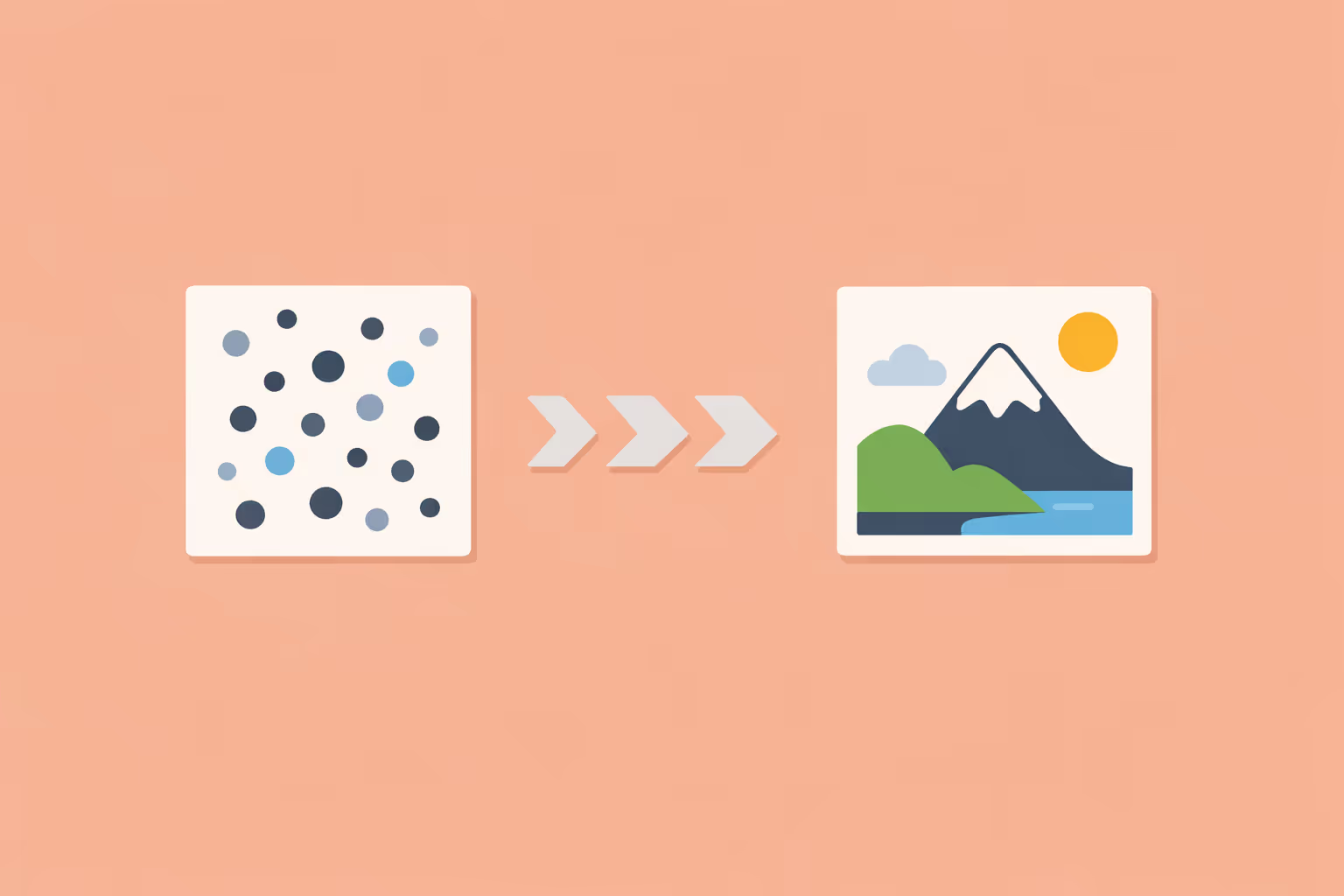
Diffusion models are a class of generative AI models that learn to create data by reversing a gradual noising process. The core idea is straightforward: take a training sample (an image, for example), progressively add random noise until the sample becomes pure static, then train a neural network to reverse each step of that corruption. Once trained, the model can start from random noise and iteratively denoise it into a coherent, high-quality output.
The name comes from thermodynamic diffusion, the physical process by which particles spread from areas of high concentration to low concentration until they reach equilibrium. In the machine learning context, "diffusion" refers to the systematic destruction of structure in data through noise injection. The generative process runs this destruction in reverse, reconstructing structure from chaos one small step at a time.
Diffusion models belong to the broader family of generative AI systems, alongside variational autoencoders (VAEs), generative adversarial networks (GANs), and autoregressive models. What distinguishes them is the noise-based generation mechanism.
Rather than generating output in a single forward pass or building it token by token, diffusion models refine the output over many small denoising steps, gradually sharpening a blurry, noisy approximation into a detailed final result.
This iterative refinement process gives diffusion models a stability advantage during training. GANs, for instance, require balancing two competing neural networks (a generator and a discriminator), which often leads to training instability and mode collapse. Diffusion models avoid this adversarial dynamic entirely, making them more reliable to train at scale.
How Diffusion Models Work
The Forward Process: Adding Noise
The forward process is the first half of the diffusion pipeline. It takes a clean data sample and progressively adds Gaussian noise across a fixed number of timesteps, often hundreds or thousands. At each step, a small amount of noise is blended into the sample according to a predefined schedule.
By the final timestep, the original data is completely destroyed. What remains is indistinguishable from pure random noise sampled from a standard normal distribution. The forward process requires no learning. It is a deterministic (or near-deterministic) corruption procedure defined by a variance schedule that controls how much noise is added at each step.
The variance schedule matters because it determines the pace of destruction. A linear schedule adds noise at a constant rate. A cosine schedule front-loads the informative timesteps, preserving more structure in the early steps and accelerating noise addition later. The choice of schedule affects training efficiency and the quality of generated outputs.
The Reverse Process: Removing Noise
The reverse process is where learning happens. A neural network, typically a U-Net or a transformer-based architecture, is trained to predict the noise that was added at each step and subtract it. Starting from pure noise, the model applies this learned denoising operation repeatedly, one timestep at a time, gradually recovering a clean data sample.
At each reverse step, the model takes the current noisy sample and the timestep as input and predicts the noise component. Subtracting the predicted noise yields a slightly cleaner version of the sample. After repeating this operation across all timesteps (or a subset, using accelerated sampling), the output converges to a sample that resembles the training distribution.
The reverse process can be understood as a learned traversal through the space of possible data. Each denoising step pulls the sample closer to the manifold of real data, correcting noise-induced deviations. This gradual correction is what enables diffusion models to produce outputs with fine detail and global coherence.
The Training Objective
Training a diffusion model is conceptually simple. For each training example, the model selects a random timestep, applies the corresponding amount of noise, then learns to predict that noise. The loss function is typically a mean squared error between the predicted noise and the actual noise that was added.
This approach, formalized in the Denoising Diffusion Probabilistic Model (DDPM) framework, simplifies what would otherwise be a complex variational inference problem into a straightforward regression task. The model does not need to generate full images during training. It only needs to learn the noise prediction at individual timesteps, which is computationally manageable.
The simplicity of this training objective is a major reason diffusion models have scaled so effectively. Teams building AI competency in deep learning often find diffusion training pipelines more accessible than GAN training, which requires careful hyperparameter tuning to maintain equilibrium between generator and discriminator.
Conditioning and Guided Generation
Unconditional diffusion models generate samples that match the overall training distribution. Conditional diffusion models accept additional input, such as a text prompt, class label, or reference image, and steer the generation process accordingly.
Classifier-free guidance is the most widely used conditioning technique. During training, the model learns both conditional and unconditional generation by randomly dropping the conditioning signal for some training examples. At inference time, the model interpolates between the conditional and unconditional predictions, with a guidance scale parameter that controls how strongly the output should match the conditioning input.
Higher guidance scale values produce outputs that align closely with the prompt but may sacrifice diversity and naturalness. Lower values allow more creative variation but weaker prompt adherence. Finding the right balance is a practical tuning challenge that depends on the specific application and the expectations of the end user.
Why Diffusion Models Matter
Diffusion models have become the dominant architecture for high-quality generative tasks, especially in image synthesis. Their significance stems from three practical factors.
First, they produce outputs with exceptional visual quality. Compared to GANs, which can produce artifacts and struggle with certain data distributions, diffusion models consistently generate detailed, coherent images across a wide range of subjects and styles. The iterative refinement process allows the model to correct errors progressively, resulting in outputs that hold up under close inspection.
Second, diffusion models offer better training stability than adversarial approaches. GAN training is notoriously difficult to stabilize, often requiring careful architectural choices, learning rate schedules, and regularization techniques. Diffusion models train with a simple noise-prediction loss, reducing the engineering overhead required to achieve strong results.
This stability has enabled researchers and engineering teams to scale diffusion models to very large parameter counts and training datasets without the failure modes common in GAN training.
Third, diffusion models support flexible conditioning. The same architecture can be conditioned on text, images, depth maps, segmentation masks, or combinations of these inputs. This composability makes diffusion models useful across a broad range of types of AI applications, from text-to-image generation to video synthesis, 3D asset creation, and scientific simulation.
The practical impact is visible in products and workflows already in use. Text-to-image tools built on diffusion architectures are reshaping creative production, marketing, and product design. Organizations exploring AI-powered content creation are encountering diffusion models as the engine behind the tools they evaluate.
Types of Diffusion Models
Denoising Diffusion Probabilistic Models (DDPMs)
DDPMs are the foundational architecture that established the diffusion paradigm. Introduced by Ho, Jain, and Abbeel, DDPMs formalize the forward and reverse processes using a Markov chain of Gaussian transitions. The forward process adds noise according to a fixed schedule, and the reverse process learns to undo each step.
DDPMs demonstrated that iterative denoising could produce image quality competitive with GANs while avoiding adversarial training dynamics. The trade-off was speed: generating a single image required hundreds or thousands of denoising steps, making inference significantly slower than a single forward pass through a GAN generator.
Score-Based Generative Models
Score-based models take a complementary theoretical approach. Instead of modeling the forward and reverse processes as discrete Markov chains, they frame generation as solving a stochastic differential equation (SDE). The model learns the "score function," the gradient of the log-probability of the data at different noise levels, and uses this score to guide the denoising trajectory.
Song and Ermon's work on score matching unified DDPMs and score-based models under a common framework, showing that both approaches are different perspectives on the same underlying mathematics. This unification opened the door to more efficient sampling algorithms and better theoretical understanding of why diffusion generation works.
Latent Diffusion Models
Latent diffusion models (LDMs) address the computational cost of running the diffusion process in pixel space. Instead of operating directly on high-resolution images, LDMs first compress the image into a lower-dimensional latent representation using a pretrained autoencoder. The diffusion process then operates in this compact latent space, where each denoising step is much cheaper.
Stable Diffusion, one of the most widely deployed generative image models, is a latent diffusion model. By shifting the diffusion process to latent space, LDMs made high-resolution image generation feasible on consumer hardware, dramatically expanding access to diffusion-based generation. The autoencoder handles the compression and reconstruction, while the diffusion model handles the creative generation in the latent space.
This architecture has practical implications for teams evaluating AI tools for content production. Latent diffusion models run faster and require less memory than pixel-space models, making them viable for integration into production workflows where speed and cost matter.
Consistency Models
Consistency models, proposed by Song and colleagues, aim to solve the slow inference problem directly. Instead of requiring many sequential denoising steps, consistency models learn to map any point along the diffusion trajectory directly to the final clean output in a single step or a small number of steps.
The training process enforces a consistency constraint: any two points on the same diffusion trajectory should map to the same final output. This allows the model to "shortcut" the standard multi-step process, producing results in one or two steps rather than hundreds. The quality trade-off is minimal for many applications, making consistency models an active area of research for real-time generation scenarios.
| Type | Description | Best For |
|---|---|---|
| Denoising Diffusion Probabilistic Models (DDPMs) | DDPMs are the foundational architecture that established the diffusion paradigm. | Introduced by Ho, Jain, and Abbeel |
| Score-Based Generative Models | Score-based models take a complementary theoretical approach. | — |
| Latent Diffusion Models | Latent diffusion models (LDMs) address the computational cost of running the diffusion. | Instead of operating directly on high-resolution images |
| Consistency Models | Consistency models, proposed by Song and colleagues. | Instead of requiring many sequential denoising steps |
Diffusion Models in Practice: Use Cases
Text-to-Image Generation
The most visible application of diffusion models is text-to-image generation. Models like Stable Diffusion, DALL-E, and Midjourney accept natural language descriptions and produce corresponding images. The diffusion model serves as the generative backbone, while a text encoder (typically a transformer-based language model) converts the prompt into a conditioning signal that guides the denoising process.
This capability has practical uses across creative industries, marketing, product design, and education. Course creators generating visual learning materials can produce illustrations and diagrams without commissioning custom artwork. Design teams can prototype visual concepts rapidly, compressing weeks of iteration into hours.
Image Editing and Inpainting
Diffusion models excel at targeted image editing. Inpainting allows a user to mask a region of an existing image and have the model regenerate only that region, filling it with content that is consistent with the surrounding context. The diffusion process runs on the masked area while keeping the unmasked pixels fixed, producing edits that blend naturally.
Beyond inpainting, diffusion models support style transfer, resolution enhancement (super-resolution), and image-to-image translation. These capabilities make them useful in professional photography, film post-production, and graphic design workflows where precise control over specific image regions is required.
Video and Motion Generation
Extending diffusion models to video requires generating temporally consistent sequences of frames. Models like Runway's Gen-2 and Stability AI's Stable Video Diffusion apply the diffusion process across both spatial and temporal dimensions, producing short video clips from text prompts or reference images.
The challenge with video generation is maintaining coherence across frames. A character's appearance, lighting conditions, and scene geometry must remain consistent as the video progresses. Current video diffusion models use temporal attention mechanisms and frame-conditioning strategies to enforce this consistency, though the results still exhibit visible artifacts in longer sequences.
Audio and Music Synthesis
Diffusion models have been applied to audio generation with strong results. Models like AudioLDM and Riffusion use diffusion architectures to generate speech, sound effects, and music from text descriptions. The approach typically operates on spectrograms (visual representations of audio frequency content over time), then converts the generated spectrogram back to a waveform.
Audio diffusion models are relevant to education technology teams exploring automated narration, podcast production, and multilingual audio content. The ability to generate natural-sounding speech from text, combined with voice cloning and style control, opens practical workflows for organizations producing training content at scale.
Drug Discovery and Molecular Design
Outside of media generation, diffusion models have found important applications in computational biology. Protein structure prediction and molecular generation benefit from the ability of diffusion models to navigate complex, high-dimensional spaces while maintaining structural validity.
Models like RFdiffusion generate novel protein structures by running a diffusion process over three-dimensional coordinates. The model learns the distribution of valid protein geometries and can generate new structures that satisfy specific functional constraints. This application demonstrates that the diffusion framework extends well beyond images and audio to any domain where the goal is to generate structured data from a learned distribution.
3D Asset Generation
Diffusion models are increasingly used to generate three-dimensional objects and scenes. Models like Point-E and Shap-E generate 3D point clouds or implicit representations from text descriptions. These 3D assets can be used in gaming, virtual reality, architecture visualization, and product prototyping.
The extension to 3D is technically challenging because three-dimensional data is more complex than two-dimensional images. Representing 3D geometry requires choices about data format (meshes, point clouds, neural radiance fields), and the diffusion process must respect the spatial structure of three-dimensional space. Despite these challenges, 3D diffusion models are progressing rapidly and beginning to produce results usable in production pipelines.
Limitations and Challenges
Inference Speed
The most frequently cited limitation of diffusion models is slow inference. Standard DDPM sampling requires hundreds of sequential denoising steps, each involving a full forward pass through the neural network. This makes generation significantly slower than single-pass methods like GANs.
Researchers have developed several strategies to accelerate sampling: DDIM (Denoising Diffusion Implicit Models) reduces the number of required steps by reformulating the reverse process as a deterministic mapping. Distillation techniques train smaller, faster models to approximate the output of the full multi-step process. Consistency models aim to achieve single-step generation.
Despite this progress, the speed gap between diffusion models and single-pass generators remains a practical concern for real-time applications.
Computational Cost
Training diffusion models at scale requires substantial compute resources. Large models like Stable Diffusion XL train on thousands of GPUs for weeks, consuming significant energy and hardware budgets. The data fluency required to manage and prepare the massive datasets used in training adds further operational complexity.
Inference cost is also non-trivial. Each generation request requires multiple sequential forward passes, which consumes more memory and compute time than single-pass generation. For applications serving high request volumes, the infrastructure cost of running diffusion models at scale must be carefully weighed against alternatives.
Control and Precision
While diffusion models accept conditioning signals, achieving precise control over specific output attributes remains difficult. A text prompt like "a red car parked in front of a Victorian house" may produce an image where the car is the wrong shade of red, the house style is approximate, or spatial relationships are imprecise.
Improving fine-grained control is an active research area. Techniques like ControlNet add structural conditioning (edge maps, depth maps, pose skeletons) to give users more precise spatial control. Attention manipulation methods allow users to adjust the influence of specific words in a prompt. These advances are closing the gap, but precise, reliable control over every aspect of the output is not yet fully solved.
Training Data and Bias
Diffusion models learn from their training data, and any biases present in that data are reflected in the generated outputs. If the training set overrepresents certain demographics, art styles, or content types, the model's outputs will skew accordingly. This raises ethical considerations around representation, copyright, and the potential for generating harmful content.
Organizations deploying diffusion models in production need robust content filtering, output moderation, and governance frameworks to manage these risks. Responsible deployment requires ongoing monitoring and adjustment, not just a one-time configuration.
How to Get Started with Diffusion Models
Getting started with diffusion models depends on whether the goal is to use existing models or build custom ones.
For practitioners who want to apply diffusion models to their work without training from scratch, the most accessible path is through pretrained models and inference APIs. Stable Diffusion is available as an open-source model with active community support, extensive documentation, and integration libraries for Python. Hugging Face's Diffusers library provides a standardized interface for loading, configuring, and running pretrained diffusion models with minimal code.
For teams that need custom models, the starting point is understanding the DDPM training loop. The process involves preparing a dataset, defining a noise schedule, building a U-Net architecture, and training the model to predict noise at random timesteps. Frameworks like PyTorch and JAX provide the necessary primitives, and reference implementations are widely available.
Key practical considerations include:
- Hardware requirements. Fine-tuning a pretrained diffusion model requires at least one modern GPU with 16 GB or more of VRAM. Training from scratch on large datasets requires multi-GPU clusters.
- Dataset preparation. The quality and diversity of training data directly determine the quality of generated outputs. Data cleaning, deduplication, and caption quality matter significantly.
- Evaluation. Measuring the quality of generative outputs is not straightforward. Metrics like FID (Frechet Inception Distance) and CLIP score provide quantitative benchmarks, but human evaluation remains essential for assessing subjective quality.
- Ethical review. Before deploying any generative model, teams should assess potential harms, implement content filters, and establish clear usage policies.
Building organizational capability around generative AI is an investment that benefits from structured learning and development programs. Teams that combine hands-on experimentation with systematic study of the underlying theory develop stronger intuition for when and how to apply diffusion models effectively.
FAQ
How are diffusion models different from GANs?
Diffusion models and GANs are both generative architectures, but they work very differently. GANs use two competing networks, a generator and a discriminator, trained in an adversarial loop. Diffusion models use a single network trained to reverse a noise-adding process. The key practical difference is stability: GANs are prone to training collapse and mode dropping, while diffusion models train reliably with a simple noise-prediction loss.
Diffusion models typically produce higher-quality and more diverse outputs, but they are slower at inference because they require multiple denoising steps.
What is latent diffusion and why does it matter?
Latent diffusion runs the denoising process in a compressed representation space rather than directly on pixels. A pretrained autoencoder compresses the image into a smaller latent code, the diffusion model operates on that code, and the autoencoder decodes the result back to pixel space. This approach reduces computational cost dramatically, making high-resolution image generation feasible on hardware that could not handle pixel-space diffusion. Stable Diffusion is the most prominent example of a latent diffusion model.
Can diffusion models generate text?
Diffusion models were originally designed for continuous data like images and audio, where the gradual addition and removal of noise maps naturally to the data structure. Applying diffusion to discrete text is less intuitive, because small perturbations to discrete tokens do not produce meaningful intermediate states the way noise in pixel space does.
Recent research has explored continuous diffusion approaches to text generation, but autoregressive models remain the dominant architecture for language generation tasks.
Are diffusion models expensive to run?
Yes, relative to single-pass generators. Standard diffusion sampling requires dozens to hundreds of sequential forward passes through the neural network, which consumes more compute time and energy than a single forward pass through a GAN or VAE decoder. Accelerated sampling methods (DDIM, consistency models, distillation) reduce this cost significantly, but diffusion inference remains more expensive than alternatives for high-throughput applications.
The trade-off is that diffusion models typically produce higher-quality outputs with better diversity.
Further reading

AI Accelerator: Types, Examples, and Workloads
AI accelerator hardware explained: learn the types (GPUs, TPUs, FPGAs, ASICs, NPUs), key workloads, real-world examples, and how to choose the right one.

Backpropagation Algorithm: How It Works, Why It Matters, and Practical Applications
Learn how the backpropagation algorithm trains neural networks, why it remains essential for deep learning, and where it applies in practice.

Inception Score (IS): What It Is, How It Works, and Why It Matters
Learn what the Inception Score is, how it evaluates generative models, and why it remains a foundational metric for measuring image quality and diversity in AI.
Generative Adversarial Network (GAN): How It Works, Types, and Use Cases
Learn what a generative adversarial network is, how the generator and discriminator work together, explore GAN types, real-world use cases, and how to get started.

What Is Cognitive Modeling? Definition, Examples, and Practical Guide
Cognitive modeling uses computational methods to simulate human thought. Learn key approaches, architectures like ACT-R and Soar, and real-world applications.

Chain-of-Thought Prompting (CoT): Definition, Examples, and Practical Guide
Chain-of-thought prompting explained: learn what CoT is, how it works, see practical examples, and master techniques for improving AI reasoning step by step.