Home Deep Learning Explained: How It Works and Real-World Use Cases
Deep Learning Explained: How It Works and Real-World Use Cases
Deep learning uses layered neural networks to learn from data. Explore how it works, key architectures, practical use cases, and how to get started.
What Is Deep Learning?
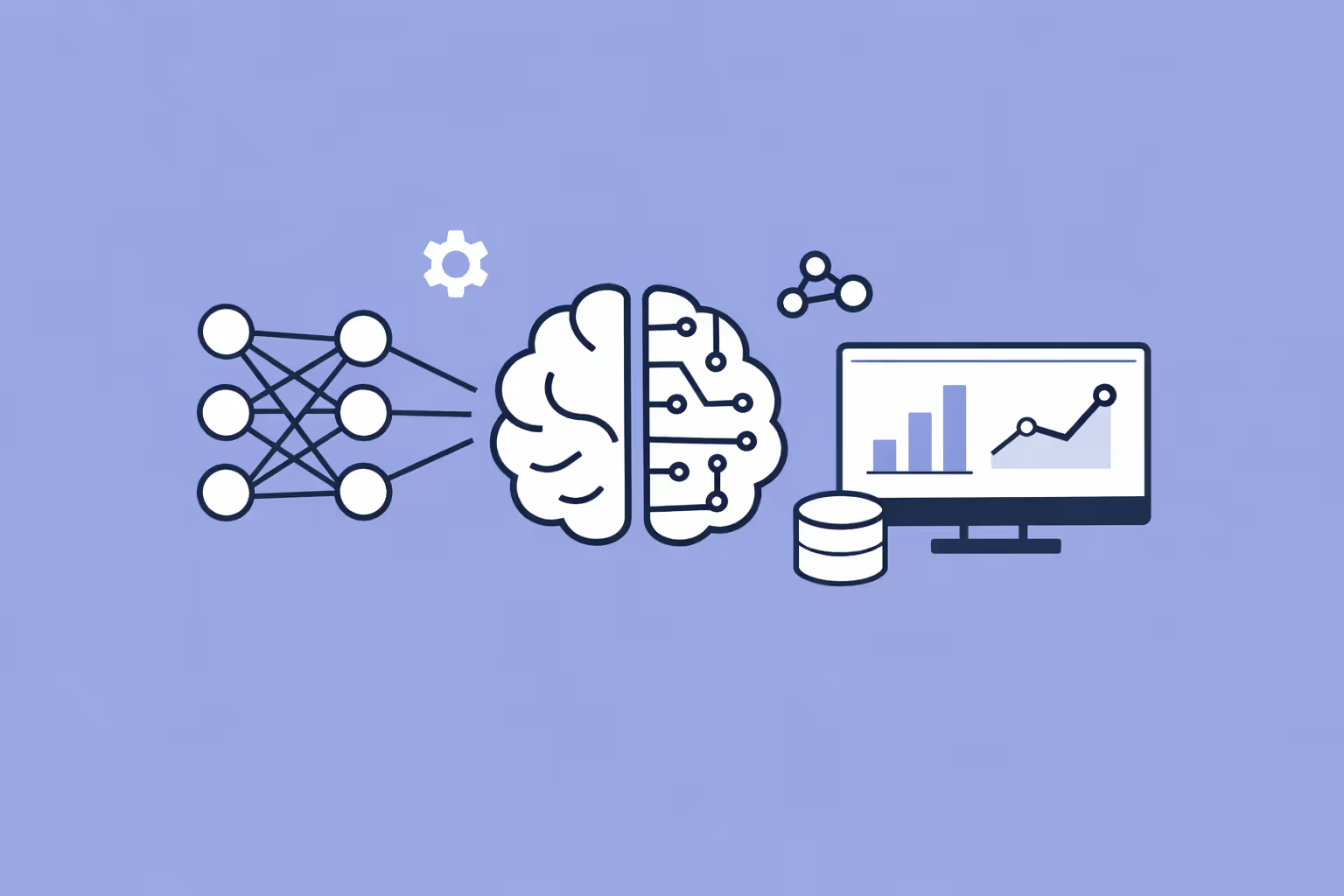
Deep learning is a subset of machine learning that uses artificial neural networks with multiple layers to model complex patterns in data. Unlike traditional algorithms that rely on hand-crafted features, deep learning systems learn hierarchical representations directly from raw input, extracting increasingly abstract features at each layer.
A deep neural network might process an image by detecting edges in the first layer, combining those edges into shapes in the second, and recognizing full objects by the final layer. This layered abstraction is what makes the approach powerful for tasks where the relationship between input and output is too complex for manual engineering.
The term "deep" refers to the number of hidden layers in the network. A model with two or three layers is considered shallow. Models with dozens or even hundreds of layers qualify as deep. The depth allows the network to learn representations that would be impossible to specify manually, which is why deep learning has become the dominant approach in image recognition, natural language processing, and speech synthesis.
How Deep Learning Works
Neurons, Layers, and Activation Functions
A deep neural network is organized into layers of interconnected nodes called neurons. Each neuron receives input, applies a mathematical transformation, and passes the result to the next layer. The three fundamental layer types are the input layer, which receives raw data; hidden layers, which perform computations; and the output layer, which produces the final prediction.
Each connection between neurons carries a weight, a numerical value that determines how much influence one neuron has on another. The network also applies an activation function at each neuron to introduce non-linearity. Without activation functions, stacking multiple layers would be mathematically equivalent to a single layer, regardless of depth. Common activation functions include ReLU (Rectified Linear Unit), sigmoid, and tanh.
Forward Propagation and Loss Calculation
During forward propagation, data flows from the input layer through every hidden layer to the output. At each step, the network multiplies inputs by their weights, adds a bias term, and applies the activation function. The output layer produces a prediction, which is then compared to the actual target value using a loss function.
The loss function quantifies how far the prediction is from the correct answer. For classification tasks, cross-entropy loss is standard. For regression tasks, mean squared error is typical. The goal of training is to minimize this loss across the entire dataset.
Backpropagation and Gradient Descent
Backpropagation is the algorithm that makes training deep networks feasible. After calculating the loss, the network propagates the error backward through each layer using the chain rule of calculus. This process computes the gradient of the loss with respect to every weight in the network.
Gradient descent then updates each weight by a small step in the direction that reduces the loss. The size of this step is controlled by the learning rate, a hyperparameter that requires careful tuning. Too large a learning rate causes the network to overshoot optimal values. Too small, and training stalls.
Modern training relies on variants like stochastic gradient descent (SGD), Adam, and RMSprop, which adapt the learning rate during training and converge faster than basic gradient descent. Training typically proceeds over many epochs, with each epoch representing one complete pass through the dataset.
Deep Learning vs. Machine Learning
Deep learning and traditional machine learning solve the same fundamental problem: learning patterns from data to make predictions. The difference lies in how they approach feature extraction and what kinds of problems they handle well.
Traditional machine learning algorithms, such as decision trees, support vector machines, and logistic regression, require feature engineering. A data scientist must decide which aspects of the raw data are relevant and transform them into a structured format the algorithm can process. For tabular data with well-understood features, these methods remain effective and often outperform deep learning with less computational cost.
Deep learning eliminates manual feature engineering by learning features automatically from raw data. This makes it the preferred approach for unstructured data like images, audio, and text, where defining useful features manually is impractical.
The trade-off is clear. Deep learning requires substantially more training data and computational power. A gradient-boosted decision tree can train on a laptop with thousands of examples. A large neural network may need millions of examples and GPU clusters. For small datasets or problems with well-defined features, traditional machine learning is often the better choice.
Understanding the broader landscape of types of AI helps practitioners decide when deep learning is warranted and when simpler methods suffice.
Common Deep Learning Architectures
Convolutional Neural Networks (CNNs)
CNNs are designed for grid-structured data, primarily images and video. They use convolutional layers that apply small filters across the input to detect local patterns like edges, textures, and shapes. Pooling layers then reduce the spatial dimensions while preserving the most important features.
The key advantage of CNNs is parameter sharing. Instead of learning separate weights for every pixel, a single filter scans the entire image. This dramatically reduces the number of parameters compared to a fully connected network and makes CNNs robust to spatial translations, meaning they can recognize an object regardless of where it appears in the image.
CNNs power applications from medical imaging diagnostics to autonomous vehicle perception systems. Architectures like ResNet, VGG, and EfficientNet have pushed image classification accuracy beyond human performance on standardized benchmarks.
Recurrent Neural Networks (RNNs) and LSTMs
RNNs process sequential data by maintaining a hidden state that carries information from previous time steps. This makes them suitable for tasks where order matters, such as time series forecasting, speech recognition, and language modeling.
Standard RNNs struggle with long sequences because gradients either vanish or explode during backpropagation through time. Long Short-Term Memory (LSTM) networks solve this with gating mechanisms that control what information to remember, forget, or output at each step. Gated Recurrent Units (GRUs) offer a simplified alternative with comparable performance.
While LSTMs remain relevant in certain domains, Transformer-based architectures have largely replaced them for natural language tasks due to superior parallelization and long-range dependency handling.
Transformers
Transformers represent the most significant architectural shift in deep learning over the past several years. Introduced in the "Attention Is All You Need" paper, they replace recurrence with self-attention mechanisms that weigh the importance of every element in a sequence relative to every other element.
Self-attention allows Transformers to capture long-range dependencies without the sequential processing bottleneck of RNNs. This enables massive parallelization during training, which is why Transformers scale effectively to billions of parameters.
The BERT model demonstrated that pre-training a Transformer on large text corpora produces representations that transfer well to downstream tasks. GPT-series models showed that scaling Transformers to enormous sizes produces emergent capabilities in text generation, reasoning, and code synthesis. The distinction between generative AI and predictive AI is rooted in how these architectures are trained and deployed.
Transformers have expanded beyond language into vision (Vision Transformers), audio, protein structure prediction, and multimodal applications that process text and images simultaneously.
Generative Adversarial Networks (GANs)
GANs consist of two networks trained in opposition. A generator creates synthetic data, while a discriminator evaluates whether samples are real or generated. Through this adversarial process, the generator improves until its outputs are indistinguishable from real data.
GANs have proven effective for image synthesis, style transfer, data augmentation, and super-resolution. They also introduce unique training challenges, including mode collapse (where the generator produces limited variety) and training instability that requires careful architectural and hyperparameter choices.
| Type | Description | Best For |
|---|---|---|
| Convolutional Neural Networks (CNNs) | CNNs are designed for grid-structured data, primarily images and video. | Grid-structured data, primarily images and video |
| Recurrent Neural Networks (RNNs) and LSTMs | RNNs process sequential data by maintaining a hidden state that carries information from. | Time series forecasting, speech recognition, and language modeling |
| Transformers | Transformers represent the most significant architectural shift in deep learning over the. | Introduced in the "Attention Is All You Need" paper |
| Generative Adversarial Networks (GANs) | GANs consist of two networks trained in opposition. | Mode collapse (where the generator produces limited variety) |
Real-World Use Cases
Healthcare and Medical Imaging
Deep learning has transformed diagnostic imaging. CNNs trained on labeled medical scans can detect conditions like diabetic retinopathy, lung nodules, and skin cancer with accuracy comparable to specialist physicians. These systems do not replace clinicians, but they serve as a second pair of eyes that can flag cases requiring urgent attention, particularly in settings with limited specialist access.
Beyond imaging, deep learning accelerates drug discovery by predicting molecular interactions, identifying candidate compounds, and modeling protein folding. DeepMind's AlphaFold demonstrated that neural networks can predict three-dimensional protein structures with experimental-level accuracy, a problem that had resisted conventional computational approaches for decades.
Natural Language Processing
Natural language processing (NLP) is one of the most visible applications of deep learning. Transformer-based models power machine translation, text summarization, sentiment analysis, and conversational AI agents in education. These systems process language at a scale and fluency that was not feasible with earlier approaches.
Pre-trained language models have also changed how organizations approach text-heavy workflows. Legal teams use them for contract analysis. Support teams deploy them for ticket classification and routing. Research teams apply them to literature reviews that would take weeks to complete manually.
Organizations investing in AI adaptive learning rely on NLP models to personalize content delivery based on learner behavior and comprehension signals.
Autonomous Systems
Self-driving vehicles depend on deep learning for perception, combining CNNs for object detection with recurrent or Transformer-based networks for trajectory prediction. The system must process camera feeds, lidar point clouds, and radar data simultaneously to build a real-time model of the environment.
Robotics applies similar techniques for manipulation tasks, navigation, and human-robot interaction. Reinforcement learning, a related paradigm, trains agents to make sequential decisions by maximizing cumulative rewards, enabling robots to learn complex motor skills through simulated or real-world practice.
Finance and Fraud Detection
Financial institutions use deep learning for fraud detection, credit scoring, risk assessment, and algorithmic trading. Neural networks excel at identifying subtle patterns in transaction data that rule-based systems miss.
Anomaly detection models, often built with autoencoders, learn the distribution of legitimate transactions and flag deviations. These systems process millions of transactions in real time, reducing fraud losses while maintaining low false-positive rates. The principles behind this approach connect directly to predictive analytics and how organizations use data to anticipate outcomes.
Education and Training
Deep learning enables AI-powered course design tools that generate curriculum content, quiz questions, and learning pathways tailored to individual progress. NLP models can evaluate written responses, provide formative feedback, and surface patterns in learner performance that instructors might overlook.
Adaptive assessment systems use neural networks to estimate learner proficiency in real time and adjust question difficulty accordingly. Speech recognition models support language learning applications that give pronunciation feedback. Computer vision systems can proctor remote examinations or analyze classroom engagement patterns.
Challenges and Limitations
Data Requirements
Deep learning models are data-hungry. Training a competitive image classifier typically requires hundreds of thousands of labeled examples. Acquiring and annotating data at this scale is expensive, especially in domains like medical imaging where expert labeling is required. Insufficient or biased training data produces models that generalize poorly or perpetuate existing disparities.
Transfer learning partially mitigates this by allowing a model pre-trained on a large general dataset to be fine-tuned on a smaller domain-specific dataset. This approach reduces the data needed for new tasks, but it does not eliminate the need for representative, high-quality training data.
Computational Cost
Training large deep learning models demands significant computational resources. Modern language models can require weeks of training on clusters of hundreds or thousands of GPUs, with energy consumption and environmental impact that raise legitimate concerns.
Inference costs also matter. Deploying a billion-parameter model in production requires infrastructure that scales with user demand. Techniques like model distillation, pruning, and quantization reduce model size and inference latency, but they introduce trade-offs in accuracy.
Interpretability
Deep neural networks are often criticized as black boxes. Unlike a decision tree that produces a human-readable rule set, a neural network distributes its decision logic across millions of parameters. Explaining why a model made a specific prediction is difficult, and this opacity is a barrier in regulated domains like healthcare, finance, and criminal justice.
Interpretability research has produced tools like SHAP, LIME, and attention visualization, but these provide approximations rather than complete explanations. Bridging the gap between model performance and explainability remains an active and important research area. Understanding the principles of algorithmic transparency is essential for teams deploying these systems responsibly.
Adversarial Vulnerability
Deep learning models are susceptible to adversarial attacks, where small, carefully crafted perturbations to input data cause the model to produce incorrect outputs with high confidence. An image classifier might confidently identify a stop sign as a speed limit sign after imperceptible pixel-level changes.
Defending against adversarial attacks is an active research area. Techniques like adversarial training, input preprocessing, and certified robustness provide partial protection, but no approach offers complete immunity. The field of adversarial machine learning explores these attack vectors and defenses in depth.
How to Get Started with Deep Learning
Getting started with deep learning requires building competence across three areas: mathematical foundations, programming tools, and domain knowledge.
- Mathematical prerequisites. Linear algebra, calculus, probability, and statistics form the theoretical backbone. Understanding matrix operations, partial derivatives, and probability distributions is necessary for grasping how networks learn and why certain design choices matter.
- Programming frameworks. PyTorch and TensorFlow are the dominant frameworks. PyTorch is generally preferred in research for its dynamic computation graphs and intuitive debugging. TensorFlow, with its Keras API, is widely used in production deployments. Both frameworks provide pre-built layers, optimizers, and training utilities that reduce boilerplate code.
- Start with established problems. Rather than tackling novel research immediately, begin with well-documented tasks like image classification on CIFAR-10 or text classification on IMDB reviews. These datasets have known baselines, extensive community documentation, and clear evaluation metrics.
- Leverage pre-trained models. Platforms like Hugging Face provide thousands of pre-trained models for language, vision, and audio tasks. Fine-tuning a pre-trained model on your specific data is faster, cheaper, and often more effective than training from scratch.
- Build iteratively. Start with a simple architecture, verify that training loss decreases, then add complexity. Debugging a failing deep learning pipeline is significantly harder when multiple variables change simultaneously.
Teams evaluating how deep learning fits into their AI strategy should also explore resources on automated machine learning, which abstracts some of the architectural and hyperparameter decisions for common tasks.
FAQ
What is the difference between deep learning and a neural network?
A neural network is the underlying computational structure. Deep learning refers specifically to neural networks with multiple hidden layers. A network with one or two hidden layers is a neural network but not a deep learning model. The depth, meaning the number of hidden layers, is what distinguishes deep learning and enables it to learn hierarchical feature representations.
Does deep learning require labeled data?
Not always. Supervised deep learning requires labeled data, where each input has a corresponding target output. Unsupervised methods, such as autoencoders and GANs, learn patterns from unlabeled data. Self-supervised learning, used in pre-training models like BERT, creates labels from the data itself by masking portions and training the model to predict them. The approach depends on the task and available data.
Can deep learning work with small datasets?
Deep learning can work with smaller datasets when combined with transfer learning, data augmentation, or pre-trained models. Fine-tuning a model that was pre-trained on millions of examples requires far fewer domain-specific samples than training from scratch. However, extremely small datasets (fewer than a few hundred examples) typically favor traditional machine learning methods that make stronger assumptions about data structure.
What hardware is needed for deep learning?
GPUs are the standard hardware for training deep learning models because they excel at the parallel matrix operations that dominate neural network computation. NVIDIA GPUs with CUDA support are the most widely used. Cloud platforms like AWS, Google Cloud, and Azure offer on-demand GPU instances that eliminate the need for upfront hardware investment. For inference, optimized CPUs or specialized hardware like TPUs and edge AI chips can be more cost-effective.
Further reading

DeepSeek vs ChatGPT: Which AI Will Define the Future?
Discover the ultimate AI showdown between DeepSeek and ChatGPT. Explore their architecture, performance, transparency, and ethics to understand which model fits your needs.
.avif)
11 Best AI Video Generator for Education in 2025
Discover the best AI video generator tools for education in 2025, enhancing teaching efficiency with engaging, cost-effective video content creation

Artificial Superintelligence (ASI): What It Is and What It Could Mean
Artificial superintelligence (ASI) refers to AI that surpasses all human cognitive abilities. Learn what ASI means, its risks, and alignment challenges.

Google Gemini: What It Is, How It Works, and Key Use Cases
Google Gemini is Google's multimodal AI model family. Learn how Gemini works, explore its model variants, practical use cases, limitations, and how to get started.

Algorithmic Transparency: What It Means and Why It Matters
Understand algorithmic transparency, why it matters for accountability and compliance, real-world examples in hiring, credit, and healthcare, and how organizations can improve it.

Masked Language Models: What They Are, How They Work, and Why They Matter
Learn what masked language models (MLMs) are, how they use bidirectional context to understand text, and explore their use cases in NLP, search, and education.