Home Data Splitting: Train, Validation, and Test Sets Explained
Data Splitting: Train, Validation, and Test Sets Explained
Data splitting divides datasets into train, validation, and test sets. Learn how each subset works, common methods, and mistakes to avoid.
What Is Data Splitting?
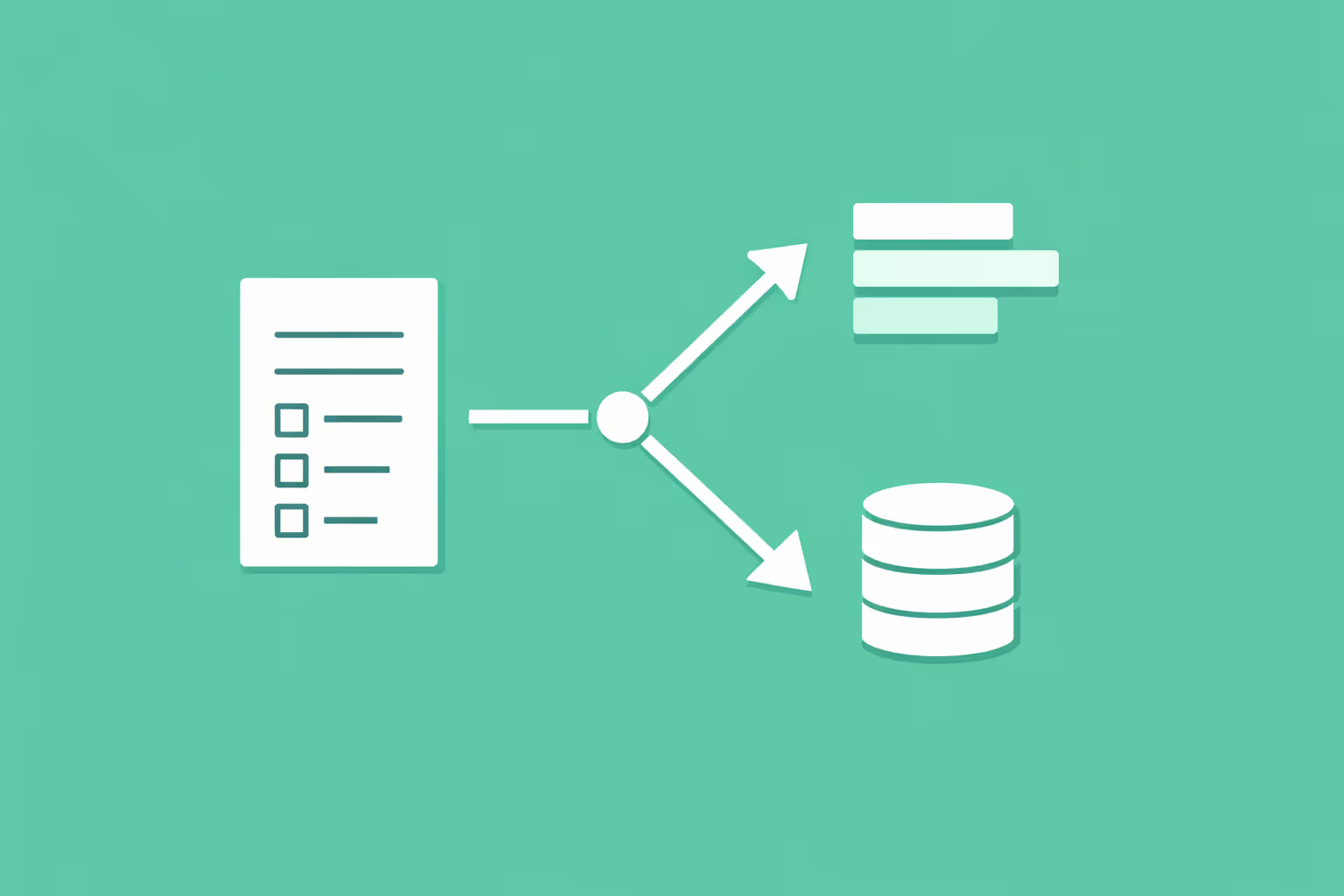
Data splitting is the practice of dividing a dataset into separate subsets, each serving a distinct role during the machine learning workflow. The most common partition creates three groups: a training set for building the model, a validation set for tuning it, and a test set for evaluating its final performance on unseen data.
The purpose is to simulate how a model will behave once deployed to production, where it encounters data it has never processed before. Without this separation, there is no reliable way to measure whether a model has genuinely learned patterns or has simply memorized the training examples. Data splitting is foundational to every supervised learning pipeline, regardless of whether the task involves classification, regression, or ranking.
How Data Splitting Works
The mechanics of splitting are straightforward in principle. You take a complete dataset and assign each observation to one of the designated subsets. The assignment can follow a simple random partition, a stratified approach that preserves class distributions, or a time-based split that respects chronological order.
A typical workflow begins with shuffling the data to remove any ordering effects. The shuffled data is then divided according to a chosen ratio. The training set receives the largest share, often 70 to 80 percent. The validation set takes 10 to 15 percent, and the test set receives the remaining 10 to 15 percent.
Once the split is made, the training set feeds into the learning algorithm. The model adjusts its internal parameters, whether those are weights in a neural network, coefficients in a linear model, or split points in a decision tree, based on patterns observed in this subset. The validation set enters the process during hyperparameter tuning and architecture selection, providing a checkpoint that is separate from training data but still available for iterative adjustments.
The test set remains untouched until the very end. It serves as a final, unbiased assessment of performance. If the test set is used during any stage of model selection, it loses its value as an independent benchmark. This strict separation is what gives the evaluation its credibility.
Train, Validation, and Test Sets: Roles and Differences
Training Set
The training set is the subset the model learns from directly. Every parameter adjustment happens in response to patterns in this data. Larger training sets generally produce more robust models because the algorithm encounters a wider variety of examples. The trade-off is that allocating too much data to training leaves less for validation and testing, which can make performance estimates unreliable.
The training set also determines the feature distributions the model considers "normal." If the training data is biased, contains duplicates, or underrepresents certain classes, those deficiencies carry directly into the model's behavior.
Validation Set
The validation set acts as a feedback mechanism during the development cycle. It answers the question: "How well does the current model configuration generalize beyond the training examples?"
Practitioners use the validation set to compare model architectures, select hyperparameters, and decide when to stop training to prevent overfitting. For example, if a neural network's loss on the training set continues to decrease but its validation loss starts climbing, that divergence signals that the model is memorizing rather than learning. The validation set makes this visible.
One critical distinction: the validation set influences model decisions indirectly. Because you use it to choose between candidates, some information from the validation set leaks into the final model through those choices. This is precisely why a separate test set is still necessary.
Test Set
The test set provides the only truly unbiased estimate of model performance. By keeping it isolated from every training and tuning decision, you get a measurement that reflects how the model will perform on genuinely new data.
A test set should be evaluated once. Running multiple evaluations against the test set and adjusting the model accordingly turns it into a second validation set, defeating its purpose. In practice, teams sometimes violate this rule under deadline pressure, which inflates their reported accuracy and leads to unpleasant surprises in production.
The test set matters most for stakeholder communication. When reporting predictive analytics results, the numbers from the test set are the ones that predict real-world behavior.
Why Data Splitting Matters
Preventing Overfitting
Overfitting occurs when a model fits the training data too closely, capturing noise and idiosyncrasies rather than generalizable patterns. An overfit model performs well on training examples but fails on new data. Splitting exposes overfitting by providing independent checkpoints at the validation and test stages.
Without a validation set, there is no mechanism to detect overfitting during development. Without a test set, there is no credible performance estimate to share with decision-makers. The three-way split creates layers of protection against releasing a model that works on paper but fails in practice.
Enabling Honest Evaluation
Performance metrics computed on training data are inherently optimistic. The model has already seen those examples, so accuracy, precision, and recall figures from training data overstate real-world capability. The test set corrects this by providing metrics on data the model has never encountered.
This honest evaluation is particularly important in high-stakes applications. A medical imaging model that reports 98 percent accuracy on training data but drops to 82 percent on test data is not ready for clinical use. The split makes the gap visible before deployment, which is why understanding different types of AI systems and their evaluation requirements matters.
Supporting Reproducible Research
Splitting creates a structured evaluation framework that others can replicate. When researchers publish results, specifying the split ratio, the random seed, and the splitting method allows independent verification. Reproducibility strengthens the credibility of findings and enables meaningful comparisons between approaches.
Common Data Splitting Methods
Holdout Method
The holdout method is the simplest approach. You divide the dataset once into training, validation, and test partitions. Common ratios include 70/15/15 and 80/10/10, though the optimal ratio depends on dataset size and problem complexity.
The holdout method is fast and easy to implement. Its weakness is variance: a single random split might produce an unusually easy or difficult test set. With large datasets (hundreds of thousands of observations or more), this variance tends to be negligible. With smaller datasets, the choice of which specific observations land in each subset can significantly influence results.
K-Fold Cross-Validation
K-fold cross-validation addresses the variance problem by creating multiple splits. The dataset is divided into k equally sized folds. The model trains on k-1 folds and validates on the remaining fold. This process repeats k times, with each fold serving as the validation set exactly once.
The final performance estimate is the average across all k iterations, providing a more stable and reliable measurement than a single holdout split. Common choices for k are 5 and 10.
K-fold cross-validation uses data more efficiently than the holdout method because every observation appears in both training and validation roles. The cost is computational: training the model k times requires proportionally more time and resources. For computationally expensive models like deep neural networks, this trade-off is significant.
Teams building AI adaptive learning systems, for instance, often balance between thorough validation and practical time constraints.
A separate test set should still be reserved before running cross-validation. The cross-validation folds replace only the validation set, not the final evaluation.
Stratified Splitting
Stratified splitting ensures that each subset preserves the class distribution of the original dataset. If the full dataset contains 90 percent negative examples and 10 percent positive examples, each split will mirror that ratio.
This is essential for imbalanced datasets. A random split on a dataset with 5 percent positive cases could produce a validation fold with zero positive examples, making evaluation meaningless. Stratified splitting eliminates this risk.
Stratified k-fold cross-validation combines both techniques, running k-fold cross-validation while maintaining class proportions in every fold. Most machine learning libraries implement this as a default option for classification tasks.
Time-Based Splitting
When data has a temporal component, random splitting can introduce a subtle but damaging problem: the model trains on future data and predicts the past. Time-based splitting avoids this by using chronological order to define the partitions.
In financial modeling, for instance, using stock prices from Tuesday to predict Monday would produce inflated accuracy that vanishes in live trading. Time-based splitting ensures the training set contains only data that would have been available at the time of prediction.
This method is standard for time-series forecasting, event prediction, and any domain where the temporal sequence of observations carries meaning. The distinction between generative AI and predictive AI is relevant here, as predictive models are especially sensitive to temporal data handling.
| Type | Description | Best For |
|---|---|---|
| Holdout Method | The holdout method is the simplest approach. | You divide the dataset once into training, validation |
| K-Fold Cross-Validation | K-fold cross-validation addresses the variance problem by creating multiple splits. | The dataset is divided into k equally sized folds |
| Stratified Splitting | Stratified splitting ensures that each subset preserves the class distribution of the. | — |
| Time-Based Splitting | When data has a temporal component. | In financial modeling, for instance |
Challenges and Common Mistakes
Data Leakage
Data leakage is the most damaging mistake in the splitting process. It occurs when information from the validation or test set influences the training process. Leakage produces artificially high performance metrics that collapse once the model encounters truly new data.
Common sources include applying normalization or feature scaling across the entire dataset before splitting, using future information in time-series problems, or allowing duplicate records to appear in both training and test sets. Leakage can also happen through feature engineering: if a derived feature is calculated using the full dataset, it carries statistical information from the test set into training.
The fix is to treat the split as a hard boundary. All preprocessing steps, from imputation to scaling to encoding, must be fit on the training set only and then applied to the validation and test sets using the training set's parameters. Building strong data fluency across teams helps practitioners recognize leakage risks early.
Small Dataset Limitations
When datasets are small (fewer than a few thousand observations), every split decision has outsized impact. Removing 20 percent of a 500-row dataset for testing leaves only 400 rows for training, which may not be enough for the model to learn meaningful patterns.
K-fold cross-validation helps by rotating observations through training and validation roles, but it does not create new data. In extreme cases, techniques like leave-one-out cross-validation (where k equals the number of observations) maximize the use of available data at the cost of very high computation.
Data augmentation, transfer learning, and Bayesian approaches offer alternative strategies when data is scarce. Recognizing dataset limitations early is a critical part of building reliable machine learning pipelines. The learning curve for practitioners new to these methods is steep, but the investment pays off in model quality.
Class Imbalance
Imbalanced class distributions create problems at the splitting stage. A random 80/20 split on a dataset where only 2 percent of examples belong to the minority class could produce a test set with almost no positive cases, making evaluation unreliable.
Stratified splitting mitigates this at the partition level. Additional techniques such as oversampling (SMOTE), undersampling, or cost-sensitive learning address imbalance during training itself. The key principle is that the test set should reflect the true distribution the model will face in production, even if the training set is rebalanced.
Ignoring Domain Context
Applying a random split to data that has inherent group structure leads to leakage and inflated metrics. Medical datasets where multiple observations come from the same patient, educational datasets where multiple responses come from the same learner, or geospatial datasets with spatial autocorrelation all require group-aware splitting.
In these cases, the split must occur at the group level rather than the observation level. All observations from a given patient or learner go into the same subset. Failing to account for this produces models that appear strong during evaluation but perform poorly in deployment because they learned to recognize individuals rather than patterns.
This challenge is especially relevant when applying AI in online learning platforms, where learner data is inherently grouped.
How to Choose the Right Split Strategy
Selecting the right approach depends on four factors: dataset size, data structure, computational budget, and deployment context.
For large, independent, identically distributed datasets with balanced classes, a simple holdout split at 80/10/10 is efficient and reliable. The variance across possible splits is low, and the computational overhead is minimal.
For small or medium datasets, k-fold cross-validation (typically k=5 or k=10) provides more stable estimates. If the dataset is imbalanced, stratified k-fold is the standard choice. Organizations building competency assessment systems that rely on limited learner data often face exactly this scenario.
For time-series or sequential data, time-based splits are mandatory. Random shuffling would violate the temporal structure and produce misleading results.
For grouped data, group-aware splits prevent leakage. Most machine learning frameworks provide GroupKFold or equivalent implementations for this purpose.
Regardless of the method chosen, one principle holds: the test set must remain untouched until final evaluation. Every decision, from preprocessing choices to model architecture to hyperparameter values, should be made using only the training and validation data.
A practical checklist for splitting decisions:
- Determine whether the data has temporal ordering, group structure, or class imbalance before choosing a method.
- Reserve a test set before any cross-validation or experimentation begins.
- Fit all preprocessing transformations on training data only.
- Verify that no duplicate observations span the train-test boundary.
- Document the split method, ratio, and random seed for reproducibility.
Teams investing in automated machine learning tools should note that most AutoML pipelines handle splitting internally, but understanding the underlying logic remains essential for interpreting results and debugging failures.
FAQ
What is the best train-validation-test split ratio?
There is no universal best ratio. The 80/10/10 and 70/15/15 splits are common starting points for datasets with tens of thousands of observations. For very large datasets (millions of rows), allocating 98 percent to training and 1 percent each to validation and test can work because even a small percentage represents a substantial number of examples. For small datasets, cross-validation is preferable to a fixed holdout split because it uses data more efficiently.
Can I skip the validation set and only use train and test?
Technically, yes, but this limits the tuning process. Without a validation set, hyperparameter selection must rely on the training set or the test set. Using the training set leads to overfitting the hyperparameters. Using the test set compromises its independence. Cross-validation provides an alternative by creating temporary validation folds from the training data, eliminating the need for a dedicated validation partition.
How does cross-validation relate to the train-test split?
Cross-validation replaces the validation set, not the test set. You first reserve a test set, then run k-fold cross-validation on the remaining data. Each fold cycle uses a different portion as the validation set. After selecting the best model through cross-validation, you evaluate it once on the held-out test set. The test set remains the final arbiter of performance.
Understanding this relationship is fundamental for anyone working in AI and machine learning workflows.
What is data leakage and how does it relate to splitting?
Data leakage occurs when information from outside the training set influences the model during training. In the context of splitting, leakage typically happens when preprocessing steps like normalization, encoding, or imputation are applied before the split, allowing statistical properties of the test data to seep into the training process. The result is inflated performance metrics that do not reflect real-world capability. Preventing leakage requires fitting all transformations exclusively on the training partition.
Further reading
.avif)
25+ Best ChatGPT Prompts for Instructional Designers
Discover over 25 best ChatGPT prompts tailored for instructional designers to enhance learning experiences and creativity.

Artificial Superintelligence (ASI): What It Is and What It Could Mean
Artificial superintelligence (ASI) refers to AI that surpasses all human cognitive abilities. Learn what ASI means, its risks, and alignment challenges.
.avif)
11 Best AI Video Generator for Education in 2025
Discover the best AI video generator tools for education in 2025, enhancing teaching efficiency with engaging, cost-effective video content creation

Robot Economy: Definition, Impact, and What It Means for the Future
The robot economy is an economic system where robots, AI agents, and autonomous machines perform tasks traditionally done by humans. Learn how it works, why it matters, and how to prepare.
Prompt Chaining: What It Is, How It Works, and Practical Use Cases
Prompt chaining explained: learn what prompt chaining is, how it connects sequential LLM calls, and how to use it for complex AI workflows in practice.

Algorithmic Transparency: What It Means and Why It Matters
Understand algorithmic transparency, why it matters for accountability and compliance, real-world examples in hiring, credit, and healthcare, and how organizations can improve it.