Home Data Scientist: What They Do, Key Skills, and How to Become One
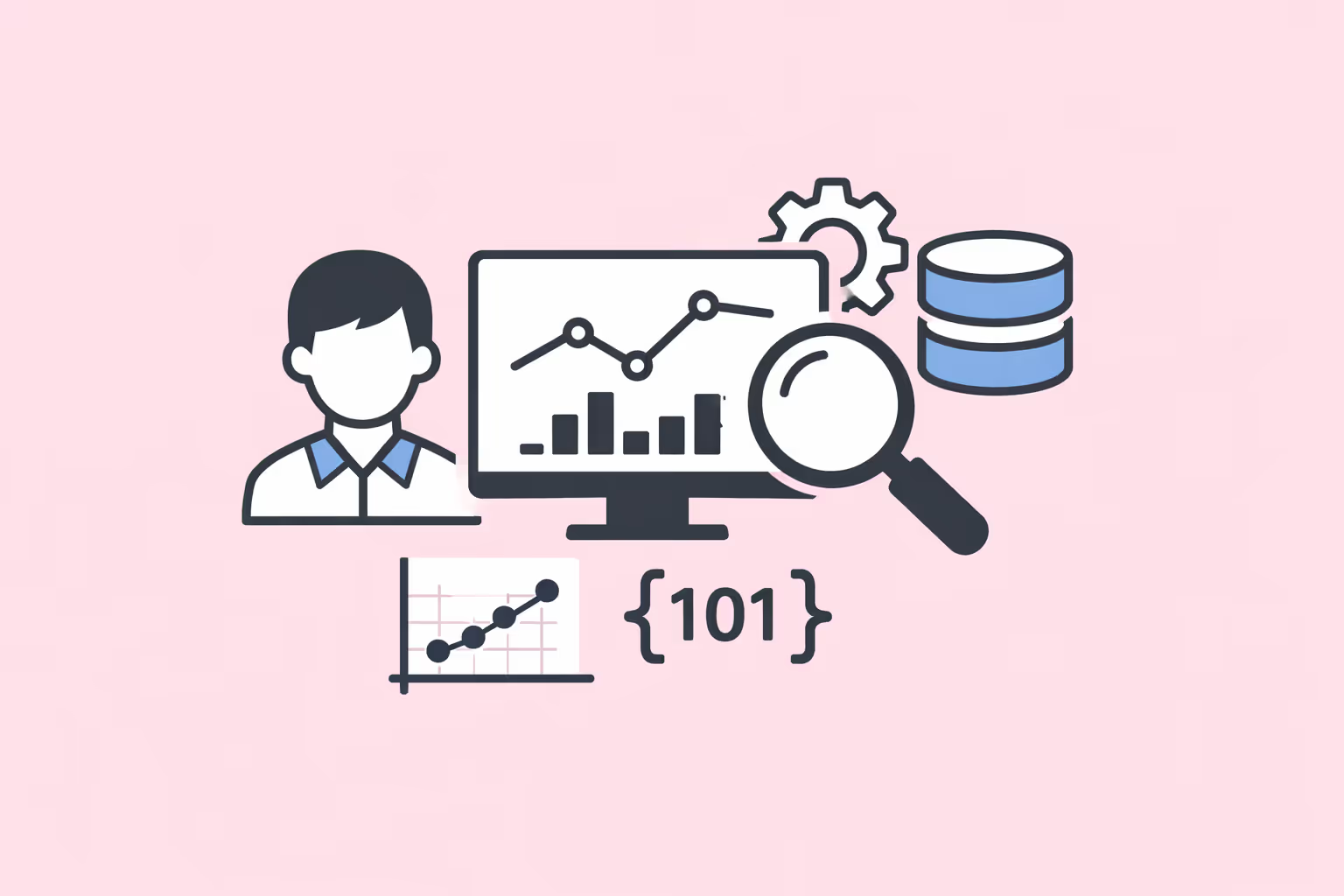
Data Scientist: What They Do, Key Skills, and How to Become One
Learn what a data scientist does, the key skills required, common tools they use, and how to build a career in data science.
What Is a Data Scientist?
A data scientist is a professional who extracts meaningful insights from structured and unstructured data using statistics, programming, and domain expertise. The role sits at the intersection of mathematics, computer science, and business strategy.
Unlike a data analyst who focuses primarily on describing what happened, a data scientist builds predictive models, designs experiments, and develops algorithms that inform decisions before they are made. The distinction matters because organizations increasingly need professionals who can move beyond reporting into forecasting and optimization.
Data scientists work across industries, from healthcare and finance to logistics and education. Their core function is to transform raw data into actionable knowledge that drives product development, operational efficiency, and strategic planning.
What Does a Data Scientist Do?
The day-to-day work of a data scientist varies depending on the organization, but several responsibilities remain consistent across roles.
Data scientists spend a significant portion of their time on data preparation. Raw datasets are rarely clean. Missing values, inconsistent formats, and duplicated records require careful handling before any analysis can begin. This phase, often called data wrangling, accounts for a large share of the work.
Once data is prepared, the scientist applies statistical methods and machine learning techniques to identify patterns. This might involve building classification models to predict customer churn, running regression analyses to forecast revenue, or clustering users into segments based on behavior.
Key responsibilities include:
- Collecting and cleaning large datasets from multiple sources
- Designing and running experiments, including A/B tests
- Building predictive and prescriptive models
- Communicating findings to stakeholders through visualizations and reports
- Collaborating with engineers to deploy models into production
- Monitoring model performance and retraining when accuracy degrades
Communication is an underappreciated part of the role. A model that produces accurate predictions has limited value if the team cannot understand or act on the results. Data scientists translate technical outputs into business language, often presenting to executives who do not have a technical background.
Key Skills Every Data Scientist Needs
The skill set of an effective data scientist spans technical depth, mathematical reasoning, and business fluency. Hiring managers consistently look for a combination of hard and soft competencies.
Technical Skills
- Programming. Python and R are the primary languages. Python dominates because of its ecosystem of libraries for data manipulation (pandas), numerical computing (NumPy), and machine learning (scikit-learn, TensorFlow, PyTorch).
- Statistics and probability. Hypothesis testing, Bayesian inference, distributions, and regression analysis form the mathematical backbone of data science work.
- Machine learning. Supervised learning (classification, regression), unsupervised learning (clustering, dimensionality reduction), and deep learning architectures are expected knowledge areas.
- SQL and database management. Nearly every data science workflow starts with querying databases. Proficiency in SQL is non-negotiable.
- Data visualization. Tools like Matplotlib, Seaborn, Plotly, and Tableau help data scientists explore datasets and communicate results effectively.
Analytical and Business Skills
- Problem framing. The ability to translate a vague business question into a well-defined analytical problem separates strong data scientists from those who only execute technical tasks.
- Domain expertise. A data scientist working in healthcare needs different contextual knowledge than one working in fintech. Understanding the domain accelerates insight generation and reduces misinterpretation.
- Critical thinking. Not every correlation implies causation. Strong data scientists question assumptions, validate results, and acknowledge uncertainty.
Communication and Collaboration
Technical excellence alone is insufficient. Data scientists must explain complex findings to non-technical stakeholders, write clear documentation, and work within cross-functional teams that include product managers, engineers, and business leaders.
The best data scientists ask questions before building models. They understand the decision that needs to be made and work backward to determine what data and methods will support that decision.
Tools and Technologies Data Scientists Use
The data science toolkit has expanded considerably, but certain tools remain foundational across most organizations.
- Python ecosystem. Jupyter Notebooks for interactive analysis, pandas for data manipulation, scikit-learn for traditional machine learning, and TensorFlow or PyTorch for deep learning.
- R. Preferred in academic and statistical research environments. Strong for exploratory data analysis and statistical modeling.
- SQL. PostgreSQL, MySQL, BigQuery, and Snowflake are common database platforms where data scientists query and transform data.
- Cloud platforms. AWS SageMaker, Google Cloud AI Platform, and Azure Machine Learning provide scalable environments for model training and deployment.
- Version control. Git and GitHub are standard for managing code, tracking experiments, and collaborating with engineering teams.
- Business intelligence tools. Tableau, Power BI, and Looker help data scientists share insights with broader teams through dashboards and interactive reports.
- Big data frameworks. Apache Spark and Hadoop handle datasets too large for a single machine, enabling distributed processing.
The choice of tools depends on team size, data infrastructure, and the types of problems being solved. A startup might rely on Python notebooks and a single database, while an enterprise team might operate across multiple cloud services with dedicated MLOps pipelines.
Data Scientist vs. Data Analyst vs. Data Engineer
These three roles are often confused, but they serve distinct functions within a data team.
A data analyst focuses on descriptive analytics. They use SQL, spreadsheets, and visualization tools to summarize historical data and generate reports. The primary output is dashboards, charts, and ad hoc analyses that explain what has already happened.
A data scientist goes further by building predictive and prescriptive models. They apply machine learning, statistical modeling, and experimental design to answer questions about what will happen next and what actions to take. The work is more exploratory and research-oriented.
A data engineer builds and maintains the infrastructure that makes data science possible. They design data pipelines, manage databases, optimize query performance, and ensure data quality at scale. Without reliable data engineering, data scientists spend most of their time on infrastructure problems instead of analysis.
In small organizations, one person may cover all three roles. In larger companies, these functions are specialized, and collaboration between them determines how effectively data translates into decisions.
How Data Science Is Applied Across Industries
Data science is not confined to technology companies. The methods and tools apply wherever large datasets exist and decisions carry significant consequences.
Healthcare. Predictive models identify patients at risk of readmission, optimize treatment protocols, and accelerate drug discovery. Natural language processing extracts structured information from clinical notes.
Finance. Credit scoring, fraud detection, algorithmic trading, and risk assessment all rely on data science techniques. Real-time anomaly detection models flag suspicious transactions before they clear.
Retail and e-commerce. Recommendation engines drive product discovery. Demand forecasting models optimize inventory levels. Customer segmentation informs personalized marketing campaigns.
Education and training. Learning analytics track student progress, identify learners at risk of dropping out, and personalize content delivery. Organizations that run structured training programs use data to measure completion rates, assess engagement, and refine instructional design.
Manufacturing. Predictive maintenance models reduce equipment downtime by detecting failures before they occur. Quality control systems use computer vision to identify defects on production lines.
Transportation and logistics. Route optimization, demand prediction for ride-sharing services, and supply chain analytics reduce costs and improve delivery times.
The common thread across these applications is the same: data science converts raw information into decisions that reduce risk, improve efficiency, or create competitive advantage.
Challenges and Limitations of the Data Science Role
Despite the high demand, the data science profession carries real challenges that prospective professionals should understand.
Data quality problems. Models are only as good as the data they consume. Incomplete records, biased samples, and inconsistent collection methods undermine even sophisticated algorithms. A significant amount of time goes into cleaning and validating data rather than building models.
Misaligned expectations. Organizations sometimes hire data scientists expecting immediate, transformative results. In practice, meaningful insights require clean data infrastructure, clear problem definitions, and iterative experimentation. When these foundations are missing, frustration builds on both sides.
Model interpretability. Complex models, particularly deep learning networks, often function as black boxes. Stakeholders in regulated industries like healthcare and finance need to understand why a model makes a specific prediction, not just what the prediction is.
Ethical considerations. Biased training data produces biased models. Data scientists must evaluate whether their models reinforce existing inequalities, particularly in hiring, lending, and criminal justice applications. Responsible practice requires ongoing auditing and transparency.
Skill obsolescence. The field evolves rapidly. Frameworks, best practices, and deployment patterns shift frequently. Continuous learning is not optional; it is a structural requirement of the profession.
These challenges do not diminish the value of the role. They clarify what it takes to practice data science responsibly and effectively.
How to Become a Data Scientist
There is no single path into data science, but most successful professionals follow a pattern that combines formal education, practical experience, and continuous skill development.
Educational Foundation
Most data science positions require at least a bachelor's degree in a quantitative field: computer science, statistics, mathematics, physics, or engineering. Many roles, especially in research-heavy organizations, prefer candidates with a master's degree or PhD.
Formal education provides depth in statistics and mathematical reasoning that self-study often skips. However, a degree alone is insufficient. Employers evaluate practical ability alongside academic credentials.
Building Technical Skills
Start with Python and SQL. These two languages cover the majority of data science workflows. From there, expand into machine learning libraries, cloud platforms, and data engineering concepts.
Structured learning paths, whether through university programs, online bootcamps, or self-directed study, should include hands-on projects. Building a portfolio of completed projects demonstrates ability more convincingly than listing certifications.
Gaining Practical Experience
Entry-level roles such as data analyst or junior data scientist provide real-world exposure to messy datasets, stakeholder communication, and production systems. Internships and contract work serve the same purpose for those transitioning from other fields.
Contributing to open-source projects, participating in Kaggle competitions, and publishing analyses on personal blogs also build credibility.
Continuing Development
The field rewards professionals who stay current. Reading research papers, attending industry conferences, and experimenting with new tools keeps skills relevant. Data scientists who also develop expertise in a specific domain, such as healthcare informatics or financial modeling, become especially valuable.
The most effective employee training strategies in data science combine structured coursework with project-based application, replicating real workplace conditions as closely as possible.
| Component | Function | Key Detail |
|---|---|---|
| Educational Foundation | Most data science positions require at least a bachelor's degree in a quantitative field:. | Many roles, especially in research-heavy organizations |
| Building Technical Skills | Start with Python and SQL. | These two languages cover the majority of data science workflows |
| Gaining Practical Experience | Entry-level roles such as data analyst or junior data scientist provide real-world. | Data analyst or junior data scientist provide real-world exposure to |
| Continuing Development | The field rewards professionals who stay current. | Healthcare informatics or financial modeling |
FAQ
What is the difference between a data scientist and a machine learning engineer?
A data scientist focuses on analysis, experimentation, and insight generation. They build models to answer business questions. A machine learning engineer specializes in taking those models and deploying them into production systems at scale. The machine learning engineer optimizes for performance, latency, and reliability. In some organizations, one person fills both roles; in larger teams, they are distinct positions.
Do I need a PhD to become a data scientist?
A PhD is not required for most data science positions. Many professionals enter the field with a bachelor's or master's degree combined with strong technical skills and project experience. A PhD can be advantageous for research-focused roles at organizations that develop novel algorithms, but practical experience and demonstrated problem-solving ability carry significant weight in hiring decisions.
What programming languages should a data scientist learn first?
Python is the most widely used language in data science and the strongest starting point. SQL is essential for working with databases and should be learned alongside Python. R is valuable for statistical analysis and is common in academic and research contexts. Beyond these, familiarity with shell scripting and version control through Git supports collaboration and workflow automation.
How long does it take to become a data scientist?
The timeline depends on the starting point. Someone with a quantitative degree and programming experience might transition into a data science role within six to twelve months of focused study. For someone starting without a technical background, building the necessary foundation typically takes two to four years, including formal education or an intensive bootcamp followed by entry-level experience.
Further reading

What Is IBM Watson? Definition, Products, and Use Cases
Learn what IBM Watson is, how it works, and what products and services it offers. Explore real use cases, challenges, and how to get started with Watson AI.

What Is Face Detection? Definition, How It Works, and Use Cases
Learn what face detection is, how it identifies human faces in images and video, the algorithms behind it, practical use cases, and key challenges to consider.
Graph Neural Networks (GNNs): How They Work, Types, and Practical Applications
Learn what graph neural networks are, how GNNs process graph-structured data through message passing, their main types, real-world use cases, and how to get started.
%201.avif)
Ambient Intelligence: What It Is, How It Works, and Examples
Understand ambient intelligence (AmI), how it works through sensing and adaptive response, real-world examples in healthcare, buildings, and retail, and the benefits and risks organizations should consider.

What Is a Telepresence Robot? Definition, Use Cases, and How It Works
Learn what a telepresence robot is, how it works, and where it applies. Explore use cases in education, healthcare, and business, plus challenges and how to get started.
.avif)
What Is a Headless LMS? From APIs to Agentic Learning Systems
Explore what a Headless LMS is, how it works, and why Agentic Learning Systems are redefining enterprise learning in the AI era.