Home Data Dignity: What It Is and Why It Matters
Data Dignity: What It Is and Why It Matters
Data dignity is the principle that people should have agency, transparency, and fair compensation for the personal data they generate. Learn how it works and why it matters.
What Is Data Dignity?
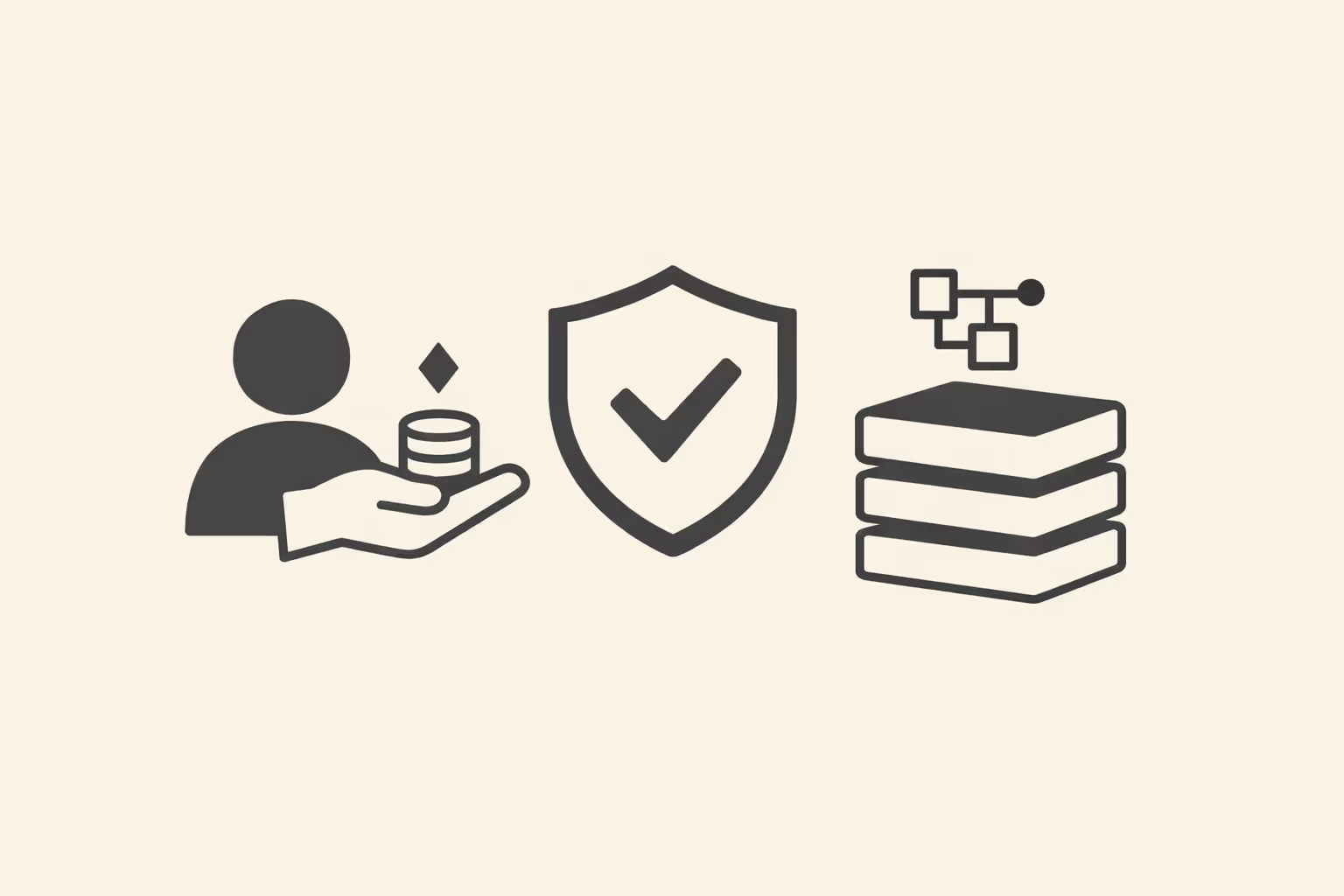
Data dignity is the principle that individuals should retain meaningful agency over the personal data they produce, including the right to know how that data is used, the ability to control its distribution, and the opportunity to benefit from its economic value. The concept rejects the prevailing model in which personal data is extracted at scale, often with minimal consent, and converted into profit by platforms and intermediaries with no return to the people who generated it.
The term gained prominence through the work of computer scientist and virtual reality pioneer Jaron Lanier, who argued that the current data economy treats human contributions as a free resource. Lanier's framework, articulated in his book "Who Owns the Future?", positions personal data as a form of labor.
If data generated by individuals powers AI systems, recommendation engines, and targeted advertising, then the people who produce that data deserve recognition, transparency, and compensation.
Data dignity is not simply a privacy framework. Privacy focuses on preventing harm by restricting access to personal information. Data dignity goes further by asserting that people should have an active, participatory role in the data economy, not just a defensive one. It combines elements of data ownership, informed consent, economic participation, and structural accountability.
How Data Dignity Works
Data dignity operates through a set of interlocking principles that shift the power balance between individuals and the organizations that collect, process, and profit from personal data.
Informed and Meaningful Consent
Under a data dignity model, consent is not a checkbox buried in a terms-of-service agreement. It requires that individuals understand what data is being collected, how it will be used, who will access it, and what value it generates. Consent must be specific, revocable, and ongoing rather than a one-time event.
This standard differs sharply from common practice. Most digital platforms collect consent through broad, pre-written agreements that few users read and fewer understand. Data dignity demands that consent mechanisms be designed for genuine comprehension, not legal liability coverage.
Transparency of Data Flows
Organizations operating under data dignity principles must make their data practices visible. Transparency means disclosing not just what data is collected, but how it moves through internal and external systems, how it is aggregated, what inferences are drawn from it, and which third parties receive access.
Algorithmic transparency is a closely related concept. When personal data feeds into automated decision-making systems, individuals should be able to trace the connection between their data contribution and the outcomes those systems produce. Without this visibility, meaningful consent becomes impossible because people cannot consent to processes they cannot see.
Data as Labor and Economic Participation
One of the most distinctive features of data dignity is the proposition that personal data has economic value that should flow back to its source. When millions of users contribute behavioral data that trains a machine learning model, the value created does not emerge from the platform's code alone. It emerges from the aggregated contributions of those users.
Data dignity proposes mechanisms for compensating individuals or communities for their data contributions. These mechanisms range from direct micropayments to collective bargaining structures, such as data cooperatives that negotiate on behalf of groups. The precise implementation varies, but the principle is consistent: if data creates value, that value should be shared.
Individual Agency and Portability
Data dignity requires that individuals can move their data between services, revoke access, and delete records. Portability prevents lock-in and ensures that people are not forced to remain on a platform simply because leaving means losing their data history.
Agency also means the ability to choose different terms for different types of data. A person might willingly share health data with a research institution under strict governance but refuse to share the same data with an advertising platform. Data dignity supports granular, context-specific control rather than all-or-nothing models.
| Component | Function | Key Detail |
|---|---|---|
| Informed and Meaningful Consent | Under a data dignity model, consent is not a checkbox buried in a terms-of-service. | Genuine comprehension, not legal liability coverage |
| Transparency of Data Flows | Organizations operating under data dignity principles must make their data practices. | Transparency means disclosing not just what data is collected |
| Data as Labor and Economic Participation | One of the most distinctive features of data dignity is the proposition that personal data. | Data cooperatives that negotiate on behalf of groups |
| Individual Agency and Portability | Data dignity requires that individuals can move their data between services, revoke access. | — |
Why Data Dignity Matters
Addressing Economic Inequality in the Data Economy
The current data economy concentrates value at the top. A small number of technology companies capture the vast majority of economic returns from personal data, while the individuals who produce that data receive services in exchange but no direct economic benefit. This dynamic creates a structural inequality that grows as AI systems become more capable and data becomes more valuable.
Data dignity offers an alternative distribution model. By treating data contributions as a form of labor that warrants compensation, it creates pathways for broader economic participation. This matters particularly as AI and automation reshape employment patterns and the economic value of data continues to increase relative to traditional forms of work.
Strengthening Trust Between Organizations and Individuals
Organizations that adopt data dignity practices build stronger trust relationships with their users, customers, and employees. Trust is not built through privacy policies alone. It is built through demonstrated respect for individual agency and visible accountability for how data is handled.
In contexts like education and corporate training, learner data flows through multiple systems, from learning management platforms to analytics dashboards to third-party integrations. When organizations treat that data with dignity, learners engage more openly because they understand how their information is used and trust that it will not be exploited.
Aligning with Regulatory Direction
Privacy regulations like the GDPR, Brazil's LGPD, and California's CCPA already establish baseline data rights including access, correction, deletion, and portability. Data dignity aligns with and extends these regulatory foundations. Organizations that embed dignity principles into their data practices position themselves ahead of regulatory evolution rather than scrambling to comply after new rules take effect.
The regulatory trend is moving toward greater individual control and organizational accountability. Compliance training helps teams understand current obligations, but data dignity provides the philosophical and operational foundation that makes compliance sustainable rather than reactive.
Improving Data Quality and AI Performance
When individuals trust the systems that collect their data, they provide more accurate, complete, and intentional information. Coerced or opaque data collection often produces low-quality inputs because people game, minimize, or fabricate responses when they do not trust how their information will be used.
Better data quality improves the performance of learning analytics, predictive models, and decision-support systems. Data dignity creates a positive feedback loop: respect for individuals produces better data, which produces better outcomes, which reinforces trust.
Data Dignity in Practice
Data Trusts and Cooperatives
Data trusts are legal structures in which an independent trustee manages data on behalf of individuals. The trustee negotiates terms with organizations that want to access the data, ensures that usage complies with agreed conditions, and distributes any economic value back to participants. This model mirrors the structure of financial trusts and provides a governance layer between individuals and data consumers.
Data cooperatives function similarly but with a membership-driven governance model. Members collectively decide how their data is shared, under what conditions, and at what price. Several pilot programs in healthcare, urban planning, and research settings have tested cooperative models, with promising results in terms of both participation rates and data quality.
Platform Design and Data Portability Standards
Some technology companies have begun integrating data dignity principles into their platform architecture. This includes providing granular data export tools, clear data-use dashboards, and opt-in rather than opt-out defaults for data sharing.
Industry initiatives around data portability, such as the Data Transfer Project backed by several major technology companies, create technical infrastructure for moving personal data between services. These efforts represent an early, partial implementation of the portability principle central to data dignity.
Education and Workforce Training
Data dignity has direct implications for how organizations design training programs and manage learner data. Learning record stores, assessment platforms, and analytics systems all collect sensitive information about individual performance, behavior, and progress.
When training programs operate under data dignity principles, learners know exactly what data is collected, who can access it, and whether it informs decisions about their careers.
Building organizational capacity around data fluency enables teams to engage with these questions substantively rather than leaving data governance decisions to legal departments alone. When managers, instructional designers, and learners all understand data flows, dignity becomes an operational practice rather than an abstract policy.
Regulatory and Policy Frameworks
Governments and international organizations are beginning to codify data dignity principles into law and policy guidance. The European Data Governance Act, for instance, creates a framework for data intermediaries that operate in the interests of data subjects rather than commercial data buyers. Similar proposals are emerging in other jurisdictions.
Organizations that proactively adopt data dignity practices gain an advantage as these frameworks mature. Rather than retrofitting compliance into systems designed around extraction, they build dignity into their operations from the foundation.
Challenges and Limitations
Valuation Complexity
Determining the economic value of individual data contributions is genuinely difficult. A single person's data has marginal value in isolation. Its value emerges through aggregation, and the marginal contribution of each individual to that aggregate is hard to calculate. This makes direct compensation models complex to implement and easy to trivialize through token payments.
Collective models, where groups negotiate for the value of aggregated data rather than individual records, address this problem partially. But they introduce their own challenges around governance, representation, and distribution of returns.
Incentive Misalignment
The companies that profit most from the current data economy have limited incentive to voluntarily adopt data dignity practices. Shifting to a model where data contributors receive compensation or meaningful control reduces margins for business models built on free data extraction. Without regulatory pressure or significant consumer demand, voluntary adoption remains slow among the largest data collectors.
Technical Implementation
Building systems that support granular consent, real-time data tracking, portability, and revocation requires significant engineering investment. Existing data architectures in most organizations were not designed for this level of individual control. Retrofitting them is expensive and operationally complex, particularly for organizations with legacy systems and distributed data stores.
Standards for data portability and interoperability remain fragmented. Without common formats and protocols, moving data between services creates friction that undermines the practical exercise of individual agency.
Collective Action Problems
Data dignity works best when adopted broadly. A single platform offering data dignity protections in an ecosystem where competitors do not faces pressure from users who value convenience over control and from investors who prioritize growth over governance. The collective action problem, where individual adopters bear costs while the benefits require widespread adoption, slows the transition.
How Organizations Can Get Started
Organizations do not need to wait for regulatory mandates or industry-wide standards to begin implementing data dignity principles. Practical steps include the following:
- Audit existing data practices. Map what personal data is collected, where it flows, who accesses it, and what value it generates. Identify gaps between current practices and dignity principles. Organizations investing in HR analytics or learner performance tracking should prioritize these audits.
- Redesign consent mechanisms. Replace blanket consent forms with specific, understandable, and revocable consent processes. Use plain language. Provide examples. Make it easy for individuals to change their preferences over time.
- Increase transparency. Publish clear documentation of data practices. Create dashboards that let individuals see what data has been collected about them, how it has been used, and who has accessed it. Transparency builds trust and reduces the gap between policy and practice.
- Evaluate compensation models. Determine whether and how data contributors can share in the economic value their data creates. Compensation does not always mean direct payment. It can include improved services, community investment, or collective benefits negotiated through cooperatives.
- Invest in organizational literacy. Data dignity requires that people across the organization, not just legal and compliance teams, understand data flows, rights, and responsibilities. Programs that build digital learning capacity help embed dignity into daily operations rather than confining it to policy documents.
- Design for portability. Build systems that allow individuals to export their data in standard, machine-readable formats. Support interoperability standards that make switching between services practical rather than theoretical.
- Engage with policy development. Participate in industry and regulatory discussions about data governance. Organizations that contribute to standard-setting processes help shape frameworks that work operationally rather than imposing compliance burdens designed without practical input.
FAQ
How is data dignity different from data privacy?
Data privacy focuses on protecting personal information from unauthorized access or misuse. Data dignity includes privacy but extends further. It asserts that individuals should have active participation in the data economy, including the right to understand how their data generates value, the ability to control its use across contexts, and the opportunity to share in economic returns. Privacy is about defense. Data dignity is about agency and participation.
Who coined the term data dignity?
The concept is most closely associated with Jaron Lanier, a computer scientist and author who argued that personal data should be treated as a form of labor deserving compensation and respect. Lanier's work, particularly in "Who Owns the Future?" and through his advocacy for responsible AI development, brought the idea into mainstream technology policy discussions.
Other scholars, including Glen Weyl, have expanded the framework through proposals like data coalitions and collective bargaining for data rights.
Can small organizations implement data dignity principles?
Yes. Data dignity does not require massive infrastructure investment. Small organizations can start by auditing their data collection practices, simplifying consent mechanisms, publishing clear data-use policies, and giving individuals control over their own records.
In training and education contexts, even basic steps like disclosing what learner data is collected and providing options for deletion demonstrate respect for data dignity.
Does data dignity slow down AI development?
Not necessarily. Data dignity changes how data is collected and used, not whether AI development proceeds. Systems built on high-quality, consensually provided data often perform better than those built on extracted, low-trust data. Organizations that implement dignity principles may face higher initial costs for data acquisition, but the resulting datasets tend to be more accurate, representative, and legally sustainable.
Investing in bias training alongside data dignity practices further improves AI outcomes by reducing the risk of discriminatory models built on flawed data.
Further reading

Artificial General Intelligence (AGI): What It Is and Why It Matters
Artificial general intelligence (AGI) refers to AI that matches human-level reasoning across any domain. Learn what AGI is, how it differs from narrow AI, and why it matters.

Backpropagation Algorithm: How It Works, Why It Matters, and Practical Applications
Learn how the backpropagation algorithm trains neural networks, why it remains essential for deep learning, and where it applies in practice.
Graph Neural Networks (GNNs): How They Work, Types, and Practical Applications
Learn what graph neural networks are, how GNNs process graph-structured data through message passing, their main types, real-world use cases, and how to get started.
What Is Face Detection? Definition, How It Works, and Use Cases
Learn what face detection is, how it identifies human faces in images and video, the algorithms behind it, practical use cases, and key challenges to consider.
What Is Semantic Search? Definition, How It Works, and Use Cases
Learn what semantic search is, how it uses AI to understand meaning behind queries, how it compares to keyword search, and where it is applied across industries.

Kolmogorov-Arnold Network (KAN): How It Works and Why It Matters
A Kolmogorov-Arnold Network (KAN) places learnable activation functions on edges instead of nodes. Learn how KANs work, how they compare to MLPs, and where they excel.