Home Crypto-Agility: What It Is and Why It Matters for Security Teams
Crypto-Agility: What It Is and Why It Matters for Security Teams
Crypto-agility is the ability to swap cryptographic algorithms without rebuilding systems. Learn how it works, why it matters, and how to implement it.
What Is Crypto-Agility?
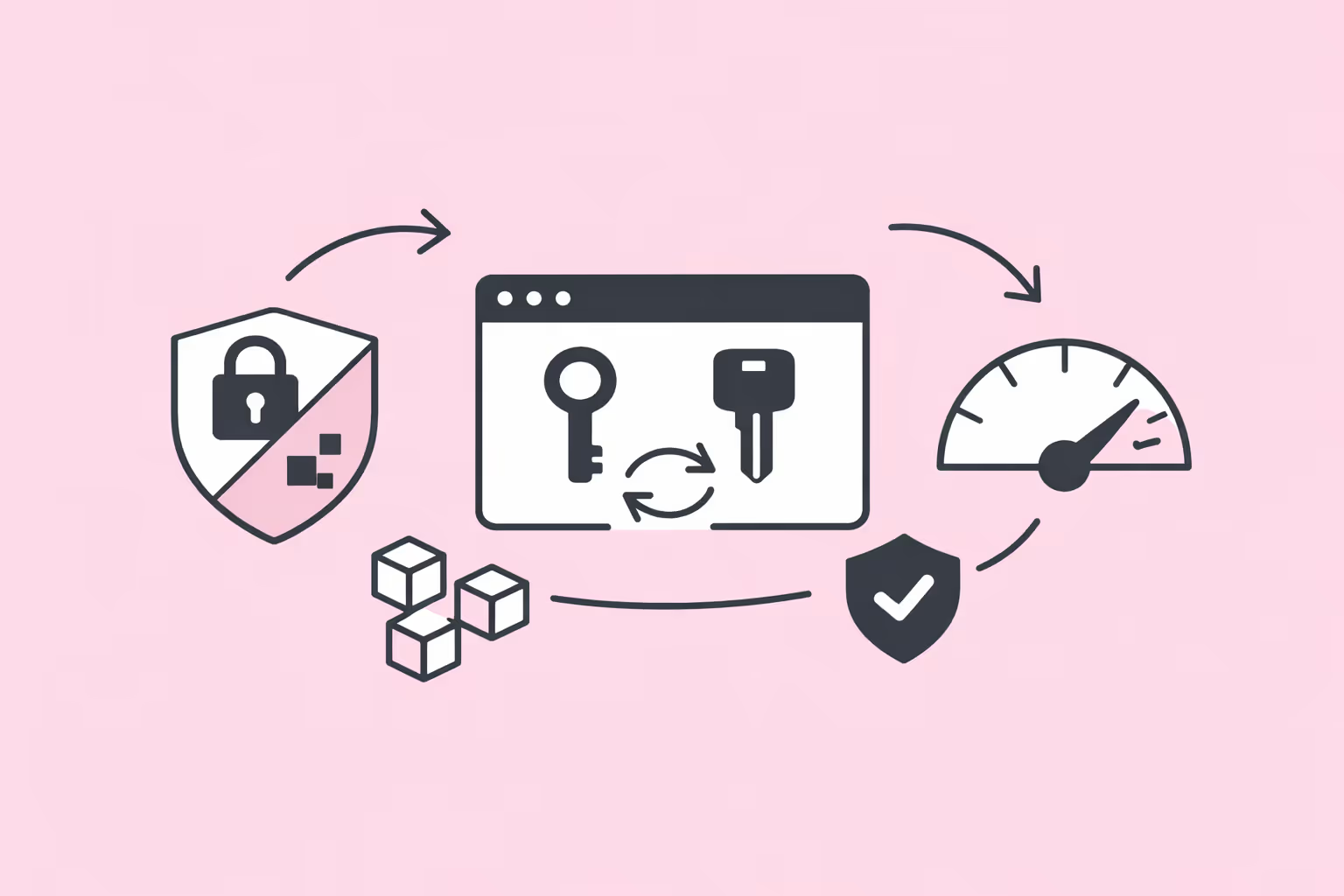
Crypto-agility is the capacity of an information system to switch between cryptographic algorithms, protocols, and key management practices without requiring significant changes to the surrounding infrastructure. It is a design principle, not a product. An organization with crypto-agile systems can replace a compromised or deprecated encryption method with a stronger alternative quickly, with minimal downtime and minimal code changes.
The concept gained urgency with the advancement of quantum computing. Quantum computers, once sufficiently powerful, will be capable of breaking widely used public-key algorithms such as RSA and elliptic-curve cryptography. But the need for crypto-agility predates quantum threats.
Every major cryptographic transition in the past three decades, from DES to AES, from SHA-1 to SHA-256, from SSL to TLS, revealed how deeply embedded cryptographic choices become in enterprise systems and how painful migrations can be when those choices are hardcoded.
Crypto-agility treats cryptographic components as modular, replaceable elements rather than permanent fixtures. The goal is to decouple the security logic from the application logic so that updating one does not break the other.
How Crypto-Agility Works
Abstraction Layers
The technical foundation of crypto-agility is abstraction. Rather than calling specific cryptographic functions directly in application code, developers interact with a cryptographic abstraction layer. This layer handles algorithm selection, key management, and protocol negotiation. When a new algorithm needs to be deployed, the change happens at the abstraction layer, and the applications that depend on it continue to function without modification.
In practice, this means replacing a hardcoded call to AES-256 with a reference to a cryptographic service that resolves the appropriate algorithm based on current policy. The policy might specify AES-256 today and a post-quantum cipher tomorrow. The application code does not need to know the difference.
Cryptographic Inventories
Before an organization can be agile, it needs visibility. A cryptographic inventory catalogs every instance of cryptographic usage across the enterprise: which algorithms are in use, where they are deployed, what keys protect them, and when those keys expire. Without this inventory, migration planning is guesswork.
Inventories cover certificates, key stores, encrypted databases, API authentication mechanisms, VPN tunnels, code-signing processes, and embedded device firmware. The scope is broader than most teams expect, which is precisely why the inventory step is non-negotiable.
Policy-Driven Algorithm Selection
Crypto-agile architectures use policy engines to govern algorithm selection. These policies define which algorithms are approved for which use cases, which are deprecated, and which are in transition. When a policy update pushes a new approved algorithm, systems that rely on the policy engine adopt it automatically, without manual intervention at each endpoint.
This approach mirrors how organizations manage compliance training at scale: centralized rules, distributed enforcement. The policy is the source of truth. Individual systems execute against it.
Key Management Integration
Crypto-agility cannot function without robust key management. Switching algorithms often means generating new keys, re-encrypting data, rotating certificates, and updating trust chains. A crypto-agile key management system supports multiple algorithm families simultaneously, allowing hybrid deployments where legacy and next-generation algorithms coexist during transition periods.
This coexistence is not optional. Real-world migrations happen gradually. A payment system might need to support both RSA and a post-quantum algorithm during a multi-month transition window while partners, vendors, and internal systems catch up.
| Component | Function | Key Detail |
|---|---|---|
| Abstraction Layers | The technical foundation of crypto-agility is abstraction. | — |
| Cryptographic Inventories | Before an organization can be agile, it needs visibility. | Without this inventory, migration planning is guesswork |
| Policy-Driven Algorithm Selection | Crypto-agile architectures use policy engines to govern algorithm selection. | — |
| Key Management Integration | Crypto-agility cannot function without robust key management. | Switching algorithms often means generating new keys |
Why Crypto-Agility Matters
The Quantum Threat
The most prominent driver of crypto-agility is the approaching viability of quantum computing. The National Institute of Standards and Technology (NIST) has finalized its first set of post-quantum cryptographic standards, signaling that the transition from classical to quantum-resistant algorithms is no longer theoretical. Organizations that wait until quantum computers are operational to begin their migration will be too late.
The migration itself takes time, and the data encrypted today under vulnerable algorithms can be harvested now and decrypted later, a strategy known as "harvest now, decrypt later."
This is not a future-state concern. Intelligence agencies and sophisticated threat actors are already collecting encrypted traffic with the expectation that they will eventually have the capability to decrypt it. Data with long-term confidentiality requirements, such as health records, trade secrets, and national security information, is especially vulnerable.
Regulatory Pressure
Regulatory bodies are beginning to require or strongly recommend crypto-agility as a compliance requirement. The U.S. government issued a National Security Memorandum on quantum-resistant cryptography, directing federal agencies to inventory their cryptographic dependencies and prepare migration plans. The European Union Agency for Cybersecurity (ENISA) has published guidance urging organizations to adopt crypto-agile practices.
For organizations subject to HIPAA, PCI-DSS, or sector-specific regulations, crypto-agility is becoming a component of compliance readiness. Auditors are beginning to ask not just "what encryption do you use?" but "how quickly can you change it?"
Reducing Migration Risk
Even outside the quantum context, cryptographic algorithms have a limited operational lifespan. Vulnerabilities are discovered. Processing power increases. What was considered computationally infeasible becomes feasible. When SHA-1 was deprecated, organizations that had hardcoded it into hundreds of systems faced years of remediation work. Organizations with crypto-agile designs made the same transition in weeks.
The cost difference is significant. A well-known example is the Heartbleed vulnerability in OpenSSL, which forced emergency certificate replacements across millions of servers. Organizations with strong certificate management and agile cryptographic infrastructure responded faster and with less disruption than those scrambling to identify affected systems.
Protecting Long-Lived Data
Not all data has the same shelf life. A session token for a web application might be valid for hours. A patient health record or a classified government document might need to remain confidential for decades. Crypto-agility ensures that the encryption protecting long-lived data can be upgraded as threat models evolve, without migrating the data itself to entirely new storage systems.
This is a fundamental shift in how security architects think about encryption. Instead of choosing one algorithm and hoping it remains secure for the life of the data, they design systems that can re-encrypt or re-wrap data with updated algorithms on a defined schedule.
Crypto-Agility in Practice
Enterprise IT and Cloud Infrastructure
Large enterprises typically operate thousands of certificates, dozens of encrypted channels, and multiple key management systems across hybrid cloud environments. Crypto-agility in this context means building a centralized policy engine that governs certificate issuance, renewal, and revocation across all environments. It means ensuring that cloud-native services, on-premises systems, and partner integrations can all negotiate algorithm upgrades without breaking interoperability.
Cloud providers like AWS, Azure, and Google Cloud are actively building post-quantum support into their key management and TLS services. Organizations that consume these services benefit from some degree of inherited agility, but only if their own application layers are designed to accept algorithm changes without manual reconfiguration.
Internet of Things and Embedded Systems
IoT devices present one of the hardest crypto-agility challenges. Many embedded devices ship with fixed firmware and limited computational resources.
Updating cryptographic algorithms on a temperature sensor in a factory or a medical device in a hospital is fundamentally different from updating a software service running in a container. Cybersecurity awareness training for teams managing IoT deployments must include awareness of the cryptographic limitations of embedded devices.
Crypto-agile design for IoT means selecting devices that support firmware updates, choosing hardware with sufficient processing headroom for heavier post-quantum algorithms, and building update mechanisms that do not require physical access to every device.
Financial Services
Financial institutions face some of the strictest regulatory requirements around data protection and are among the earliest adopters of crypto-agility planning. Payment card networks, interbank messaging systems like SWIFT, and digital identity platforms all depend on cryptographic trust chains that span multiple organizations and jurisdictions.
In financial services, crypto-agility must be implemented not just internally but across an ecosystem of partners, clearinghouses, and regulators who all need to coordinate their transitions. This is a governance challenge as much as a technical one.
Government and Defense
Government agencies are under direct mandates to prepare for post-quantum cryptography. The White House's Office of Management and Budget has directed agencies to submit their cryptographic inventories and migration timelines. For defense and intelligence applications, the "harvest now, decrypt later" threat makes crypto-agility an immediate operational priority rather than a long-term planning exercise.
Government implementations often involve classified systems with long certification cycles, which makes the abstraction-layer approach especially important. Changes to the cryptographic layer can be made and certified independently of the applications that run on top of it.
Challenges and Common Misconceptions
"We Can Wait Until Quantum Computers Arrive"
This is the most dangerous misconception. The transition to quantum-resistant cryptography is not a switch that gets flipped on a single day. It involves years of inventory work, architecture changes, testing, certification, and coordinated rollout. The data being encrypted today under RSA or ECC is already at risk from harvest-now-decrypt-later attacks. Waiting is itself a decision with security consequences.
Performance and Compatibility Trade-Offs
Post-quantum algorithms are generally larger in key size and signature size than their classical counterparts. CRYSTALS-Kyber and CRYSTALS-Dilithium, two of NIST's selected algorithms, produce significantly larger keys and ciphertexts than RSA or ECC equivalents. This has real performance implications for bandwidth-constrained environments, handshake latency, and storage.
Crypto-agile systems need to accommodate these differences. Testing must validate that performance remains acceptable under the new algorithms, and fallback mechanisms must handle cases where a peer does not yet support the upgraded algorithm.
Organizational Complexity
Crypto-agility is not purely a technology problem. It requires coordination across security teams, development teams, operations, compliance training programs, vendor management, and executive leadership.
Many organizations struggle not because they lack the technical capability to swap algorithms, but because they lack the organizational processes to coordinate the change across dozens of teams and hundreds of systems.
The governance dimension of crypto-agility is often underestimated. An AI governance framework provides a useful parallel: just as organizations need policies, roles, and monitoring to govern AI systems responsibly, they need equivalent structures to govern their cryptographic estate.
Legacy Systems
Every organization has systems that predate modern cryptographic practices. Mainframes running COBOL applications, legacy databases encrypted with deprecated algorithms, and old VPN appliances that only support TLS 1.0 all represent barriers to crypto-agility. The solution is not to ignore these systems but to document them, isolate them, and plan their migration or retirement as part of a broader cryptographic modernization roadmap.
Vendor Lock-In
Some vendors implement proprietary cryptographic approaches that create dependency. Crypto-agile procurement requires evaluating whether a vendor's products allow algorithm substitution, whether they support open standards, and whether their roadmap includes post-quantum support. Organizations that prioritize interoperability and standards compliance in their procurement criteria are better positioned for agile transitions.
How to Build a Crypto-Agile Organization
Step 1: Conduct a Cryptographic Inventory
Map every cryptographic asset across the organization. This includes TLS certificates, code-signing keys, database encryption configurations, VPN settings, SSH keys, API tokens, and firmware encryption on embedded devices. Automated discovery tools exist, but they rarely cover everything. Manual audit is often necessary for legacy systems and custom applications.
The inventory should capture the algorithm in use, key length, expiration date, owner, and criticality rating. Without this baseline, migration planning has no foundation.
Step 2: Assess Risk and Prioritize
Not all systems require the same urgency of migration. Prioritize based on three factors: the sensitivity of the data being protected, the exposure window (how long the data must remain confidential), and the difficulty of migration. Systems protecting long-lived, high-sensitivity data with hardcoded algorithms are the highest priority.
Risk assessment should also consider regulatory timelines. If a specific regulation requires post-quantum compliance by a defined date, that deadline becomes the schedule driver for affected systems.
Step 3: Introduce Abstraction
Refactor cryptographic calls in application code to use abstraction layers, cryptographic service providers, or standardized APIs. Where possible, adopt libraries and frameworks that already support algorithm negotiation. For Java environments, the Java Cryptography Architecture (JCA) provides built-in abstraction. For other languages, equivalent libraries exist.
Abstraction is the most technically demanding step, but it delivers the most lasting value. Once in place, every subsequent algorithm change becomes a configuration update rather than a code change.
Step 4: Implement Policy-Driven Key Management
Deploy or upgrade key management systems to support multiple algorithm families simultaneously. Define policies that govern which algorithms are approved, deprecated, or mandatory for each category of use case. Ensure that policy changes propagate automatically to all dependent systems.
Organizations investing in learning and development for their security teams should include key management operations and crypto-agility principles as core competencies. The people running these systems need to understand not just how to operate them but why specific policies exist.
Step 5: Test and Validate
Run hybrid deployments where classical and post-quantum algorithms operate side by side. Test for performance, compatibility, and correctness. Validate that fallback mechanisms work when a peer does not support the new algorithm. Conduct penetration testing against the new configurations.
Testing must be continuous, not a one-time event. As AI adaptive learning shows in the education context, the most effective systems are those that adjust to changing conditions in real time. Crypto-agile systems require the same adaptive mindset: continuous monitoring, continuous validation, continuous improvement.
Step 6: Establish Governance and Accountability
Assign ownership of the cryptographic estate. Define roles for who approves algorithm changes, who monitors compliance, and who responds to incidents. Create reporting structures that give leadership visibility into the state of the organization's cryptographic health.
Governance structures for crypto-agility closely parallel those used in corporate training program management: centralized policy, distributed execution, clear accountability, and regular reporting. The specifics differ, but the organizational pattern is the same.
FAQ
What is the difference between crypto-agility and post-quantum cryptography?
Post-quantum cryptography refers to specific cryptographic algorithms designed to resist attacks from quantum computers. Crypto-agility is the broader organizational and architectural capability to switch between any cryptographic algorithms, including post-quantum ones, without major system disruption. Post-quantum cryptography is a destination. Crypto-agility is the vehicle that gets you there, and to every destination that follows.
How long does it take to make an organization crypto-agile?
The timeline depends on the size and complexity of the organization's cryptographic footprint. For a mid-sized enterprise, building a cryptographic inventory typically takes three to six months. Introducing abstraction layers and policy-driven management can take an additional six to eighteen months. Full crypto-agile maturity, where algorithm transitions can happen within days rather than months, is a multi-year effort for most organizations.
Is crypto-agility only relevant for quantum readiness?
No. Crypto-agility addresses any scenario where cryptographic algorithms need to change. This includes vulnerability disclosures, regulatory mandate changes, performance optimizations, and interoperability requirements. The quantum threat is the most prominent driver, but organizations that achieve crypto-agility benefit from faster response to any cryptographic disruption.
Which industries are most affected by crypto-agility requirements?
Financial services, healthcare, government, defense, and telecommunications are the sectors facing the most immediate pressure. These industries handle sensitive data with long retention periods and operate under strict regulatory frameworks. However, any organization that depends on encryption for data protection, authentication, or digital signatures will eventually need crypto-agile capabilities.
Do I need to replace all my current encryption immediately?
No. Crypto-agility is about building the capability to replace encryption when needed, not about replacing everything at once. The immediate priority is inventory, abstraction, and planning. Actual algorithm replacements should be prioritized based on risk, with the most sensitive and most vulnerable systems migrated first.
Further reading

Supervised Learning: What It Is, How It Works, and Practical Use Cases
Supervised learning trains models on labeled data to make predictions. Explore how it works, key algorithm types, real-world use cases, and how to get started.

What Is Embodied AI? Definition, How It Works, and Use Cases
Learn what embodied AI is, how it combines perception and action in physical environments, and where it applies across robotics, healthcare, and education.

AI Accelerator: Types, Examples, and Workloads
AI accelerator hardware explained: learn the types (GPUs, TPUs, FPGAs, ASICs, NPUs), key workloads, real-world examples, and how to choose the right one.

AI Communication Skills: Learn Prompting Techniques for Success
Learn the art of prompting to communicate with AI effectively. Follow the article to generate a perfect prompt for precise results.

Inception Score (IS): What It Is, How It Works, and Why It Matters
Learn what the Inception Score is, how it evaluates generative models, and why it remains a foundational metric for measuring image quality and diversity in AI.
Generative Adversarial Network (GAN): How It Works, Types, and Use Cases
Learn what a generative adversarial network is, how the generator and discriminator work together, explore GAN types, real-world use cases, and how to get started.