Home Cognitive Bias: Types, Real Examples, and How to Reduce It
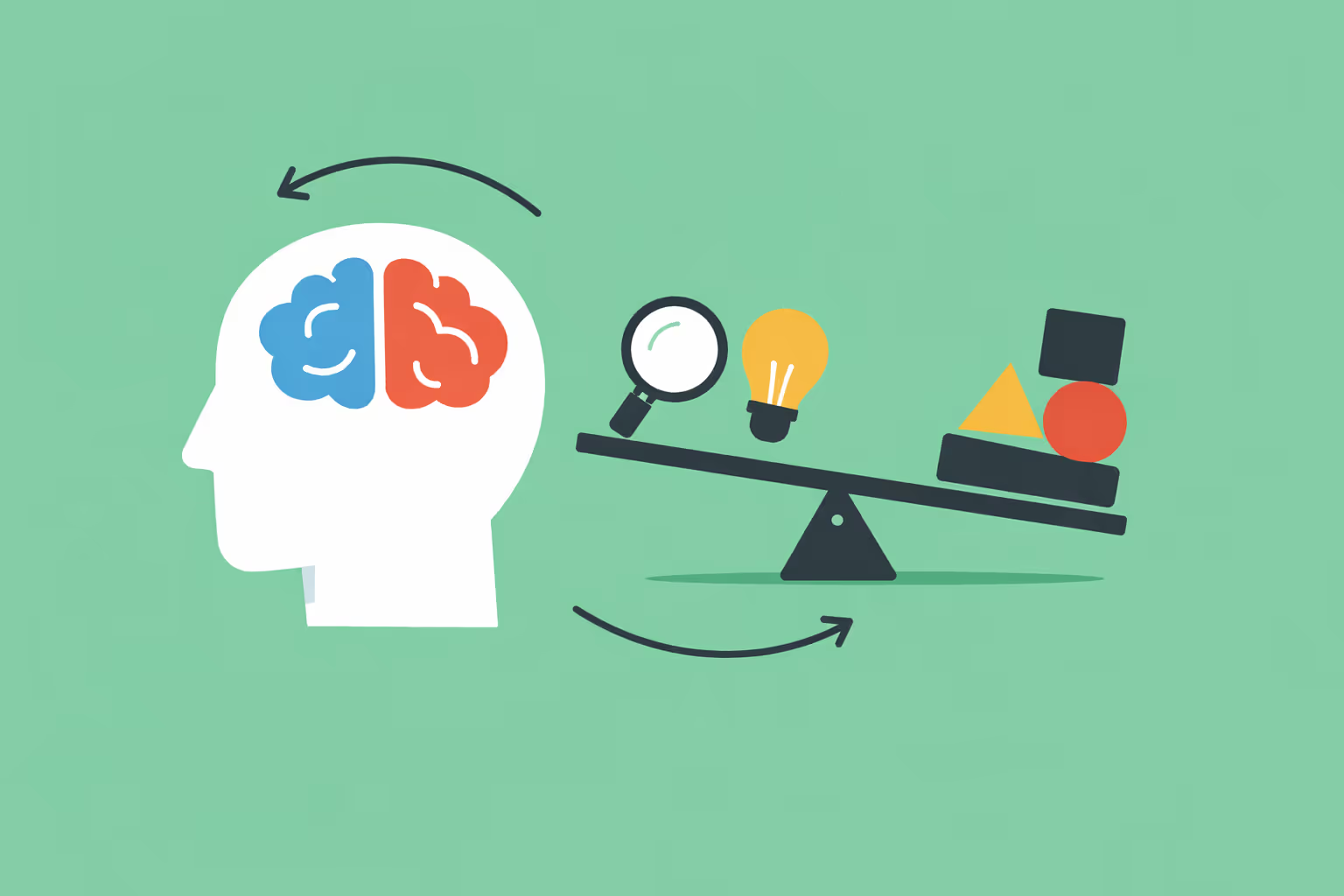
Cognitive Bias: Types, Real Examples, and How to Reduce It
Cognitive bias is a systematic pattern in how people process information and make decisions. Learn the most common types, real examples, and practical strategies to reduce bias.
What Is Cognitive Bias?
Cognitive bias is a systematic deviation from rational judgment caused by the brain's reliance on mental shortcuts, known as heuristics. These shortcuts help people process large amounts of information quickly, but they also introduce predictable errors in perception, memory, and decision-making.
The term was introduced by psychologists Amos Tversky and Daniel Kahneman in the early 1970s through their research on judgment under uncertainty. Their work demonstrated that human reasoning is not simply "noisy" or random. It follows consistent, identifiable patterns of error that can be studied, categorized, and, in many cases, mitigated.
Cognitive biases are not signs of low intelligence or laziness. They are built into the architecture of human cognition. The brain processes roughly 11 million bits of sensory information per second, but conscious thought handles only about 50 bits per second. To bridge that gap, the brain relies on filters, assumptions, and shortcuts. Most of the time, these shortcuts produce useful results. When they fail, the result is a cognitive bias.
Understanding these patterns matters for anyone involved in designing learning programs, making hiring decisions, building AI systems, or leading teams. Biases shape how people interpret data, evaluate risk, give feedback, and assess performance. Recognizing them is the first step toward building processes that account for them.
How Cognitive Biases Work
Cognitive biases emerge from the interaction between two processing systems in the brain, often described as System 1 and System 2 thinking. This framework, popularized by Kahneman in his book "Thinking, Fast and Slow," is central to understanding why biases occur.
System 1 operates automatically and quickly, with little effort or sense of voluntary control. It handles pattern recognition, emotional responses, and intuitive judgments. When you instinctively flinch at a loud noise or immediately recognize a friend's face in a crowd, System 1 is at work.
System 2 allocates attention to effortful mental activities, including complex calculations, deliberate analysis, and logical reasoning. It requires concentration and is slower, more energy-intensive, and less comfortable to use.
Most cognitive biases arise because System 1 generates impressions, feelings, and inclinations that System 2 accepts without thorough verification. The brain defaults to fast processing unless there is a strong reason to engage the slower, more demanding system. Three core mechanisms drive this:
- Heuristic substitution. When faced with a difficult question, the brain often answers a simpler one instead. Asked "Is this investment sound?" the brain might actually answer "Do I feel good about this company?" The emotional response substitutes for financial analysis.
- Associative coherence. The brain constructs narratives from whatever information is immediately available, filling gaps with assumptions that feel consistent. If two events happen close together, the brain assumes a causal link even when none exists.
- Cognitive ease. Information that is familiar, repeated, or easy to process feels more true. Novel or complex information triggers discomfort, which the brain often interprets as a signal of falsehood or risk.
These mechanisms are not flaws. They evolved because speed and efficiency mattered more than precision for most decisions our ancestors faced. The problem arises when these same shortcuts operate in contexts that demand careful, evidence-based reasoning, contexts like hiring, program evaluation, investment decisions, and instructional design.
Common Types of Cognitive Bias
Researchers have documented over 180 cognitive biases. The following are among the most studied and most relevant to professional contexts, each illustrated with a concrete example.
Confirmation Bias
Confirmation bias is the tendency to search for, interpret, and remember information in ways that confirm existing beliefs while ignoring or discounting contradictory evidence.
Real example: A hiring manager believes that candidates from a particular university are stronger performers. During interviews, this manager pays more attention to positive responses from those candidates and more readily excuses their weak answers. Candidates from other schools receive less benefit of the doubt. Over time, the manager's hiring data appears to support the original belief, but only because the evaluation process was biased from the start.
Confirmation bias is especially dangerous in data analysis and learning analytics because analysts can unconsciously select metrics that support a preferred conclusion while overlooking data that contradicts it.
Anchoring Bias
Anchoring bias occurs when an initial piece of information disproportionately influences subsequent judgments, even when that initial information is irrelevant.
Real example: During salary negotiations, the first number mentioned sets the anchor. If a recruiter opens with a figure of $85,000, all subsequent discussion revolves around that number regardless of the role's actual market value. Research consistently shows that the final outcome stays closer to the anchor than objective analysis would justify.
Anchoring affects how educators set expectations, too. When instructors learn that a student previously received high marks, they tend to grade that student's work more favorably, an effect that persists even when the prior information is explicitly labeled as unreliable.
Availability Heuristic
The availability heuristic leads people to judge the likelihood or frequency of events based on how easily examples come to mind, rather than on actual statistical probability.
Real example: After a widely publicized cybersecurity breach, an organization dramatically increases its cybersecurity awareness training budget while neglecting less dramatic but statistically more common risks like phishing or credential reuse. The vivid, recent event dominates the risk assessment, crowding out evidence-based analysis.
This bias shapes how organizations allocate training resources. Problems that generate visible incidents attract disproportionate attention and budget, while systemic issues that erode performance gradually receive less.
Dunning-Kruger Effect
The Dunning-Kruger effect describes a pattern where people with limited knowledge or competence in a domain overestimate their own ability, while those with genuine expertise tend to underestimate theirs.
Real example: In a corporate training needs assessment, employees with minimal exposure to data analysis rate their skills as "advanced," while the organization's most experienced analysts rate themselves as merely "proficient." When both groups take the same skills test, the self-assessments of the less experienced group prove wildly inaccurate.
This bias complicates competency assessment in learning programs. Self-reported skill levels are unreliable indicators of actual competence, which is why well-designed assessment systems use evidence-based evaluation rather than self-perception.
Sunk Cost Fallacy
The sunk cost fallacy is the tendency to continue investing in a decision because of previously invested resources (time, money, effort), even when continuing is no longer rational.
Real example: A company has spent 18 months developing a custom learning platform. Internal user testing reveals fundamental usability problems. Rather than switching to an established platform that better fits their needs, leadership authorizes another six months of development because "we've already invested too much to stop now." The rational analysis, which compares future costs and benefits only, is overridden by emotional attachment to past expenditure.
This fallacy is common in learning and development when organizations cling to underperforming programs because of the effort already invested in building them.
Halo Effect
The halo effect is the tendency for a positive impression in one area to influence judgments about unrelated attributes.
Real example: An employee who delivers excellent presentations is rated highly on teamwork, technical competence, and leadership potential during performance reviews, even when evidence for those specific skills is limited. The strong public speaking ability creates a "halo" that colors every evaluation category.
In educational contexts, the halo effect distorts peer feedback and instructor evaluations. Learners who are articulate and confident often receive higher marks on written assignments than their quieter peers, independent of actual content quality.
Framing Effect
The framing effect occurs when people react differently to the same information depending on how it is presented. Gains and losses, even when mathematically equivalent, produce different decisions.
Real example: A training program reports a "90% completion rate," which sounds strong. The same data framed as "1 in 10 learners dropped out before finishing" triggers concern and prompts investigation. The underlying facts are identical, but the framing changes the emotional and cognitive response.
Program designers who understand framing can present course completion data more accurately and prompt appropriate action.
Groupthink
Groupthink occurs when the desire for consensus within a team suppresses critical evaluation, dissenting opinions, and consideration of alternatives. The group converges on a decision not because it is the best option, but because challenging it feels socially risky.
Real example: A curriculum design team is reviewing a new program structure. The team lead expresses enthusiasm for one approach early in the meeting. Although two team members have concerns, they stay silent because the rest of the group appears supportive. The program launches with structural flaws that the dissenting members could have identified if the environment had encouraged open challenge.
Groupthink is a significant risk in any collaborative work environment. Teams that actively structure feedback mechanisms to surface disagreement, such as anonymous pre-meeting submissions or structured devil's advocate roles, reduce this risk substantially.
| Type | Description | Best For |
|---|---|---|
| Confirmation Bias | Confirmation bias is the tendency to search for, interpret. | — |
| Anchoring Bias | Anchoring bias occurs when an initial piece of information disproportionately influences. | Real example: During salary negotiations |
| Availability Heuristic | The availability heuristic leads people to judge the likelihood or frequency of events. | Real example: After a widely publicized cybersecurity breach |
| Dunning-Kruger Effect | The Dunning-Kruger effect describes a pattern where people with limited knowledge or. | Real example: In a corporate training needs assessment |
| Sunk Cost Fallacy | The sunk cost fallacy is the tendency to continue investing in a decision because of. | — |
| Halo Effect | The halo effect is the tendency for a positive impression in one area to influence. | In educational contexts |
| Framing Effect | The framing effect occurs when people react differently to the same information depending. | Gains and losses, even when mathematically equivalent |
| Groupthink | Groupthink occurs when the desire for consensus within a team suppresses critical. | Anonymous pre-meeting submissions or structured devil's advocate |
Why Cognitive Biases Matter in Professional Settings
Cognitive biases are not abstract psychological curiosities. They produce measurable consequences in organizations every day.
Hiring and talent decisions. Biases like the halo effect, confirmation bias, and affinity bias (favoring candidates who resemble the interviewer) distort the talent pipeline. Structured interviews with standardized rubrics reduce bias more effectively than unstructured conversations, which is why well-designed employee evaluation processes rely on criteria defined before the evaluation begins.
Learning program design. Designers bring their own biases to curriculum development. The availability heuristic can lead designers to prioritize trendy topics over foundational skills. Confirmation bias can cause designers to overvalue positive feedback while ignoring signals that a program is underperforming. Evidence-based instructional design frameworks counteract this by requiring data at each design stage.
AI and algorithmic systems. Cognitive biases do not only affect human decisions. They also affect the data humans create, which is the training data for AI systems.
If historical hiring data reflects decades of biased human judgment, a machine learning model trained on that data will replicate and amplify those biases. AI governance frameworks exist precisely to identify and mitigate bias at the algorithmic level, but they work best when the humans building and overseeing those systems understand how their own biases operate.
Risk assessment. The availability heuristic and optimism bias cause organizations to overweight dramatic, recent events and underweight systemic, slow-moving threats. Sound risk management requires structured frameworks that force teams to evaluate evidence rather than rely on gut feelings.
Team dynamics and feedback. Biases affect how feedback is given and received. The fundamental attribution error causes managers to attribute employees' failures to character rather than circumstance, while attributing their own failures to external factors. Upward feedback systems, when designed properly, counterbalance the power dynamics that amplify bias in performance conversations.
Strategies to Reduce Cognitive Bias
Eliminating cognitive bias entirely is not possible. The goal is to design systems, processes, and habits that reduce the impact of biases on important decisions. Five strategies, supported by research and practical evidence, are most effective.
1. Increase awareness through structured education.
Awareness alone does not eliminate bias, but it creates the precondition for change. Training programs focused on metacognition, the ability to think about one's own thinking, help individuals recognize when heuristics are influencing their judgment.
The key distinction is between generic "bias training" (which has limited lasting impact) and structured, scenario-based practice that trains people to identify specific biases in realistic contexts.
2. Implement structured decision-making processes.
Replacing unstructured judgment with defined criteria and standardized procedures is the single most effective debiasing strategy. In hiring, this means structured interviews with rubrics. In program evaluation, this means predefined metrics reviewed before seeing results. In assessment design, this means establishing scoring criteria before evaluating submissions. Structure removes the space where biases operate most freely.
3. Introduce diverse perspectives deliberately.
Homogeneous teams are more susceptible to groupthink and confirmation bias because members share similar mental models and blind spots. Actively including people with different backgrounds, expertise levels, and perspectives broadens the information considered during decision-making. The research behind cognitive learning strategies supports this: exposure to contrasting viewpoints strengthens reasoning quality.
4. Slow down high-stakes decisions.
Many biases thrive in time-pressured environments where System 2 thinking has no opportunity to engage. For consequential decisions, such as program investments, personnel changes, or policy updates, introducing mandatory reflection periods, pre-mortem analyses, and structured review stages gives the deliberate, analytical system time to override initial intuitive responses.
5. Use data and feedback loops to audit outcomes.
Biases are most clearly visible in patterns of outcomes rather than individual decisions.
Organizations that systematically track decision outcomes, examine them for patterns of bias, and adjust processes accordingly build resilience over time. Training KPIs and knowledge retention metrics, when reviewed honestly, reveal whether bias-reduction efforts are producing real change or just surface-level compliance.
FAQ
What is the difference between cognitive bias and logical fallacy?
A cognitive bias is an automatic, unconscious pattern in how the brain processes information. A logical fallacy is an error in the formal structure of an argument. Biases happen without awareness and affect perception, memory, and judgment. Logical fallacies can be identified by examining the explicit reasoning in a statement. A person can commit a logical fallacy deliberately or accidentally; cognitive biases, by definition, operate below conscious control. Both distort conclusions, but they originate from different mechanisms.
Can cognitive biases be completely eliminated?
No. Cognitive biases are deeply embedded in the way the brain processes information. They serve useful functions in most everyday situations by enabling fast, efficient decision-making. The practical goal is not elimination but mitigation: designing environments, processes, and decision-making frameworks that reduce the impact of biases on outcomes that matter. Structured procedures, diverse teams, and systematic outcome review are the most reliable approaches.
How do cognitive biases affect AI and machine learning systems?
AI systems learn from data generated by human decisions. If those decisions contain systematic biases, the AI will learn to replicate and often amplify them. A hiring algorithm trained on historical data from a biased hiring process will reproduce those biases at scale. Mitigating bias in AI requires both technical approaches, such as bias audits and fairness constraints, and organizational governance that ensures human reviewers can identify and correct biased outputs.
Which cognitive bias is most common in the workplace?
Confirmation bias is consistently identified as the most pervasive bias in professional settings. It affects hiring, performance reviews, strategic planning, and data interpretation. Because people naturally seek information that supports their existing views, confirmation bias is difficult to detect without structured processes that actively surface contradictory evidence.
Further reading

AI Governance: Framework, Principles, and Implementation
AI governance frameworks help organizations manage risk, ensure compliance, and build trust. Learn the principles, policies, and steps to implement effective governance.
AgentGPT: What It Is, How It Works, and Practical Use Cases
Understand what AgentGPT is, how its autonomous agent loop works, what it can and cannot do, how it compares to other platforms, and practical tips for getting value from it.
ChatGPT Enterprise: Pricing, Features, and Use Cases for Organizations
Learn what ChatGPT Enterprise offers, how its pricing works, key features like data privacy and admin controls, and practical use cases across industries.

Frechet Inception Distance (FID): What It Is and How It Works
Learn what Frechet Inception Distance (FID) is, how it measures the quality of generated images, how to calculate it, and why it matters for evaluating generative AI models.
Cognitive Search: Definition and Enterprise Examples
Learn what cognitive search is, how it differs from keyword search, its core components, and real enterprise examples across industries.
Data Poisoning: How Attacks Compromise AI Models and What to Do About It
Learn what data poisoning is, how attackers corrupt AI training data, the main attack types, real-world risks, and practical defenses organizations can implement.