Home What Is Case-Based Reasoning? Definition, Examples, and Practical Guide
What Is Case-Based Reasoning? Definition, Examples, and Practical Guide
Learn what case-based reasoning (CBR) is, how the retrieve-reuse-revise-retain cycle works, and see real examples across industries.
What Is Case-Based Reasoning?
Case-based reasoning (CBR) is an approach to problem solving and decision making that relies on retrieving and adapting solutions from previously encountered situations rather than deriving answers from general rules or models. Instead of starting from first principles every time a new problem appears, a CBR system searches a structured library of past cases, identifies the one most similar to the current situation, and adapts that earlier solution to fit.
The concept draws on a simple observation about human cognition: experienced professionals rarely solve problems from scratch. A physician diagnosing a patient recalls similar symptom patterns seen before. A mechanic troubleshooting an engine failure thinks back to analogous breakdowns. CBR formalizes that process into a computational framework that AI systems can execute at scale.
CBR differs from rule-based expert systems in one critical way. Rule-based systems depend on exhaustive, hand-coded logic. CBR systems learn from accumulated experience, which means they can handle novel situations by analogy even when no explicit rule exists. This makes CBR particularly useful in domains where writing complete rule sets is impractical or where exceptions are frequent.
How Case-Based Reasoning Works
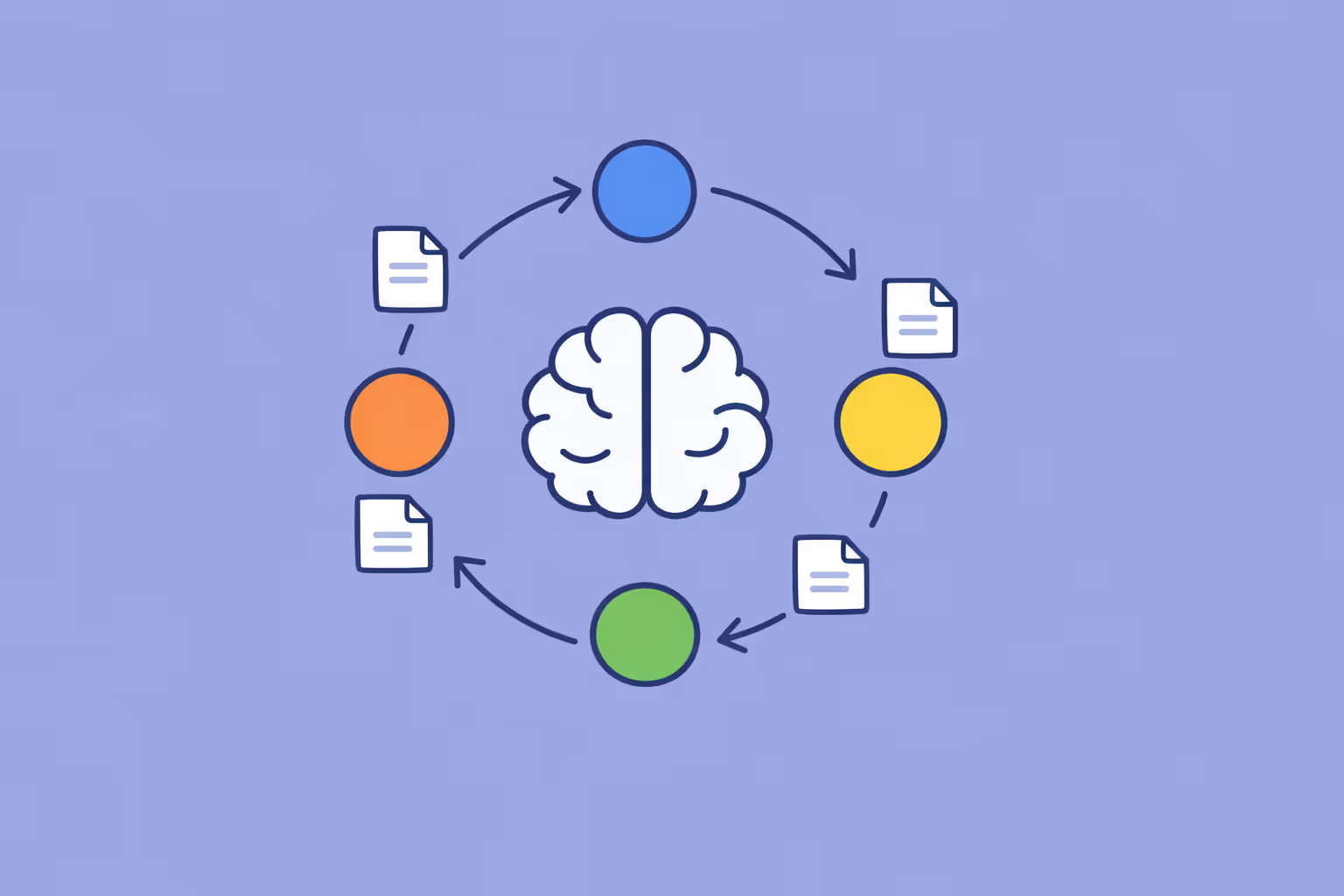
The mechanics of CBR follow a four-step cycle originally described by researchers Agnar Aamodt and Enric Plaza. Each step serves a distinct function, and together they form a feedback loop that improves the system over time.
The CBR Cycle: Retrieve, Reuse, Revise, Retain
1. Retrieve. When a new problem arrives, the system searches its case library for the stored case most similar to the current one. Similarity is measured using feature-matching algorithms that compare attributes of the new problem against indexed attributes of past cases. Retrieval quality depends on how well the case library is organized and how precisely the similarity metric captures meaningful resemblance.
2. Reuse. The solution from the retrieved case is mapped onto the new problem. In straightforward scenarios, the old solution applies directly. In more complex situations, the system modifies certain parameters, swaps components, or adjusts variables to account for differences between the stored case and the current one.
3. Revise. After applying the adapted solution, the system evaluates the result. If the outcome is unsatisfactory, the solution is refined. Revision can be automatic, guided by domain-specific constraints, or it can involve human review. This step is where errors surface and corrections happen.
4. Retain. Once a problem has been solved successfully, the new case, along with its solution and the adaptation steps taken, is stored back into the case library. This expands the system's knowledge base and makes future retrieval more precise. Over time, the case library becomes richer and more representative of the problem space.
What Makes the Cycle Effective
The retrieve-reuse-revise-retain loop creates a self-improving system. Each solved problem adds to the library, which means retrieval accuracy improves incrementally. Unlike static rule systems that remain fixed until a programmer updates them, CBR systems evolve with every new case they process.
Effective CBR depends on three design decisions: how cases are represented (the features and structure used to describe each case), how similarity is measured (the algorithm that ranks stored cases against a new problem), and how adaptation works (the logic that transforms an old solution into one that fits a new context).
Why Case-Based Reasoning Matters
CBR addresses several practical limitations that other AI approaches face in real-world settings. Its value becomes clearest in domains where problems are recurring but never identical, where past experience holds genuine predictive power, and where full automation through rigid rules is unrealistic.
Handling Incomplete Knowledge
In many professional domains, the knowledge needed to solve a problem cannot be fully formalized. Medical diagnosis, legal analysis, and engineering troubleshooting all involve nuance, context-dependent judgment, and exceptions that resist codification. CBR sidesteps this challenge by storing concrete experiences rather than abstract rules. The system does not need a complete theory of the domain. It needs a sufficient library of solved examples.
This reliance on explicit knowledge captured in structured case records makes CBR especially practical in fields where procedural knowledge is difficult to articulate through formal rules alone.
Reducing Solution Time
Retrieving and adapting an existing solution is typically faster than reasoning from scratch. For customer support operations, technical help desks, and maintenance teams, CBR systems can cut resolution time significantly by surfacing relevant past cases within seconds. The operator reviews the suggested solution, adjusts it if necessary, and moves forward without reinventing the approach.
Supporting Human Decision Making
CBR works well as a decision support tool because its output is transparent. When a CBR system recommends a solution, it also points to the specific past case that informed that recommendation. This traceability gives the human operator a concrete reference point. The practitioner can evaluate whether the analogy is sound, rather than trusting an opaque algorithmic output. That transparency is one reason CBR complements approaches like augmented intelligence, where the goal is to enhance human judgment rather than replace it.
Learning from Experience Without Retraining
Machine learning models often require periodic retraining on updated datasets to incorporate new patterns. CBR systems absorb new experience continuously through the retain step of the cycle. Each solved case immediately becomes available for future retrieval. This incremental learning makes CBR well-suited for environments where conditions shift frequently and waiting for a model retraining cycle is impractical.
Case-Based Reasoning in Practice: Examples Across Industries
Healthcare: Diagnostic Support
Clinical decision support systems use CBR to help physicians match a patient's symptoms, lab results, and medical history against a library of past diagnoses. When a new patient presents with an unusual symptom combination, the system retrieves similar past cases and suggests diagnoses that proved correct in those instances. The physician reviews the retrieved cases, considers relevant differences, and makes a final clinical judgment.
This approach is especially useful for rare conditions where a clinician may encounter only a handful of cases over a career. The case library functions as an institutional memory that no single practitioner could maintain alone.
Legal Analysis: Precedent-Based Reasoning
Law is inherently case-based. Courts rely on precedent, and attorneys build arguments by drawing parallels to prior rulings. CBR systems in legal technology formalize this process by indexing case law based on facts, legal issues, and outcomes. An attorney researching a contract dispute, for example, can retrieve cases with similar contractual terms, similar breach patterns, and similar jurisdictional contexts.
The system does not replace legal judgment, but it reduces the time required for case research from hours to minutes and surfaces relevant precedents that a manual search might miss.
Engineering: Fault Diagnosis and Design Reuse
Manufacturing and engineering teams use CBR for two primary purposes. First, fault diagnosis: when a machine fails, the system retrieves past failure cases with matching symptom profiles and suggests likely root causes and repair procedures. Second, design reuse: when engineers begin a new product design, the system retrieves similar past designs, allowing teams to build on proven solutions rather than starting from zero.
Both applications reduce cost and cycle time. Fault diagnosis becomes faster because technicians spend less time investigating from scratch. Design cycles shorten because engineers inherit validated components and configurations.
Customer Service: Resolution Matching
Help desks and customer service operations use CBR to match incoming tickets against a library of resolved issues. When a customer reports a problem, the system retrieves past tickets with similar descriptions and surfaces the solutions that resolved those earlier issues. Support agents can then apply or adapt the suggested resolution.
The effect is consistency across agents. New support staff can access the accumulated experience of the entire team through the case library, which shortens employee training ramp-up and reduces variability in service quality.
Education and Training: Scenario-Based Learning
In learning design, CBR principles inform scenario-based training programs where learners work through realistic problem situations. Instead of presenting abstract theory, the training provides concrete cases for learners to analyze, diagnose, and solve. This method aligns with how professionals actually build expertise: through exposure to varied examples and practice in applying judgment.
Organizations that invest in simulation training or experiential learning programs often draw on CBR logic to structure case libraries that instructors and learners can reference. The approach also supports competency assessment by evaluating how well learners apply past case knowledge to new scenarios.
Challenges and Limitations of Case-Based Reasoning
Case Library Quality and Maintenance
The system is only as good as its case library. If stored cases are poorly described, inconsistently structured, or outdated, retrieval accuracy degrades. Building and maintaining a high-quality case library requires ongoing curation. Cases need clear attribute definitions, consistent formatting, and periodic review to remove obsolete entries. Organizations that underestimate this maintenance burden often find that their CBR system becomes less useful over time rather than more.
Treating the case library as a formal knowledge sharing asset, with clear ownership and update protocols, significantly improves long-term outcomes.
The Cold Start Problem
A new CBR system with an empty or small case library has limited usefulness. Retrieval quality depends on having enough cases to cover the problem space adequately. During the initial deployment phase, the system may fail to find good matches, leading to poor suggestions. Solving this requires either seeding the library with historical data or running the system in a supervised mode where subject matter experts validate and supplement suggestions until the library reaches critical mass.
Scalability Concerns
As the case library grows, retrieval can slow down if the indexing strategy is not well designed. Searching thousands or millions of cases for the best match demands efficient data structures and algorithms. Poorly indexed libraries produce slow queries and irrelevant results. Careful attention to indexing schemes, similarity thresholds, and case pruning strategies is necessary for large-scale deployments.
Adaptation Difficulty
Simple problems allow direct reuse of past solutions with minimal adjustment. Complex problems require sophisticated adaptation logic that accounts for multiple interdependent variables. Building robust adaptation mechanisms is often the hardest part of a CBR implementation. If the adaptation step is too simplistic, the system produces solutions that are close but not quite right. If it is too complex, it loses the speed advantage that makes CBR attractive.
Bias in the Case Library
A case library reflects the history of decisions stored within it. If past decisions contained systematic errors or biases, the CBR system will propagate those patterns. This risk is especially relevant in domains like hiring, lending, and sentencing, where historical bias is well-documented. Auditing the case library for representativeness and fairness is not optional; it is a prerequisite for responsible AI governance.
How to Get Started with Case-Based Reasoning
Step 1: Define the Problem Domain
CBR works best in domains where problems recur with variation, where past solutions carry predictive value, and where complete rule sets are impractical. Evaluate whether your target domain meets these criteria before proceeding. Good candidate domains include technical support, clinical decision support, legal research, and product configuration.
Step 2: Design the Case Representation
Decide what attributes define a case. A medical CBR system might describe each case by patient demographics, symptoms, lab results, diagnosis, and treatment outcome. A technical support system might use product model, error code, user environment, and resolution steps. The representation must be detailed enough to support accurate similarity matching without being so complex that cases become difficult to index or compare.
Understanding the distinction between declarative knowledge (facts and data) and conceptual knowledge (relationships and principles) helps teams decide which attributes to prioritize in the case structure.
Step 3: Build the Initial Case Library
Populate the library with historical data. Extract solved cases from existing records, knowledge bases, ticketing systems, or expert interviews. Validate each case for accuracy and completeness. A library of several hundred well-structured cases is typically sufficient to begin testing; the exact number depends on the diversity of the problem space.
Step 4: Select a Similarity Metric
Choose an algorithm that measures how closely a new problem matches stored cases. Common approaches include nearest-neighbor algorithms, weighted feature matching, and semantic similarity measures. The right choice depends on the nature of the case attributes and the domain's tolerance for approximate matches. Teams exploring adaptive learning systems will find overlap between CBR similarity techniques and the personalization algorithms used in educational technology.
Step 5: Implement Adaptation Logic
Design the rules or mechanisms that modify a retrieved solution to fit the new problem. Adaptation can range from simple parameter substitution to more involved transformation rules. Start with the simplest viable approach, then iterate based on observed performance.
Step 6: Test, Monitor, and Iterate
Deploy the system in a controlled environment. Track retrieval accuracy, adaptation success rates, and user satisfaction. Use the retain step to continuously expand the case library. Review system performance periodically and refine the similarity metric, case representation, or adaptation logic as needed. Establishing clear learning outcomes for each deployment phase helps teams measure whether the system meets its intended goals.
FAQ
How does case-based reasoning differ from rule-based systems?
Rule-based systems apply explicit if-then rules written by domain experts. They work well when the domain can be fully specified with clear, non-overlapping rules. CBR systems, by contrast, solve problems by finding and adapting similar past experiences. CBR handles ambiguity and exceptions better because it does not require every scenario to be anticipated in advance. The trade-off is that CBR depends on having a sufficiently populated case library, while rule-based systems depend on having sufficiently comprehensive rules.
Can case-based reasoning work alongside machine learning?
Yes. CBR and machine learning are complementary. Machine learning models can improve the retrieval step by learning which features matter most for similarity. CBR can supplement machine learning by providing explainable precedents alongside a model's predictions. Hybrid architectures that combine both approaches are increasingly common in domains where both accuracy and transparency matter.
What types of problems are best suited for case-based reasoning?
CBR is most effective for problems that are recurring but not identical, where context matters heavily, and where past solutions carry genuine diagnostic or predictive value. Technical troubleshooting, medical diagnosis, legal research, product design, and customer service resolution are classic CBR domains. Problems that are highly novel with no relevant past experience, or problems that can be solved algorithmically with simple rules, are less suitable.
How large does a case library need to be?
There is no universal threshold. The required size depends on the diversity of the problem space and the granularity of the case representation. A narrow domain with limited variation may function well with a few hundred cases. A broad domain with high variability may require thousands. The practical test is retrieval quality: if the system consistently fails to find relevant matches, the library needs more cases or better indexing.
Further reading
Machine Teaching: How Humans Guide AI to Learn Faster
Machine teaching is the practice of designing optimal training data and curricula so AI models learn faster and more accurately. Explore how it works, key use cases, and how it compares to machine learning.
Knowledge Graph: Definition, How It Works, and Use Cases
Learn what a knowledge graph is, how it structures relationships between entities, why it matters for AI and machine learning, and how organizations build and use knowledge graphs.
What Is Knowledge Engineering? Definition, Process, and Applications
Learn what knowledge engineering is, how it captures and structures expert knowledge for AI systems, its core process, real-world use cases, and how to get started.
Machine Learning Engineer: What They Do, Skills, and Career Path
Learn what a machine learning engineer does, the key skills and tools required, common career paths, and how to enter this high-demand field.

AI Adaptive Learning: The Next Frontier in Education and Training
Explore how AI Adaptive Learning is reshaping education. Benefits, tools, and how Teachfloor is leading the next evolution in personalized training.
What Is LangChain? How It Works, Components, and Use Cases
Learn what LangChain is, how it works, its core components including chains, agents, and memory, practical use cases in AI application development, and how to get started building with it.